

A U.S. resume is a results-driven professional document designed to show employers your key qualifications and emphasize how you can contribute to their operations. Compared to longer and more detailed CVs used in many other countries, U.S. resumes are typically one page long and focus on relevance, measurable achievements, and clarity.
In this article, we’ll explain what a U.S. resume is and how it compares to other resumes around the globe. We’ll talk about three standard resume formats and show you which sections to include. We’ll also give you U.S. resume samples and templates you can use when designing your document.
Key Takeaways
A U.S. resume is a concise, typically one-page professional document designed to showcase your skills and accomplishments to recruiters.
Compared to resumes and CVs in other countries, U.S. resumes are often less biographical, more focused, role-specific, and results-oriented.
Three standard U.S. resume formats are chronological, functional, and combination, with the chronological format being the most common.
Five key sections every U.S. resume needs are contact information, resume objective or summary, work experience, education, and skills.
You can add one or more optional sections as long as they are relevant to the role you’re applying for and you don’t exceed one page.
What Is a U.S. Resume?
A U.S. resume is a strategic professional document that job-seekers use to quickly showcase their most relevant achievements, skills, and qualifications to American employers. Unlike some other parts of the world where resumes are extensive career summaries spanning multiple pages, U.S. resumes are designed on the principles of conciseness and impact.
These documents are tailored to match each job description. The goal is to immediately demonstrate how your abilities and past experiences provide value to the company you’re applying to.
Recruiters often spend mere seconds skimming resumes until one grabs their attention. This means the document needs to be meticulously designed and written to highlight the most compelling achievements and abilities through keywords and bullet points. Omit any details unrelated to the job you’re applying for.
U.S. Resume vs. International Resume
The differences between U.S. and international resumes stem from legal frameworks and cultural expectations. International resumes are also often called CVs (Curriculum Vitae). They are not to be confused with a U.S. CV, which is a different document used when applying for a scientific or research role or a position in academia.
Standard CV formats in many European (Europass CV) and Asian countries, as well as in Australia, are typically more biographical. They can be two pages or more, often requiring additional personal details such as date of birth, marital status, nationality, and a photograph.
Here’s a quick U.S. resume vs. international resume comparison:
Aspect | U.S. Resume | International Resume (CV) |
|---|---|---|
Length | Typically 1 page | 2+ pages |
Focus | Concise, role-specific, results-driven | More biographical and detailed |
Personal details | Not included | May include DOB, marital status, nationality, photo |
Content style | Tailored to each job | Comprehensive career overview |
Terminology | Resume (CV used only for academic roles) | Often called CV (Curriculum Vitae) |
3 Standard U.S. Resume Formats (With Examples)
Three standard U.S. resume formats are:
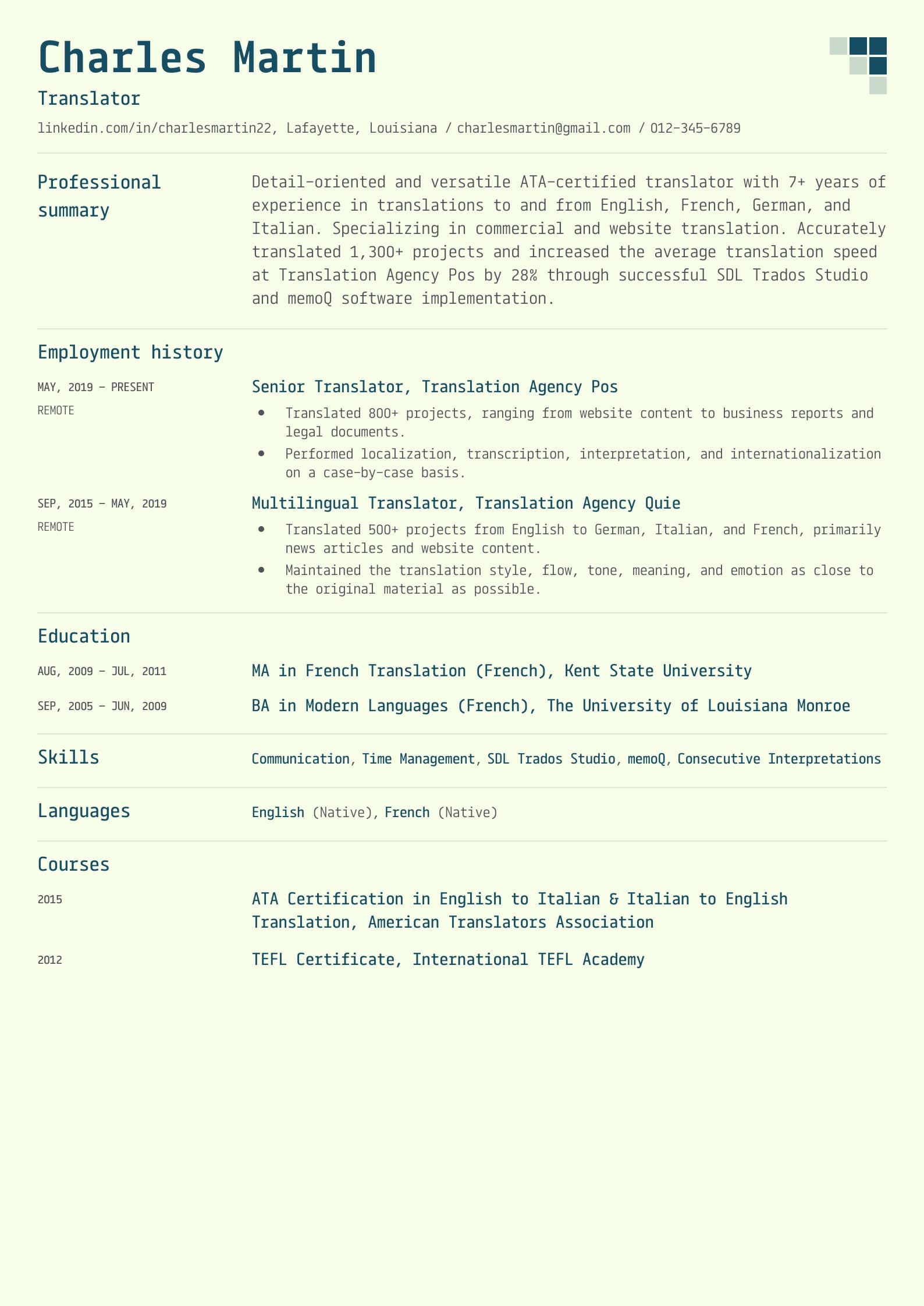
#1. Chronological resume format
The chronological resume is the golden standard when it comes to resume formats for the U.S. market. It puts your most recent job and achievements at the top, then lists the rest in descending order. This arrangement makes it a recruiter’s favorite, since it gives them neat insight into your career progress. Plus, it’s ATS-compatible.
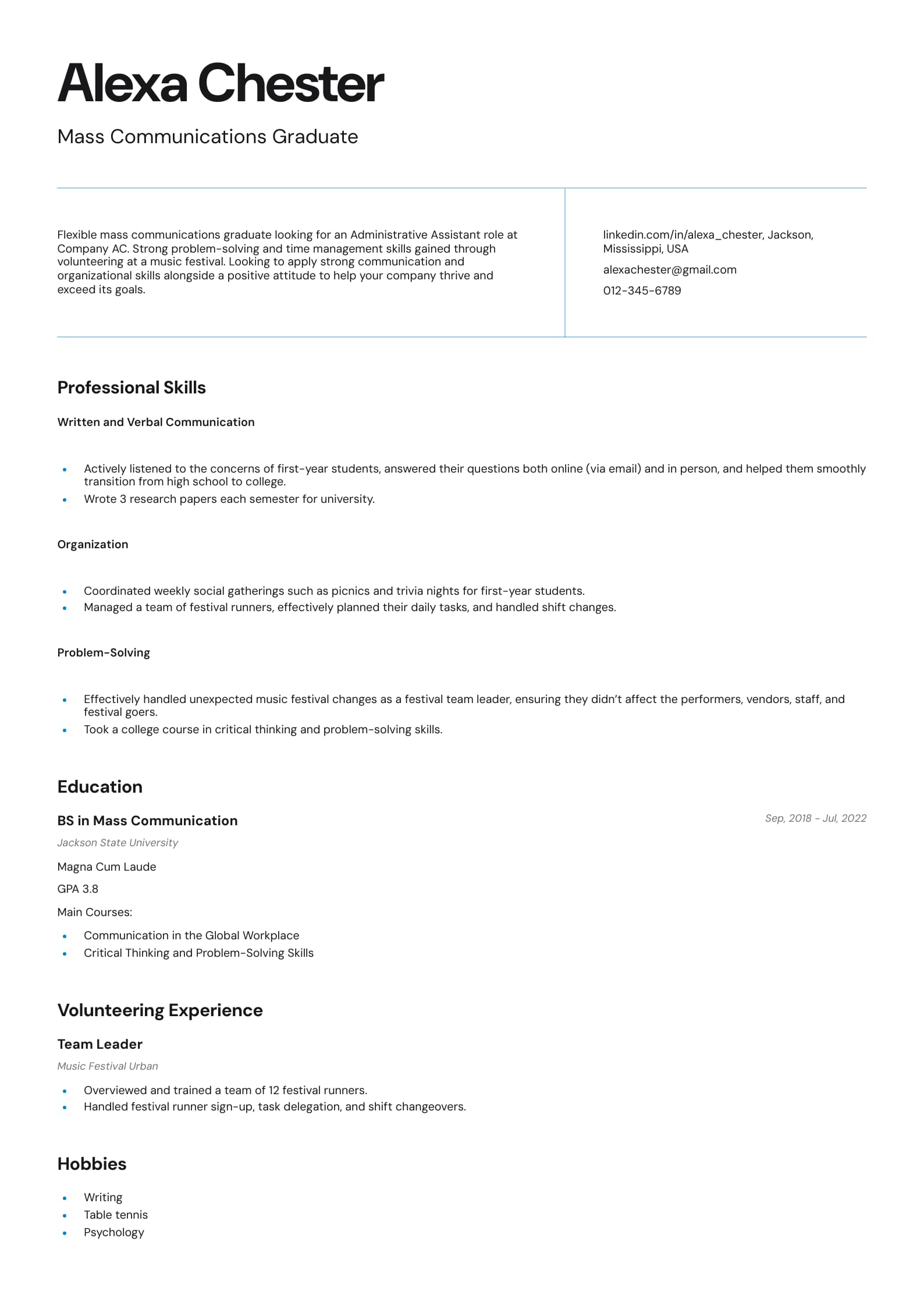
#2. Functional resume format
The functional format is for entry-level candidates. Instead of focusing on a career timeline, it emphasizes your skills and core competencies. This allows junior professionals to highlight their strengths even when they don’t have experience. On the downside, the format may struggle with ATS compatibility.
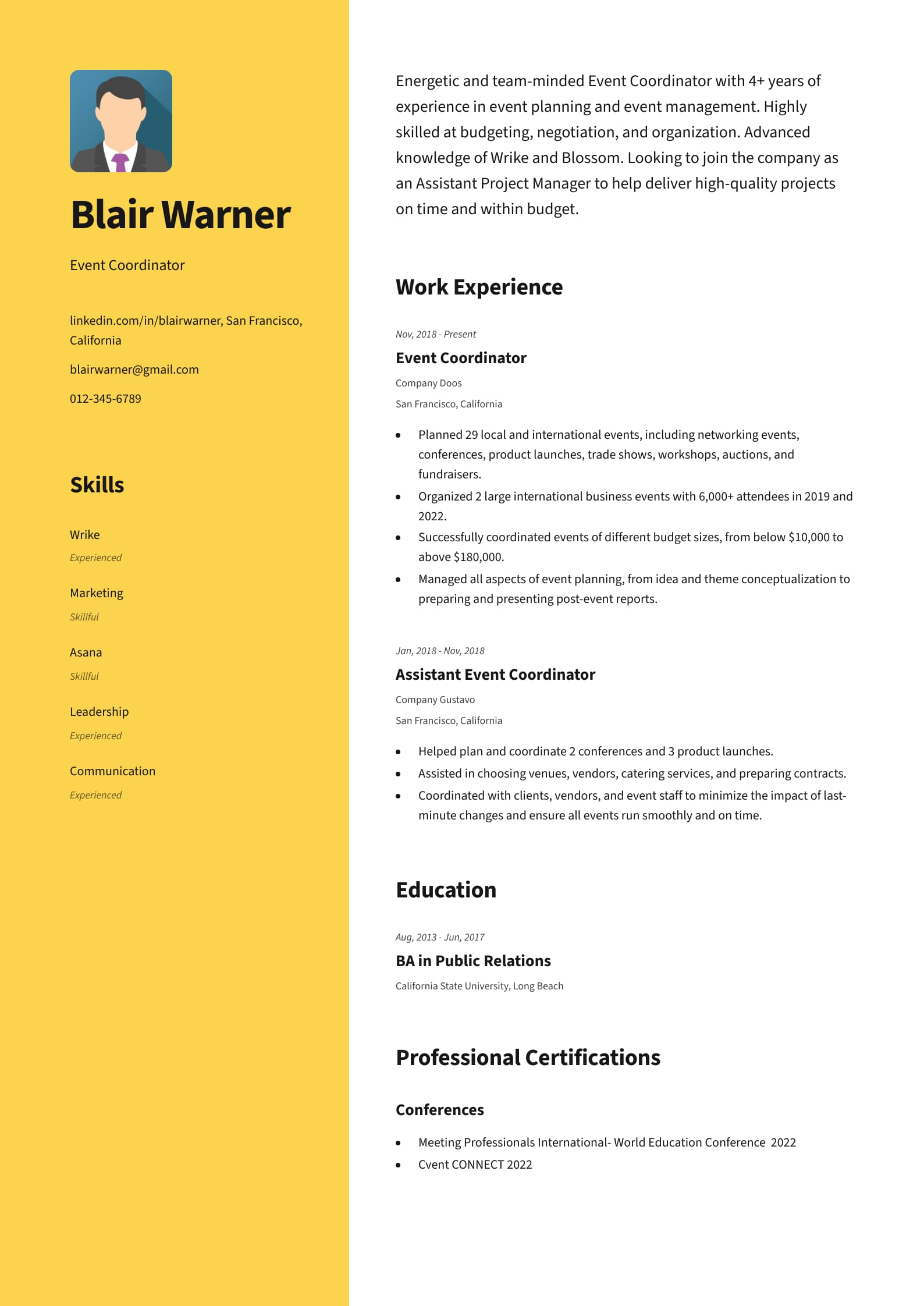
#3. Combination (hybrid) resume format
This format combines the features of the previous two formats to emphasize a candidate’s skills and qualifications while backing them up with relevant accomplishments. It’s suitable for project-based freelancers or professionals who have inconsistent work histories and employment gaps.
ATS-Friendly U.S. Resume Template You Can Use
Here’s an ATS-friendly and optimized U.S. resume template to help you create this document without having to start from scratch:
Template
Name and Surname
Phone number: 000-000-0000 | Email: namesurname@gmail.com | Location: City, State
[Adjective] [your job title] with [years of experience, if applicable] in [your area of expertise, if applicable] looking for a [position] job at [company name]. Eager to apply [relevant skills] gained through [work/volunteer/other experience] to help [company name] [mention what you can do for the company].
Work Experience
Most Recent/Current Job Title Company City, State [Start date] — [End date]
For recent jobs, use 5-6 bullet points to list your top achievements and responsibilities
Use action verbs to make your responsibilities and achievements stand out
Add numbers to quantify your achievements
Previous Job Title Company City, State [Start date] — [End date]
For recent jobs, use 5-6 bullet points to list your top achievements and responsibilities
Use action verbs to make your responsibilities and achievements stand out
Add numbers to quantify your achievements
Oldest Job Title Company City, State [Start date] — [End date]
For older jobs, use 2-3 bullet points to list your top achievements and responsibilities
Use action verbs to make your responsibilities and achievements stand out
Add numbers to quantify your achievements
Education
[Degree] in [Major] [University/college name] [Start date] - [Graduation date]
Skills
Soft Skills
Skill #1
Skill #2
Skill #3
Skill #4
Skill #5
Hard Skills
Skill #1
Skill #2
Skill #3
Skill #4
Skill #5
Additional Sections
Add any relevant additional sections (languages, licenses, publications, hobbies, etc.)
How to Format a U.S. Resume in 5 Easy Steps
Recruiters and hiring managers in the U.S. have certain expectations regarding how your resume should look. This requires a combination of professional structure and visual appeal. You need both of these aspects to pass ATS screening and to grab the recruiter’s attention.
Here are the five steps to format your U.S. resume correctly:
Set the correct page size. While most international resumes use the A4 paper size, resumes in the U.S. must be formatted for the letter size. Letter size measurements are 8.5 by 11 inches. Make sure that the word processor you’re using has these settings applied before you start adding content to your resume.
Apply standard margins. Standard margins for a resume are one inch on all sides. While you can slightly adjust the margins based on your needs, don’t go overboard with it. Pushing margins to 0.5 inches can make the document look overly cluttered, while increasing them too much can make it look like you lack experience.
Choose a professional resume font. The best resume fonts are simple, classic, and professional, like Arial, Helvetica, or Calibri. Avoid overly stylized typefaces, since they will make your document difficult to read and parse. Font size should be between 10 and 12 pt for regular text, and between 14 and 16 pt for section headings.
Control your resume’s length. Your resume should be one page long in the vast majority of cases. You should only go for an extra page if you’re a senior professional with decades of valuable experience. Otherwise, keep it concise and trim unnecessary information.
Use the right file format. Two standard file formats are PDF and DOCX. Unless the employer explicitly requests a DOCX format, it’s typically safer to submit a PDF resume, as it preserves formatting across all devices.
What to Include in a U.S. Resume? 5 Key Sections
There are five must-have sections that every U.S. resume needs to include. They are:
Contact information
Resume objective or summary
Work experience
Education
Skills
Beyond that, there are many optional sections that you can include depending on the role, your qualifications, and how much space there’s left in your resume.
#1. Contact Information
Contact information goes in your resume header. It’s a standard part of any resume, and it should consist of the following details:
Your name
Job title
Email address
Phone number
Depending on your profession and role requirements, you can also include:
Location (only city and state)
LinkedIn profile
Personal website
Portfolio
Relevant social media page
Due to systemic enforcement by EEOC and its fight against discrimination, you should never include your photo or sensitive personal information.
Let’s put this into practice and look at the example of a contact information section:
Header Example
Mary Lopez
Data Analyst
+ 412 421 0850
marylopez@example.com
Pittsburgh, PA
linkedin.com/in/marylopez123
#2. Resume Summary or Objective

A resume summary or objective is your document’s elevator pitch. It’s a brief section at the top of your resume consisting of 2–4 highly impactful sentences meant to grab the reader’s attention with your key strengths.
A resume objective is for entry-level professionals and is meant to emphasize their skills and career goals to highlight their potential. Here’s a good example:
Objective Example
“Motivated recent graduate with a BFA in Visual Arts looking for an entry-level position at your organization. Adept at Adobe Creative Suite, HTML, CSS, and social media content creation. Eager to bring a fresh perspective and assist your team on the road to becoming a visual designer.”
Experienced professionals should write a resume summary that highlights one or two of their most notable accomplishments. Let’s see that in an example:
Summary Example
“Results-oriented data analyst with over 7 years of experience looking for a position in your company. Notable accomplishments include unifying large datasets in a previous company to uncover more than $100K in avoidable expenses.”
#3. Work Experience
Work experience is the most important section of most U.S. resumes, as it directly shows the impact you had in previous roles. For each past job that you add to your resume, you should include the following information:
Company name
Your role
Employment period
Notable achievements
When listing achievements, use bullet points instead of blocks of text, as they are much easier to read. Also, focus on results rather than everyday tasks and assignments. Use numbers to quantify the results and make them more impactful. Finally, implementing action verbs can make your writing more memorable.
Here’s a good example:
Work Experience Section
Work Experience
Data Analyst Finance Bridge Solutions Pittsburgh, PA
August 2021–March 2026
Used Tableau to build a performance dashboard and enhance operational accuracy by 13%.
Analyzed large customer datasets in SQL and Excel to identify trends and improve retention by 11%.
Automated weekly reports using Python to save 10+ hours of manual work per month.
#4. Education
The education section of your U.S. resume validates your capabilities. Experienced professionals should keep this section brief and only include their highest degree with the following information:
Degree
University name
Years of attendance
Here’s an example of a resume education section:
Education Example
B.S. in Computer Science
University of Pittsburgh, Pittsburgh, PA
2017–2021
Entry-level candidates and recent graduates can include a bulleted list of notable academic accomplishments (e.g., high GPA, relevant coursework, extracurricular activities).
#5. Skills Section
Your skills section should be a concise list of abilities. Its purpose is to give recruiters a snapshot of your competencies and to provide keywords to the ATS.
That’s why you should research the company and read the job ad to determine which abilities recruiters are looking for in candidates, and only include the most relevant ones.
Make sure to list hard skills first, as they are essential for the job. Then, you can include a few highly sought-after soft skills.
Here’s an example:
Skills Section
Hard Skills
SQL
Excel
Metabase
Mixpanel
Looker
Soft Skills
Communication
Presentation
Organization
#6. Other Sections
There are many other sections you can add to your U.S. resume, depending on the role and your qualifications. However, you should only add them to the document if there’s space left after all the mandatory sections, and they are highly relevant to the job you’re after.
Some of the most common optional sections are:
Awards and certifications
Projects
What You Should Not Include in a U.S. Resume?

Knowing what not to include in your U.S. resume is critical, as a single piece of “wrong” information can result in automatic rejection.
The U.S. has stringent Equal Employment Opportunity (EEO) laws implemented to prevent workplace discrimination. Seemingly minor resume mistakes can make your document legally unusable.
Here are the elements that you should avoid including in a U.S. resume:
Your photograph. You should never include a headshot in a typical U.S. corporate resume. Even if you’re applying for a modeling job or an acting gig, you can submit a photo separately, and not in your resume.
Personal demographic information. Details like your date of birth, age, marital status, religion, gender, or nationality have no influence on your ability to do the job and should be omitted.
Full mailing address. While adding an exact street address was common in the past, it’s an outdated practice. Your city and state are enough.
Elements that aren’t prohibited but still shouldn’t be on your resume include:
High school education. If you have a college degree, your high school diploma becomes obsolete.
Personal pronouns. Resumes typically use the “first person implied” style found in academic writing. Don’t use pronouns like “I,” “me,” or “my” in your summary and bullet points. Instead of “I managed a team,” write “Managed a team.”
“References available upon request”. This is another outdated practice. In today’s modern job market, employers know that you will provide references if they ask for them during your interview stage.
Create a Job-Winning U.S. Resume with Resume.co
As you can see, creating a professional ATS resume from scratch is possible, but it takes time and effort. If you instead want to dedicate that time and effort to applying for and finding a job, you can use our resume builder.
Our software comes with professional resume templates, an AI writing assistant, and a user-friendly interface for easy customization.
Ready to make your U.S. resume in minutes?
Create my resumeClosing Thoughts
Figuring out how to write a U.S. resume involves exercising strategic restraint and absolute precision. Where international resumes allow more leeway and biographical storytelling, U.S. documents need to be concise, relevant, and results-driven.
Make sure to include all the mandatory sections and to tailor your resume for each new role that you’re applying for. This will help you pass ATS screening and grab the attention of hiring managers. If you want to speed things up and ensure accuracy, feel free to use our resume builder.
U.S. Resume FAQs
#1. How long should a U.S. resume be?
A U.S. resume should be one page long in most cases. Recruiters prefer concise documents that emphasize only relevant skills and experiences. You should only include additional pages if the employer requests it or you have over a decade of relevant experience and need extra space to show it.
#2. Can I use a CV in the US?
You can use a CV in the U.S. when applying for research and scientific roles, and for positions in academia. A U.S. CV is not the same as a CV in Europe or a resume in the U.S. It’s typically longer than one page and focused on academic accomplishments.
#3. What do U.S. employers look for in a resume?
U.S. employers look for relevant and measurable experience in a resume, as well as skills that align with the job description. They also prioritize resumes that are easy to read, have concise and powerful writing, and have passed ATS screening.