
A dancer resume condenses your talent, skills, and experiences into a concise document for recruiters and casting directors to see. A well-written one impresses casting directors and gets you in the room. By highlighting your key qualifications and accomplishments, it convinces them to invite you to an audition or give you a casting opportunity.
In this detailed guide, we’ll show you how to write a dancer resume. Aside from resume examples, you’ll discover which format and layout to use. Also, we’ll give you a few tips on how to perfect your dancer resume and briefly touch on the importance of cover letters.
Key Takeaways
The best format for most dancer resumes is the chronological resume format.
There are five must-have sections, and they are: contact information, summary or objective, work experience, education, and skills.
You can include one or more optional sections, as long as they are relevant to the role.
Make sure to include a link to your portfolio or personal website in your contact information.
Write a matching cover letter to show drive and willingness to go the extra mile.
Outstanding Dancer Resume Examples
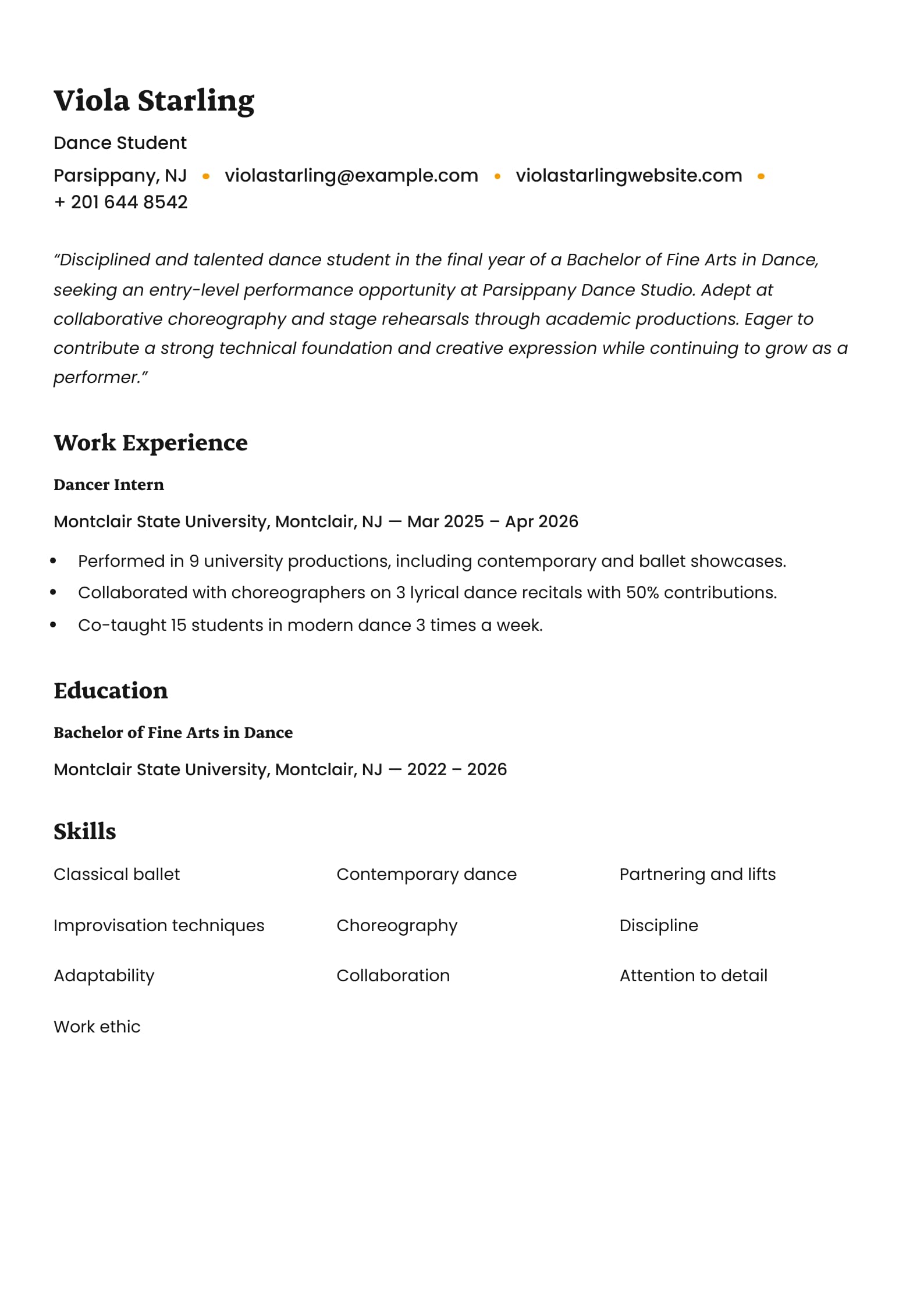
Before we show you how to write a resume, let’s take a look at two complete resume examples so you can see what the final version should look like.
What’s the Best Format for a Dancer Resume
The best format for a dancer resume, in most cases, is the chronological resume format. It represents a traditional approach to resume writing that’s the most common and employers' favorite.
The chronological resume format lists your past work in reverse-chronological order, putting your latest accomplishments on top. This gives hiring personnel a clear look at your career’s progress and current skill and experience levels. All of this makes the chronological format a safe and versatile option for most performers.
Apart from it, there are two other resume formats commonly used by job seekers in specific circumstances. They are:
Functional resume format. This format focuses on skills over experience, which makes it suitable for beginners. Keep in mind that ATS software may have trouble parsing functional resumes. Plus, many casting directors dislike this format since it hides where and when you gained your entry-level experience.
Combination (hybrid) resume format. The combination format blends the elements of chronological and functional formats. It emphasizes your key skills while adding a list of achievements to each one. This allows it to emphasize your experience without providing the exact timeline, which is good when you have gaps in employment.
What Are the Key Sections in a Dancer's Resume?
There are five key sections that every dancer’s resume needs to have, and they are:
Contact information
Resume objective/summary
Professional experience
Education
Skills
Beyond that, you can include one or more optional sections to strengthen your application, as long as they are relevant to the role that you’re applying for. Some optional sections to consider include:
Portfolio (e.g., a video reel or a personal website)
Awards and competitions
Union affiliations
Language skills
Adding all these sections to a dancer resume while maintaining proper formatting can be challenging. However, with Resume.co’s numerous professional and creative resume templates, you get a finished product in minutes. Our AI-powered writing assistant and one-click customization options help you create a perfect resume even if it’s your first time doing it.
Dancer Resume Template
Here’s one of many dancer resume templates that you can use if you opt for our resume builder:
Template
Name and Surname
Phone number: 000-000-0000 | Email: namesurname@gmail.com | Location: City, State
[Adjective] [your job title] with [years of experience, if applicable] in [your area of expertise, if applicable] looking for a [position] job at [company name]. Eager to apply [relevant skills] gained through [work/volunteer/other experience] to help [company name] [mention what you can do for the company].
Work Experience
Most Recent/Current Job Title Company City, State [Start date] — [End date]
For recent jobs, use 5-6 bullet points to list your top achievements and responsibilities
Use action verbs to make your responsibilities and achievements stand out
Add numbers to quantify your achievements
Previous Job Title Company City, State [Start date] — [End date]
For recent jobs, use 5-6 bullet points to list your top achievements and responsibilities
Use action verbs to make your responsibilities and achievements stand out
Add numbers to quantify your achievements
Oldest Job Title Company City, State [Start date] — [End date]
For older jobs, use 2-3 bullet points to list your top achievements and responsibilities
Use action verbs to make your responsibilities and achievements stand out
Add numbers to quantify your achievements
Education
[Degree] in [Major] [University/college name] [Start date] - [Graduation date]
Skills
Soft Skills
Skill #1
Skill #2
Skill #3
Skill #4
Skill #5
Hard Skills
Skill #1
Skill #2
Skill #3
Skill #4
Skill #5
Additional Sections
Add any relevant additional sections (languages, licenses, publications, hobbies, etc.)
Dancer Resume Contact Information
Contact information goes in the header of your resume, and it needs to be spotless. You need to write a clear and professional list that contains the following details:
Your name
Phone number
Email address
You can also include your city and state, relevant social media profiles, and a link to your website or portfolio.
Avoid using unprofessional job titles (“The Best Dancer”) or email addresses (“dancingqueen99@email.com”), as well as irrelevant social media accounts.
Here’s a good example of a dancer's resume contact information:
Contact Information Example
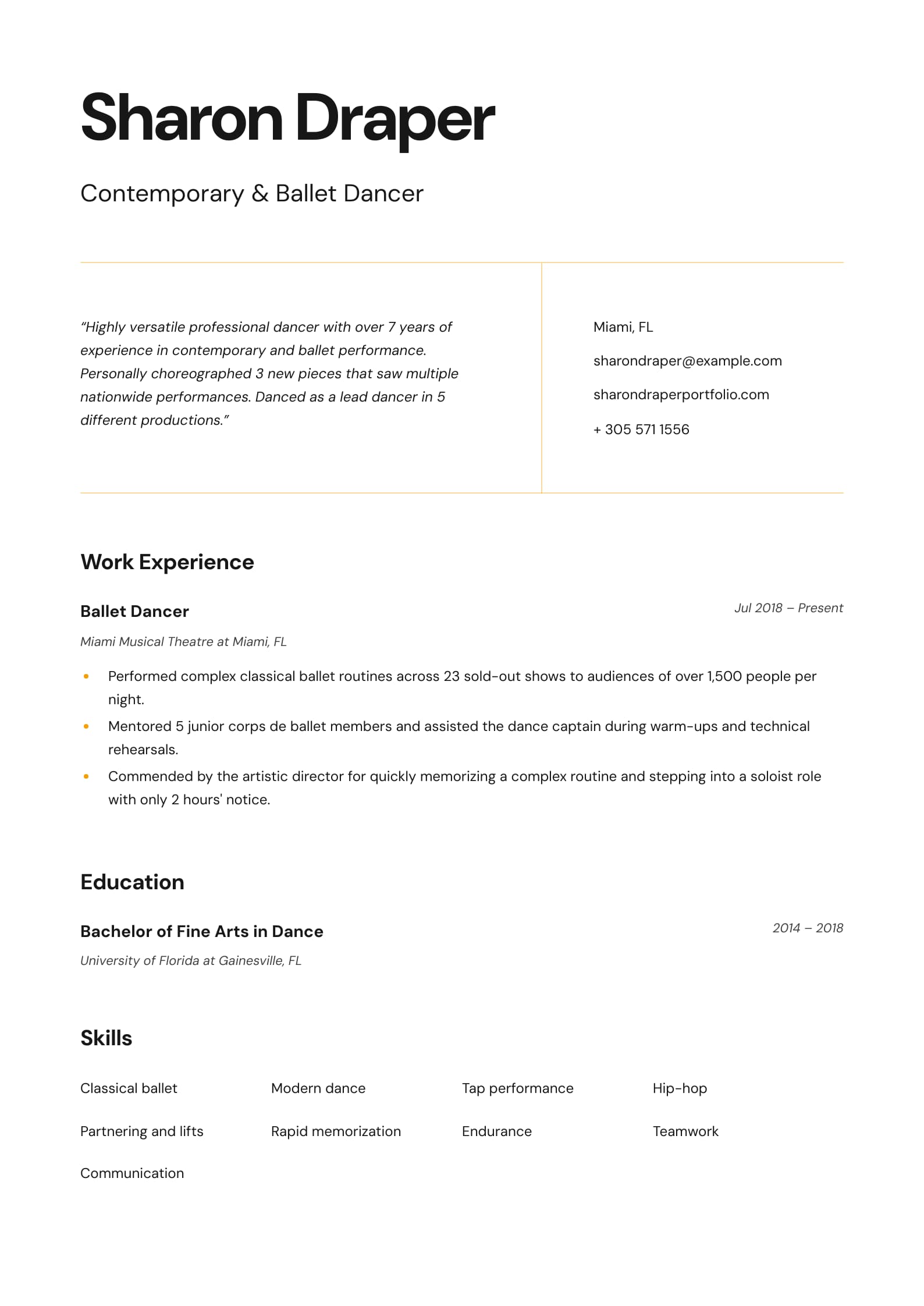
Sharon Draper
Contemporary & Ballet Dancer
+ 305 571 1556
sharondraper@example.com
Miami, FL
sharondraperportfolio.com
Dancer Resume Summary vs. Resume Objective
A dancer resume summary and objective are introductory sections that you write at the top of the document to serve as your elevator pitch. Both sections should be 3–4 sentences long, highlighting your biggest strengths. Which one you write depends on your level of experience.
Beginner dancers and recent graduates should write a resume objective to emphasize their skills and career goals. This demonstrates long-term thinking while showing which abilities you currently bring to the table.
Let’s start with a good example of a resume objective:
Resume Objective Example
“Passionate recent BFA Dance graduate from the Boston Conservatory with extensive training in classical ballet and contemporary techniques. Eager to leverage my strong partnering skills and rigorous rehearsal discipline to contribute to your ensemble while honing my skills to become a demi-soloist.”
For contrast, let’s see a bad example that doesn’t emphasize any of the candidate's qualities:
Bad Example
“I have loved dancing ever since I was a little kid, so now I am looking for my first real dancing job.”
If you’re an experienced dancer, you should write a resume summary to point out one or two of your most notable accomplishments. The idea behind this is to show your value quickly and persuade casting directors to take a closer look at your resume.
Here’s a good example of a resume summary:
Resume Summary Example
“Highly versatile professional dancer with over 7 years of experience in contemporary and ballet performance. Personally choreographed 3 new pieces of art that saw multiple nationwide performances. Danced as a lead dancer in 5 different productions.”
Lastly, here’s a bad example of a resume summary that lacks any substantial information:
Bad Example
“Professional ballet dancer with years of experience looking for work.”
How to List Work Experience on a Dancer Resume
To list work experience on a dancer resume correctly, you want to include the following information for each previous position:
Your role
Organization or production name and location
Employment period
Notable achievement
It’s essential to focus on results and accomplishments over everyday responsibilities as they best show your qualities and help you stand out among the competition.
That’s why you want to include a bullet list of relevant achievements for every previous role that you add to your dancer resume. Here’s how you can make the most out of this section:
Include 3–5 bullet points per role.
Use numbers to quantify your efforts and add measurable value.
Leverage action verbs and power words to make your writing more engaging and memorable.
Let’s put this into practice by taking a look at a good example of a well-written work experience section:
Dancer Work Experience Example
Work Experience
Ballet Dancer Miami Musical Theatre Miami, FL
July 2018–Present
Performed complex classical ballet routines across 23 sold-out shows to audiences of over 1,500 people per night.
Mentored 5 junior corps de ballet members and assisted the dance captain during warm-ups and technical rehearsals.
Commended by the artistic director for quickly memorizing a complex routine and stepping into a soloist role with only 2 hours' notice.
Note: Entry-level performers without paid experience can still use the same tips and section structure. They should list substitute activities, like academic productions, recitals, and volunteer performances.
Now, let’s take a look at some examples of bad bullet points that focus on responsibilities over quantifiable achievements:
Regularly went to rehearsals and danced in shows.
Wore different costumes as instructed by the choreographer.
Provided backstage assistance when needed.
Portfolio on a Dancer Resume
As a professional in the world of performing arts, you can’t showcase your full capabilities with just a resume, making a portfolio essential. A strong list of accomplishments can help you pique a casting director’s interest, but your skills are best demonstrated visually.
To achieve this, most dancers use one of the following methods:
Video reels (e.g., YouTube or Vimeo uploads).
Personal websites, where they showcase performances.
Social media (e.g., Instagram or TikTok), if set up and curated professionally.
Regardless of which method you go with, your portfolio should have a short, 1-to-3-minute video compilation of your best performances, studio work, and skills. The footage should be in the highest quality possible to make it easy to see all the details. Additionally, you want to cover a variety of dance techniques in which you’re proficient (e.g., ballet, hip-hop, contemporary).
Professionals who go with personal websites also often include their headshots, full-body dance shots, multiple reels categorized by style, extended resumes, and so on.
Conversely, Instagram and TikTok accounts are increasingly being used, provided they are carefully curated so that every post reflects your artistic expertise.
When adding a portfolio to your dancer resume, you want to add it to your contact information section and make sure that the hyperlink is active and clearly labeled (e.g., “janedoeportfolio.com”). If you’re sending a physical copy, try to create a shortened URL so that the casting director can easily type it and visit your portfolio.
How to Write Your Education Section

In most cases, you should write your education section to showcase your highest degree. For most dancers with some degree of experience, this should be enough to add a bit more credibility to their skills.
Here are the details to include:
Your degree
The institution that issued it
Years of attendance
Here’s an example of what that looks like:
Education Section Example
Education
Bachelor of Fine Arts in Dance
University of Florida, Gainesville, FL
2014–2018
If you’re a beginner dancer or a recent graduate who lacks professional experience, you can add more information to this section. The best way to do it is to include a bullet list of academic accomplishments, where you can include details like relevant coursework, extracurricular activities, high GPA, exchange programs, etc.
How to List Skills on Your Resume as a Dancer
To list skills on your resume as a dancer, you want to include a strong mix of hard and soft skills. However, you should keep those two separate, since they are quite different in nature.
For the list to have a maximum effect, research the role and include dancer resume skills that casting directors are looking for in candidates.
Hard Skills
Hard skills are specific to dancers. They are taught and learned via traditional means, like school, courses, and practices.
Hard skills you can add to your resume include:
Classical ballet
Modern dance
Tap performance
Hip-hop
Partnering and lifts
Choreography experience
Soft Skills
Soft skills are personality traits and professional attributes that make you more reliable and collaborative.
Sought-after soft skills for dancers include:
Endurance
Adaptability
Teamwork
Creativity
4 Additional Sections You Can Include on a Dancer Resume
Dancers can add several optional sections to strengthen their resume. Here are the four most common:
#1. Certifications
Certifications (e.g., CID International Certification or Certificate in Dance Education) demonstrate dedication to the art and formal training that goes beyond standard education. They help you show depth and discipline, and can be particularly useful in roles that involve teaching or coaching.
#2. Awards and Competitions

Awards and competition placements represent third-party validations of your competence. They show that you can perform well under increased pressure and scrutiny, and that industry professionals recognized that.
#3. Union Affiliations
Union affiliations (e.g., membership in SAG-AFTRA or a regional dance union) contribute to your credibility and signal professional status. Plus, some productions only hire union members, which can make this section mandatory.
#4. Language Skills
Language skills are often underestimated, but they can be critical for dancers who work internationally or in multidisciplinary productions. They improve communication with choreographers and directors from foreign countries, allow for participation in global tours, and even enable dancers to do theatrical performances where language may be part of the role.
Even basic proficiency can help you get ahead of the competition, so make sure to list all the languages you know using an established framework of reference.
Should You Write a Cover Letter Along With Your Resume?
You should always write a dancer cover letter along with your resume to demonstrate drive and willingness to go the extra mile. More than that, the less formal nature of a cover letter allows you to express your artistic philosophy, explain why you’re drawn to the specific role that you’re applying for, and elaborate on your most impressive qualifications relevant to it.
The easiest way to write it is with our cover letter builder, which can help you convey your message while matching the document to your resume.
3 Tips for Creating an Outstanding Dancer Resume
Here are three expert tips to help you polish your resume for a dancing audition to perfection:
Keep it concise. One-page resumes are the norm. You should always go for quality over quantity, and only include another page if you have decades of notable experience.
Tailor your resume for each audition. Always adjust your resume so that your skills and experience align with the requirements of the role that you’re applying for.
Have a clean and professional resume layout. Avoid overly creative designs, lots of color, or complex graphical elements. The focus should be on the content, so make sure it’s clean and readable.
Ready to design a dancer resume that grabs attention?
Use our AI-powered resume builder to make one in minutes!Closing Thoughts
Dancers and choreographers are looking at a positive job outlook of 5%. While this amounts to about 2,500 new openings each year, the competition can be fierce. A strong dancer resume that blends professionalism and artistry can help you impress casting directors and secure one of those spots.
Remember to focus on measurable achievements and sought-after skills while using a clean layout. Beyond that, support your resume with a compelling portfolio and strong cover letter, and your application will be impossible to ignore.
Dancer Resume FAQs
#1. How do I introduce myself as a dancer?
To introduce yourself as a dancer, you should write a compelling resume summary or objective at the top. Use this section to briefly emphasize your biggest strengths, such as your skills and career goals with an objective, or your notable accomplishments with a summary.
#2. How can I present my dancing skills in a resume?
To present your dancing skills in a resume, list them in two distinct categories: hard skills (e.g., classical ballet, jazz, tumbling) and soft skills (teamwork, organization, memorization). Additionally, connect your key skills with your achievements in the work experience section to make them concrete.
#3. Should I include photos in a dancer's resume?
No, in general, you should not include photos directly in a dancer’s resume due to employment discrimination laws. However, you can include your photo separately (especially if the employers request it) as a standalone digital file or a printed headshot submitted with a physical copy of your resume.