
A college resume is a brief professional document required when applying for an internship or your first job. It summarizes your college accomplishments, skills, and experiences to show your potential to recruiters and employers, helping you seamlessly transition from academic life to the professional world.
In this article, we’ll give you a step-by-step guide on how to write a strong college resume from scratch. We’ll dive deep into different formats and sections, and give you examples of complete resumes to help guide you through the process. Toward the end, we’ll touch on the importance of cover letters and tell you which mistakes you need to avoid.
Key Takeaways
The best format for most college resumes is the chronological resume format.
When talking about your achievements and results, use numbers to quantify them and make them concrete.
Augment your education section by including a bullet list of notable accomplishments.
Write and submit a cover letter that matches your resume to show motivation and willingness to go the extra mile.
2 Exceptional College Resume Examples
Let’s start with two college resume examples to show you what the complete document should look like.
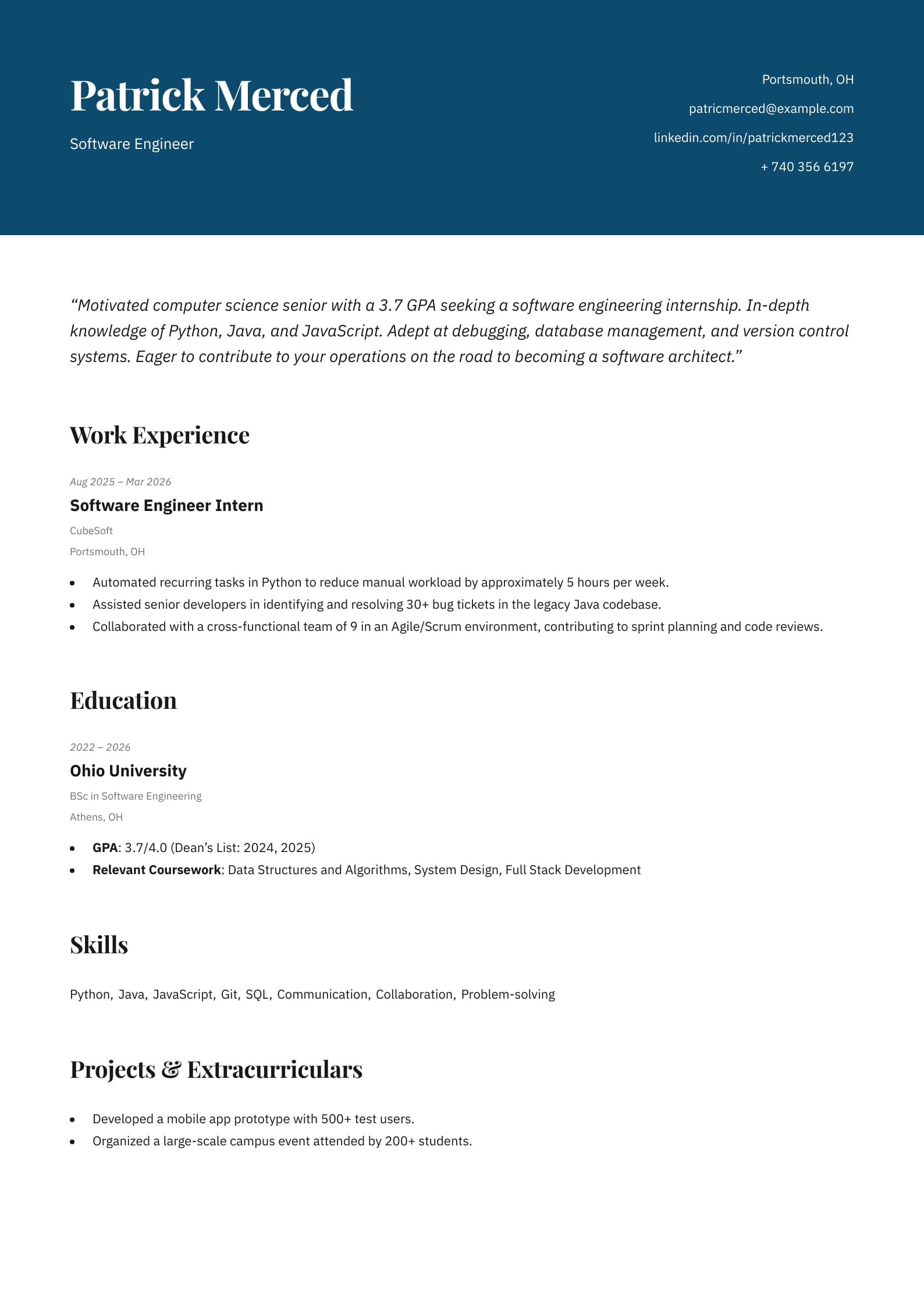
#1. College Resume Example with Internship Experience
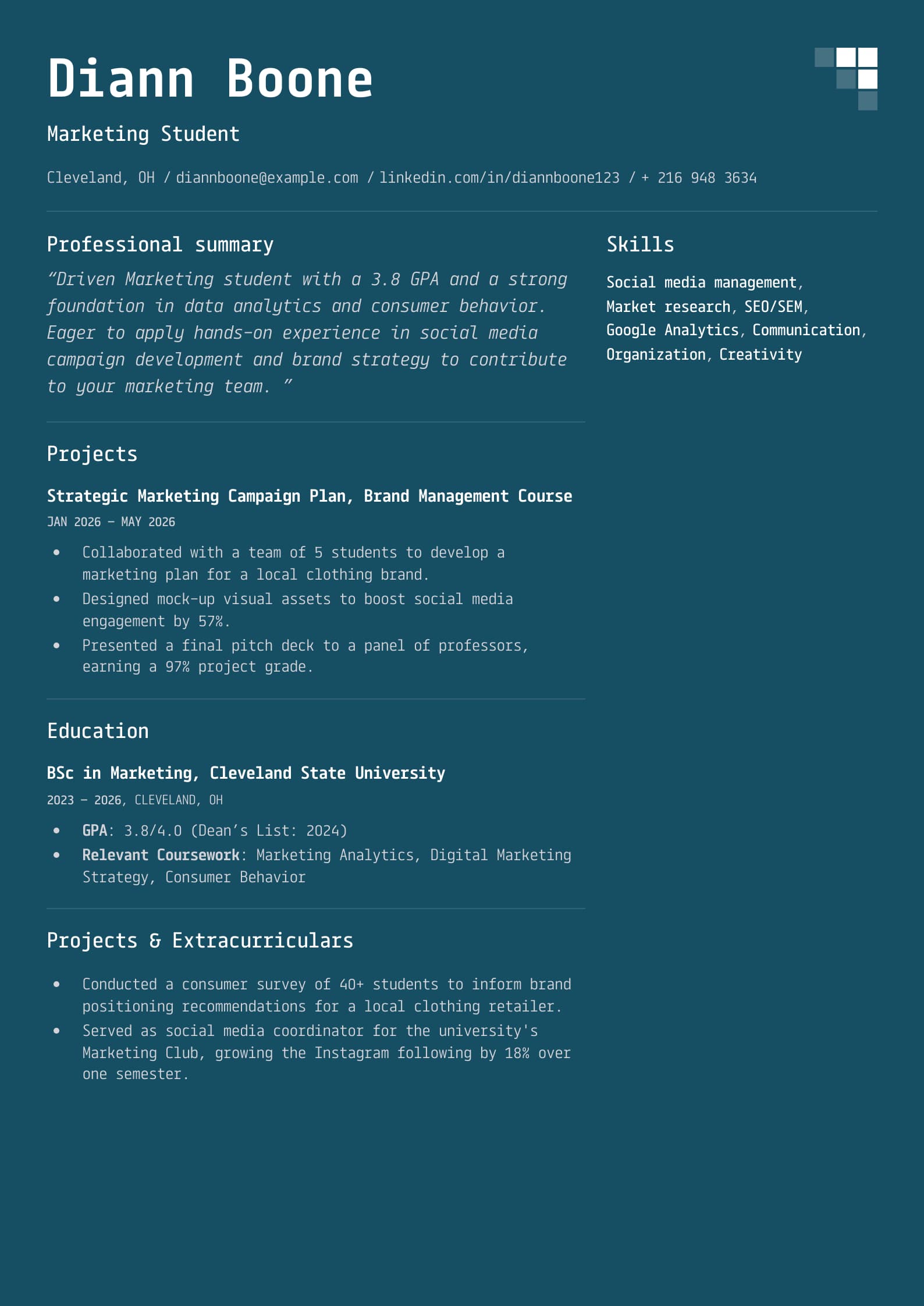
#2. College Resume Example with No Experience
College Resume vs. High School Resume
The difference between a college and high school resume is in depth and focus.
The primary purpose of a high school resume is to showcase your broad potential. To achieve this, it highlights your general academic performance, basic activities, scores in standardized tests, and experience from teenage part-time jobs. You can also use many of these qualifications in your college application resume.
On the other hand, the purpose of a college resume is to zero in on your specific career direction. The document contains achievements related to specialized higher education and points out relevant professional skills.
That’s why you shouldn’t use your high school resume for college internships and jobs. Moreover, most of the high school information should be removed from your college resume by the time you finish your sophomore year. At this point, recruiters will no longer be interested in your SAT scores or high school clubs and projects.
Here’s a brief table that outlines the key differences between a college and a high school resume:
Feature | High School Resume | College Resume |
|---|---|---|
Focus | General academics. | Career-specific skills and accomplishments. |
Education Section | High school name, GPA, SAT/ACT scores. | University name, major/minor, expected graduation, relevant coursework. |
Experience | Generic part-time jobs | Internships, academic projects, campus leadership. |
Skills | Basic | Technical and transferable |
What’s the Best Format for a College Resume?
The best format for a college resume is the chronological resume format. It’s considered a golden standard for the majority of job seekers overall, as it lists your achievements and career history in reverse-chronological order. This means it puts your latest accomplishments first and goes back from there.
This structure is favored by recruiters as it gives them a clear look at your career’s progress. Moreover, the majority of applicant tracking systems (ATS) are programmed to parse dates, job titles, and achievements chronologically.
If you have no work experience whatsoever, you can use the functional format for your student resume. It puts your skills front and center, helping you showcase qualifications without emphasizing results and accomplishments. However, this format often runs into issues with ATS. Plus, recruiters prefer to see some experience, even on a college resume.
Finally, there’s the combination (hybrid) resume format, which blends chronological and functional formats. This format also focuses on skills, but it backs up each skill with a list of achievements in chronological order. This makes it good for college students who have some work experience, but it’s inconsistent (e.g., due to freelancing or employment gaps).
College Resume Template
Template
Name and Surname
Phone number: 000-000-0000 | Email: namesurname@gmail.com | Location: City, State
[Adjective] [your job title] with [years of experience, if applicable] in [your area of expertise, if applicable] looking for a [position] job at [company name]. Eager to apply [relevant skills] gained through [work/volunteer/other experience] to help [company name] [mention what you can do for the company].
Work Experience
Interships/Projects Company City, State [Start date] — [End date]
Use 5-6 bullet points to list your top achievements and responsibilities
Use action verbs to make your responsibilities and achievements stand out
Add numbers to quantify your achievements
Education
[Degree] in [Major] [University/college name] [Start date] - [Graduation date]
Skills
Soft Skills
Skill #1
Skill #2
Skill #3
Skill #4
Skill #5
Hard Skills
Skill #1
Skill #2
Skill #3
Skill #4
Skill #5
Additional Sections
Add any relevant additional sections (languages, licenses, publications, hobbies, etc.)
6 Key Sections You Should Have in Your College Resume
Your college resume needs to contain certain sections to pass ATS screening and to show hiring managers what they want to see. Each section serves a specific purpose, so let’s see what they are:
#1. Contact Information
Contact information is a standard section that goes in the resume header, at the top of the document. It should include the following details:
Your name
Email address
Phone number
Additionally, you can include a link to your LinkedIn profile and portfolio, depending on your profession. If you’re adding your address, avoid your physical street address and only include your city and state.
Moreover, you should not include sensitive personal information in your college resume (e.g., gender or political affiliations), and you should not add a photo.
Here is a good example of a well-written contact information section:
Contact Information Example
Patrick Merced
Software Engineer
patrickmerced@example.com
+ 740 356 6197
Portsmouth, OH
linkedin.com/in/patrickmerced123
#2. Professional Objective
A professional objective is your college resume’s elevator pitch. It’s your opening section that should explain what position you’re applying for and what you bring.
This section should be between two and four sentences, and it should emphasize your core skills and career goals. This will help you highlight your value and display potential.
Here’s a good example of a college resume objective:
Resume Objective Example
“Motivated computer science senior with a 3.7 GPA seeking a software engineering internship. In-depth knowledge of Python, Java, and JavaScript. Adept at debugging, database management, and version control systems. Eager to contribute to your operations on the road to becoming a software architect.”
If you don’t include specific details about your goals and qualifications, you’ll end up with a vague objective, like in this poor example:
Bad Example
“I am a computer science student. I am looking for my first job where I can grow and learn.”
#3. Work Experience

Work experience is typically the most important section in a resume, but not all college students have it. Fortunately, you don’t have to have corporate experience to write this section. Instead, you can use substitutes, like internships, part-time jobs, volunteer experience, or freelance work.
For each previous job, project, or academic endeavor that you add to this section, you should include the following:
Company or project name
Your role
Employment dates
Notable achievements
Use bullet points when highlighting your accomplishments, and leverage numbers to quantify the results. Strong action verbs can help your writing stand out.
Here’s a good example:
Work Experience Example
Work Experience
Software Engineer Intern CubeSoft Portsmouth, OH
August 2025–March 2026
Automated recurring tasks in Python to reduce manual workload by approximately 5 hours per week.
Assisted senior developers in identifying and resolving 30+ bug tickets in the legacy Java codebase.
Collaborated with a cross-functional team of 9 in an Agile/Scrum environment, contributing to sprint planning and code reviews.
#4. Education Section
For a college student, your education section can be your strongest asset. At a minimum, you should include:
University name
Your degree
Years of attendance (if you’re still studying, include the expected graduation year)
Following that, you can strengthen this section by adding a list of notable academic accomplishments. You can include your GPA (if it’s at least 3.0), relevant coursework, academic honors, and so on.
Let’s see that in an example:
Education Example
Education
BSc in Software Engineering
Ohio University, Athens, OH
2022– 2026 (Expected)
GPA: 3.7/4.0 (Dean’s List: 2024, 2025)
Relevant Coursework: Data Structures and Algorithms, System Design, Full Stack Development
#5. Skills Section
A dedicated skills section is essential for passing ATS screening. Plus, it allows recruiters to see your skill set at a glance.
However, you shouldn’t list every skill you can think of. Instead, research the company and carefully read the job ad to discover which abilities recruiters are looking for in candidates. This will allow you to create a tailored list to add to your college resume.
Your main focus should be on hard skills, since they are technical and required for the job. Hard skills will vary depending on your profession and the role you’re after. Once you’ve included them, you should list a few of your strongest soft skills separately.
Here’s an example of a college resume skills section for a software engineer:
Skills Example
Hard Skills
Python
Java
JavaScript
Git
SQL
Soft Skills
Communication
Collaboration
Problem-solving
#6. Projects & Extracurriculars
On a standard resume, projects and extracurricular activities are typically parts of other sections (work experience and education, respectively). Students, who often have limited professional experience, can put these in a dedicated section to emphasize their ability to execute complex tasks, work in teams, and more.
When listing your accomplishments, use bullet points and numbers to quantify them, similar to how you’d showcase your work experience.
Here’s a good example of the projects and extracurriculars section:
Extracurriculars Example
Projects & Extracurriculars
Developed a mobile app prototype with 500+ test users.
Organized a large-scale campus event attended by 200+ students.
How to Make Your College Resume Stand Out: 4 Must-Know Strategies
Writing a college resume is straightforward when you follow the steps, but making it stand out requires a more strategic approach. Since recruiters often have to go through dozens of resumes quickly, every detail can make a difference.
Here are the four best strategies to incorporate when writing your college resume to polish it to perfection:
Tailor resume keywords for ATS software. Since over 90% of Fortune 500 companies use ATS, your college resume needs to be optimized. Analyze the job description for keywords (like job titles and skills required), and organically include them in your resume in their exact same form. Alternatively, use an ATS resume checker to see how you score and what to optimize for.
Quantify everything possible. Numbers add measurable value to your results and accomplishments. This makes them stand out and be much more believable than vague and descriptive claims. For example, instead of “Mentored new members of the club,” you can write “Mentored 15 freshmen to boost regional tournament placement by 30%.”
Use a professional resume layout. The resume layout represents the document's visual style. It needs to make your resume easy for software to scan and for recruiters to read. For this, you want a good resume font (e.g., Arial or Helvetica), sufficient white space, bullet points instead of blocks of text, and no complex graphics or lots of color.
Keep it to one page. A college resume should almost never exceed one page. Most resumes for corporate roles shouldn’t exceed this length, even when candidates have years of professional experience. Focus on quality over quantity. If your document spills onto a second page, you likely have substantial irrelevant content that you need to trim.
Should You Attach a Cover Letter Along With Your Resume?

You should always attach a cover letter along with your resume to provide additional context that your resume cannot. While your resume demonstrates what you’ve done, your cover letter shows why you want the role.
Moreover, a mere act of writing and submitting a tailored cover letter shows your drive and willingness to go the extra mile. However, don’t just repeat what you’ve already stated in your resume. Instead, use this additional document to showcase additional accomplishments and talk about your reasons for applying.
A cover letter allows you to be more descriptive and less formal than you should be with your resume. However, you still need to keep it concise and professional. If you need help writing one, check out our cover letter builder. It comes with a powerful AI writing assistant that can help you generate a resume-matching cover letter in seconds.
3 Critical Mistakes to Avoid on a College Resume
Writing a standout college resume involves knowing what not to do. Here are the three biggest mistakes you need to avoid:
Writing a vague and self-centered objective. Your resume objective needs to show what you bring to the table. Instead of saying that you’re looking for a job, shift focus to how the employer can benefit from hiring you. This involves emphasizing your academic background, skills, and experiences that can help you contribute to their company.
Focusing on duties and responsibilities instead of achievements. When you’re talking about your past efforts (e.g., previous jobs or projects), avoid listing responsibilities. Instead, emphasize the results of your actions and the concrete metrics that can help recruiters assess your competence.
Overcomplicating the design. Flashy colors, custom graphics, complex tables, overly stylized fonts, and other complex elements make your college resume hard to read and scan. Recruiters may skip such a resume, and ATS can outright reject it. That’s why you should stick to clean formats with standard fonts and black text on a white background.
Effortlessly Write a College Resume with Resume.co
If you’d rather focus on applying than formatting and designing the layout, you can use our resume builder. The tool comes with numerous ready-made college resume templates, an AI writing assistant, and user-friendly customization tools. You can create a resume from scratch or upload an existing one and let our software polish it to perfection.
Ready to enter the job market confident in your resume?
Make my resumeClosing Thoughts
Writing a college resume for an internship or your first corporate job becomes much easier once you know what format to use and which sections to include. Emphasize your university results and accomplishments with numbers and action verbs, and you’ll demonstrate potential even if you don’t have work experience.
Remember to keep it to one page and to tailor your resume to each specific job application. If you need assistance, don’t forget to check out our resume and cover letter builders. Spend less time writing these documents and more time applying for jobs.
College Resume FAQs
#1. How can I write achievements if I don’t have any work experience?
To write achievements when you don’t have any work experience, you can focus on academic projects, extracurricular activities, volunteer work, and similar efforts. Make sure to describe and quantify your contributions and results so that you can emphasize job-related skills and qualifications.
#2. Do I need a CV or a resume as a college student?
You need a resume as a college student if you’re applying for a corporate job or internship in the U.S. A CV (Curriculum Vitae) is a much longer document than a resume (which is typically one page), and it’s used for academic, research, and scientific roles.
#3. Should I include GPA on a college resume?
You should include GPA on a college resume only if it’s high or the employer requests it. Your GPA should be at least 3.0 to warrant a place in your resume, though it’s better if it’s at least 3.5.