
A scholarship resume is an application document that includes your academic achievements, skills, extracurricular activities, and other experiences that show why you deserve financial support. It helps selection committees determine whether you are the right candidate for the scholarship.
However, most scholarship applicants undersell themselves because knowing what to include, what to leave out, and how to make everything fit on one polished page can be challenging. In this guide, we will show you how to write a scholarship resume in the most effective way. You will also learn which common mistakes to avoid and see real resume examples.
Key Takeaways
The best format for a scholarship resume is usually the combination format because it highlights both achievements and skills.
At the top, include your contact information, objective, education, and academic achievements, so reviewers immediately see your identity and strongest qualifications.
The bottom of your resume should include skills, extracurricular activities, and optional sections like certifications or projects if they strengthen your application.
Attaching a cover letter to your scholarship resume is recommended because it helps explain your goals, motivation, and why you are a strong fit for the scholarship.
Common mistakes to avoid include vague wording, poor formatting, irrelevant details, inconsistent dates, and failing to tailor your resume to the scholarship’s priorities.
2 Strong Scholarship Resume Examples
Before we show you how to write a resume, let’s take a look at these two scholarship resume examples.
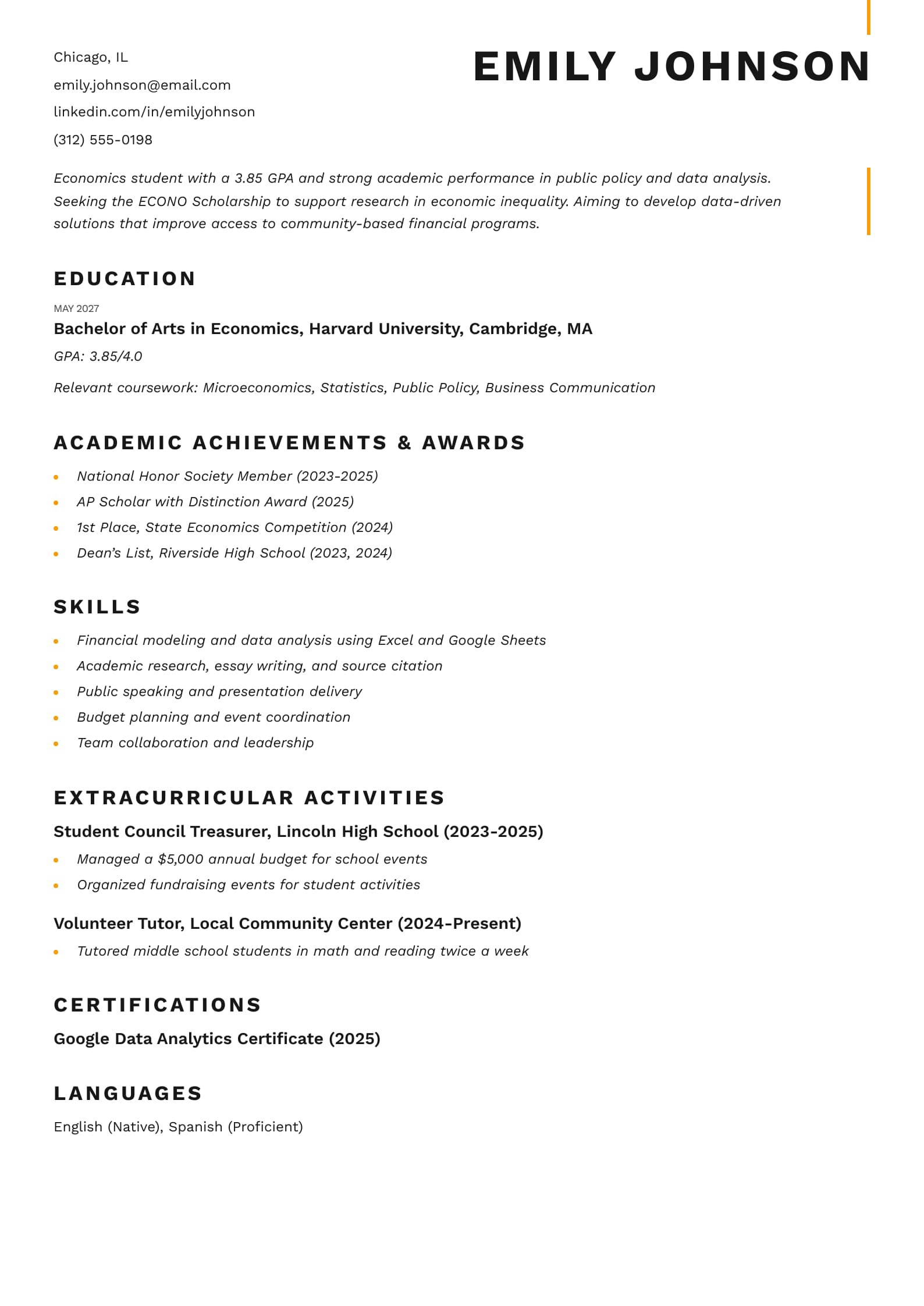
#1. Student Resume for Scholarship Example
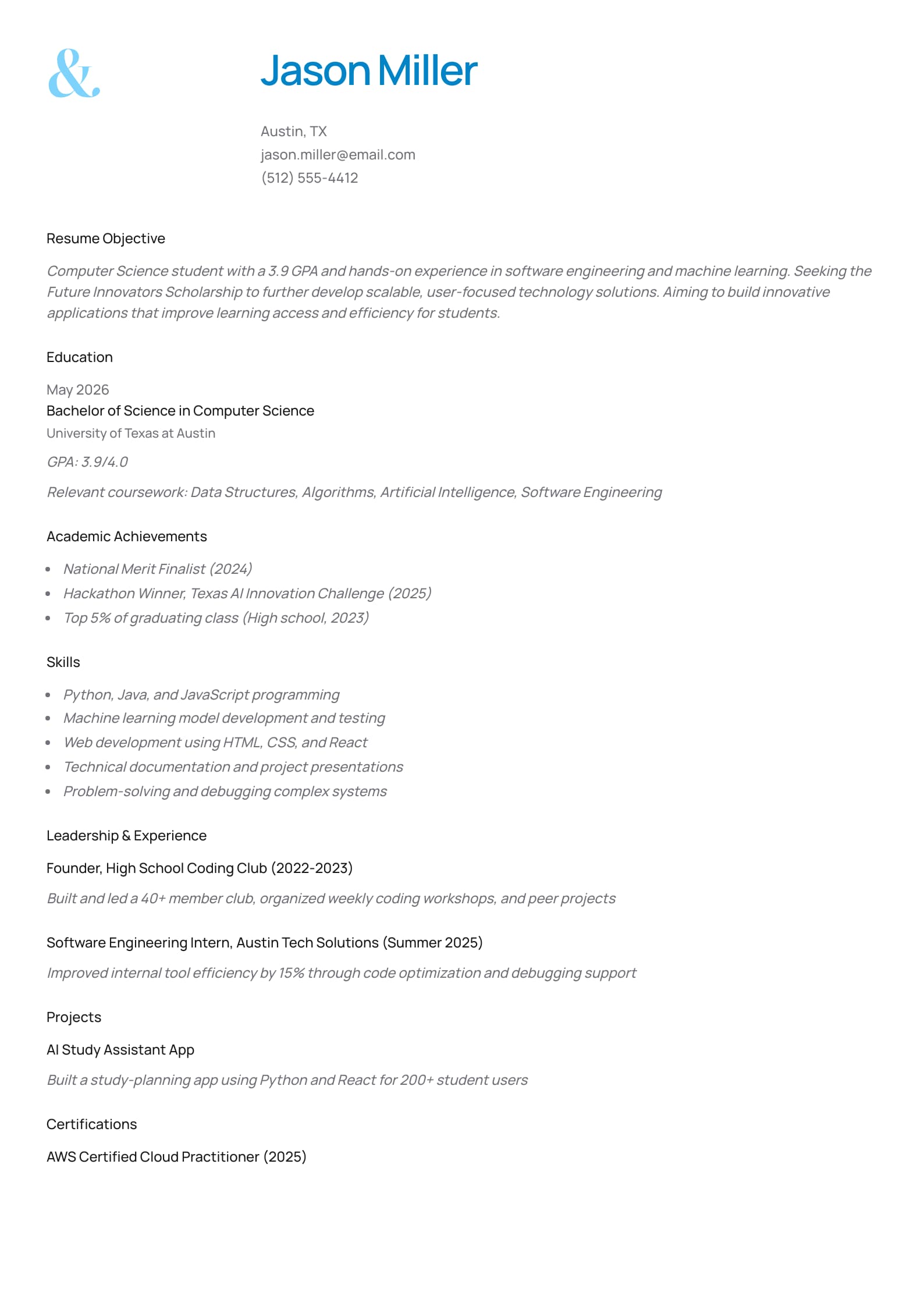
#2. College Scholarship Resume Example
What’s the Best Scholarship Resume Format?
The best scholarship resume format for most is combination resume. As one of the three main resume formats, it allows you to lead with education and academic achievements, then support them with extracurricular activities, leadership experience, volunteering, and part-time work.
This format is a hybrid between reverse chronological and functional resumes, giving reviewers a full picture of both your performance and your potential.
Resume Format | Best For | Pros | Cons |
|---|---|---|---|
Reverse chronological | Strong academic history | Easy to scan, familiar | Less flexible |
Functional | Limited experience | Skills-focused | Less credible |
Combination | Most applicants | Balanced, flexible | Slightly longer |
How to Write a Scholarship Resume: 6 Must-Have Sections
To write a scholarship resume, you need to include five key sections. Let’s examine each one in more detail.
#1. Contact Information
Your Contact Information section should sit at the top of your resume and include:
Full name
Phone number
Professional email address
City and state
You can also add a LinkedIn profile or a personal academic portfolio if relevant. The goal is to make it effortless for scholarship committees to reach you or verify your identity. That said, let’s compare a good vs. a poor example of contact information:
Good Example
Emily Johnson
emily.johnson@email.com
(312) 555-0198
Chicago, IL
linkedin.com/in/emilyjohnson
Poor Example
“Em”
emilyrocks2005@yahoo.com
The poor example is informal and incomplete, which can reduce credibility immediately. A clean and professional contact section signals seriousness and attention to detail.
#2. Resume Objective
A resume objective explains your goals and connects your background to the scholarship. Two to three sentences are sufficient; focus on your field of study, key strength, and what you aim to achieve with the support.
Let’s take a look at a good vs. poor example:
Good Example
Economics student with a 3.85 GPA and strong academic performance in public policy and data analysis. Seeking the ECONO Scholarship to support research in economic inequality. Aiming to develop data-driven solutions that improve access to community-based financial programs.
Poor Example
Motivated student looking for opportunities to grow.
If we analyze the examples, the poor one is too vague and generic. A strong objective should clearly show your purpose, relevance, and how the scholarship fits into your academic and career goals.
#3. Education Section
Scholarship committees review the Education section to quickly assess academic consistency, so clarity matters most. Include your school name, location, expected or completed graduation date, GPA if it is required, or above 3.5, and any relevant coursework, honors, or academic awards.
Here’s a good vs. poor example of the education section on a scholarship resume:
Good Example
Harvard University, Cambridge, MA
Bachelor of Arts in Economics, Expected May 2027
GPA: 3.85/4.0
Relevant coursework: Microeconomics, Statistics, Public Policy
Honors: Dean’s List (2024, 2025)
Poor Example
Harvard University
Studying economics
The poor example does not give enough context for reviewers in terms of academic strength. It feels vague and underdeveloped, which weakens the overall application.
#4. Academic Achievements & Awards

This section highlights recognition you have earned for academic performance, which is especially important for scholarship applications. It should include honors, awards, competitions, and distinctions that demonstrate excellence, consistency, or leadership in academic settings.
Be specific about the award name, issuing institution, and year received. For example:
National Honor Society Member (2023-2025)
AP Scholar with Distinction Award (2025)
1st Place, State Economics Competition (2024)
Dean’s List, Riverside High School (2023, 2024)
If the award is not widely known, you should still include it, but you need to “translate” it so the reviewer understands its value quickly. Briefly explain three things on your academic resume for a scholarship:
What the award is
How competitive is it
Why it matters
For example:
Achievements Example
Regional Economics Innovation Challenge - 1st Place (2025)
Selected from 200+ students across 15 schools for a project analyzing inflation trends and proposing policy solutions to improve local economic stability.
#5. Skills Section
The Skills section is where you highlight practical strengths that support your academic and extracurricular achievements. For a scholarship resume, this should focus on relevant abilities such as research skills, writing, data analysis, leadership, communication, or technical tools.
Here’s a good example of skills on a scholarship resume:
Skills on a Scholarship Resume
Skills
Financial modeling and data analysis using Excel and Google Sheets
Academic research, essay writing, and source citation
Public speaking and presentation delivery
Budget planning and event coordination
Team collaboration and leadership
A strong Skills section should feel practical and evidence-based, showing abilities that directly support your academic performance and scholarship potential.
#6. Extracurriculars
The Extracurriculars section shows what you do outside the classroom. The extent of participation in extracurricular activities is often just as important as academics in scholarship decisions due to the positive impact on soft skills development.
These activities can include clubs, sports, volunteering, community service, internships, or student organizations, influencing your communication, leadership, time management, teamwork, and critical thinking skills.
Scholarship committees use this section on your student resume to understand your character, interests, and how you contribute beyond grades. Therefore, be specific about your role, organization name, and time commitment.
Whenever possible, show impact instead of just participation. For example:
Extracurriculars Example
Student Council Treasurer, Lincoln High School (2023-2025)
Managed a $5,000 annual budget for school events
Organized fundraising events for student activities
Volunteer Tutor, Local Community Center (2024-Present)
Tutored middle school students in math and reading twice a week
Additional Sections for Scholarship Resume
Depending on the scholarship and your background, you may need additional sections that help strengthen your application. The key is to only include them if they add clear value and are relevant to the scholarship criteria.
Common additional sections on a scholarship resume include:
Work experience: Important if you have part-time jobs, internships, or paid roles that show responsibility and skills.
Research or projects: Helpful for STEM, academic, or competitive scholarships where independent work matters.
Certifications: Includes online courses, technical certifications, or language proficiency tests.
Languages: Relevant if multilingual ability is an advantage for the scholarship.
Publications or presentations: For students who have written papers, presented at conferences, or contributed to academic work.
References: Can be included if the scholarship specifically asks for them or if a recommendation contact would strengthen your application.
Should You Attach a Cover Letter Along With Your Resume?
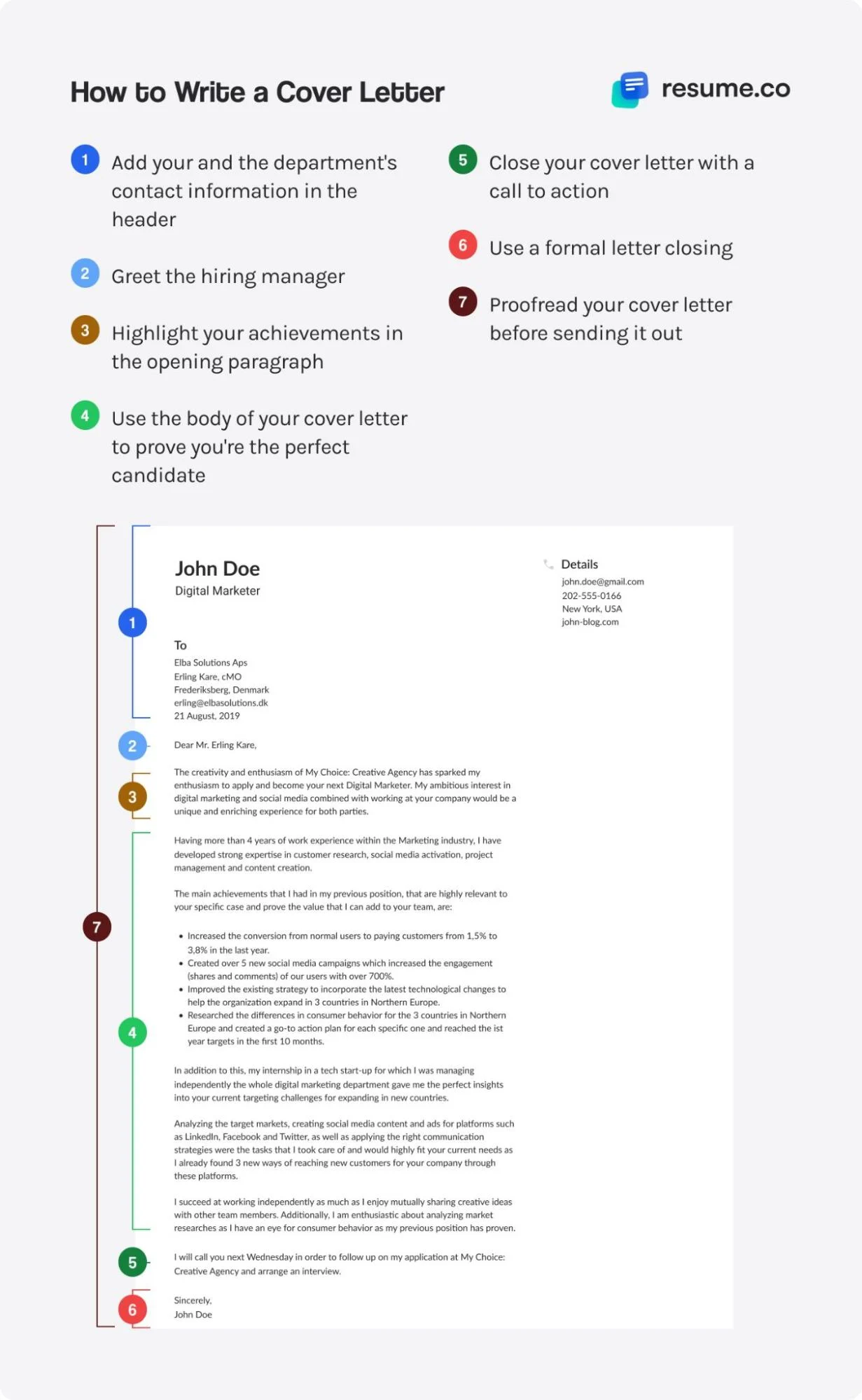
You should attach a cover letter along with your scholarship application resume if the application allows it or explicitly requests one. A resume shows your achievements, but a cover letter explains your story, motivation, and why you are applying for the scholarship. It is your chance to connect the dots and show personality beyond grades and activities.
A strong cover letter can turn a good application into a memorable one by explaining your goals, background, and how the scholarship fits into your future plans. Keep it focused and tailored to each scholarship rather than using a generic version.
If you are not sure where to start, our AI-powered cover letter builder can help you quickly build a structured, professional draft. It gives you a solid foundation that you can personalize, saving time while still keeping your application polished and competitive.
5 Typical Mistakes to Avoid When Creating a Scholarship Resume
Here are five mistakes to avoid when creating a scholarship resume:
Mixing unrelated timeframes or inconsistent dates. If your education, awards, and activities do not follow a clear timeline, it creates confusion. For example, listing an award from “2022-2023” after a 2025 activity makes the resume feel disorganized. Reviewers should be able to understand your progression without guessing.
Not aligning content with the scholarship’s values. Many students list strong achievements but fail to connect them to what the scholarship actually rewards. For example, applying for a leadership-focused scholarship but emphasizing only technical skills without showing leadership roles weakens the application.
Including outdated or irrelevant early achievements. High school awards or middle school activities that no longer reflect your current level can take up space that should be used for recent, stronger accomplishments.
Submitting with typos or grammar mistakes. Even one spelling mistake can make your resume feel rushed or careless. Scholarship committees may see errors as a sign of poor attention to detail, especially when reviewing academic applications.
Submitting without proofreading for tone consistency. Switching between formal and casual wording makes the resume feel unpolished. Even small inconsistencies in language can reduce professionalism. Using an online resume builder can help keep formatting and wording polished.
Ready to Build Your Scholarship Resume?
Create a polished, personalized scholarship resume in minutes with Resume.co.Closing Thoughts
Ultimately, a strong scholarship resume is all about presenting your academic achievements, skills, and experiences in a clear, compelling way. By choosing the right format, including the most relevant sections, and avoiding common mistakes, you can create a resume that stands out to scholarship committees.
Even if you are early in your academic journey, the right structure and wording can make your experience feel more impressive and intentional. With our resume builder and professional resume templates, you can turn these guidelines into a finished, downloadable scholarship resume in minutes.
Scholarship Resume FAQs
#1. Should I include part-time jobs in my scholarship resume?
Yes, you should include part-time jobs in your scholarship resume if they show transferable skills like communication and time management. Even unrelated jobs can be valuable if you highlight what you learned, such as handling customers, managing schedules, or working under pressure.
#2. Is GPA required on a scholarship resume?
GPA is not always required on a scholarship resume, but it is strongly recommended if it is competitive. A high GPA helps strengthen your academic profile, while a lower GPA can be omitted if the scholarship does not specifically ask for it.
#3. How can I make my resume stand out?
To make your resume stand out, use strong action-oriented bullet points, highlight measurable achievements, and tailor your resume to the scholarship’s priorities. Avoid filler content and make sure every section reinforces why you are a strong candidate.