
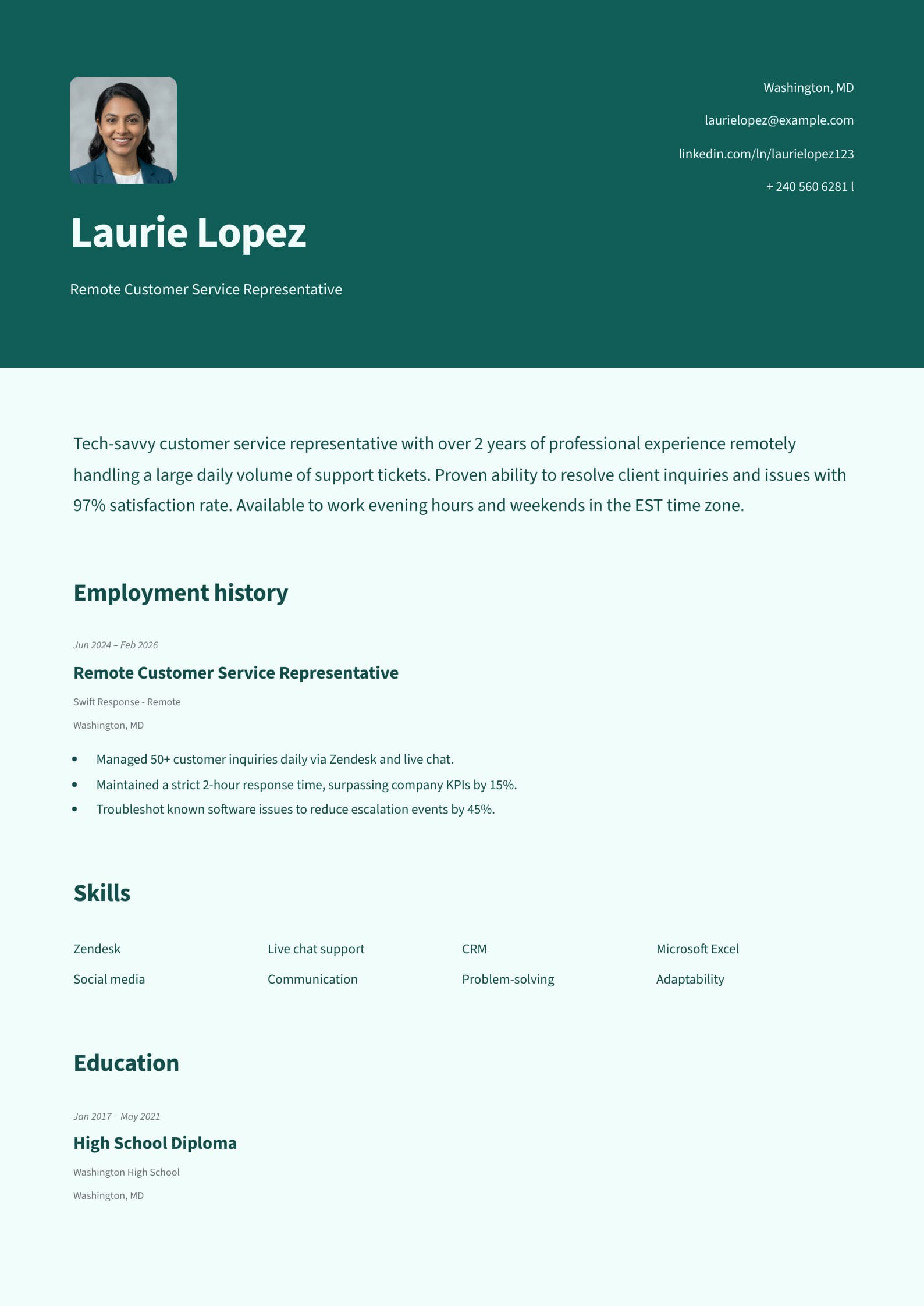
A part-time job resume is a concise professional document created to quickly communicate your value to recruiters and convince them that you’re the right person for the role. However, you need to treat it as if you’re applying for a full-time job, since cutting corners with your resume may set you back and allow other candidates to get ahead.
In this article, we will teach you how to write a resume for a part-time job from scratch. You’ll learn how to choose the right format, which sections to include, whether to write a cover letter, and more.
Key Takeaways
The best format for a part-time job resume is the chronological format, while a hybrid format is good for those with employment gaps.
Make sure to include five mandatory sections: contact information, summary or objective, work experience, education, and skills.
When listing work experience, focus on quantifiable results and achievements over everyday tasks.
Write and submit a cover letter that matches your resume to show drive and get ahead of the competition.
Exceptional Part-Time Job Resume Examples
Before we move on to resume writing, we’ve prepared three complete resume examples to help you visualize what your part-time job resume should look like.
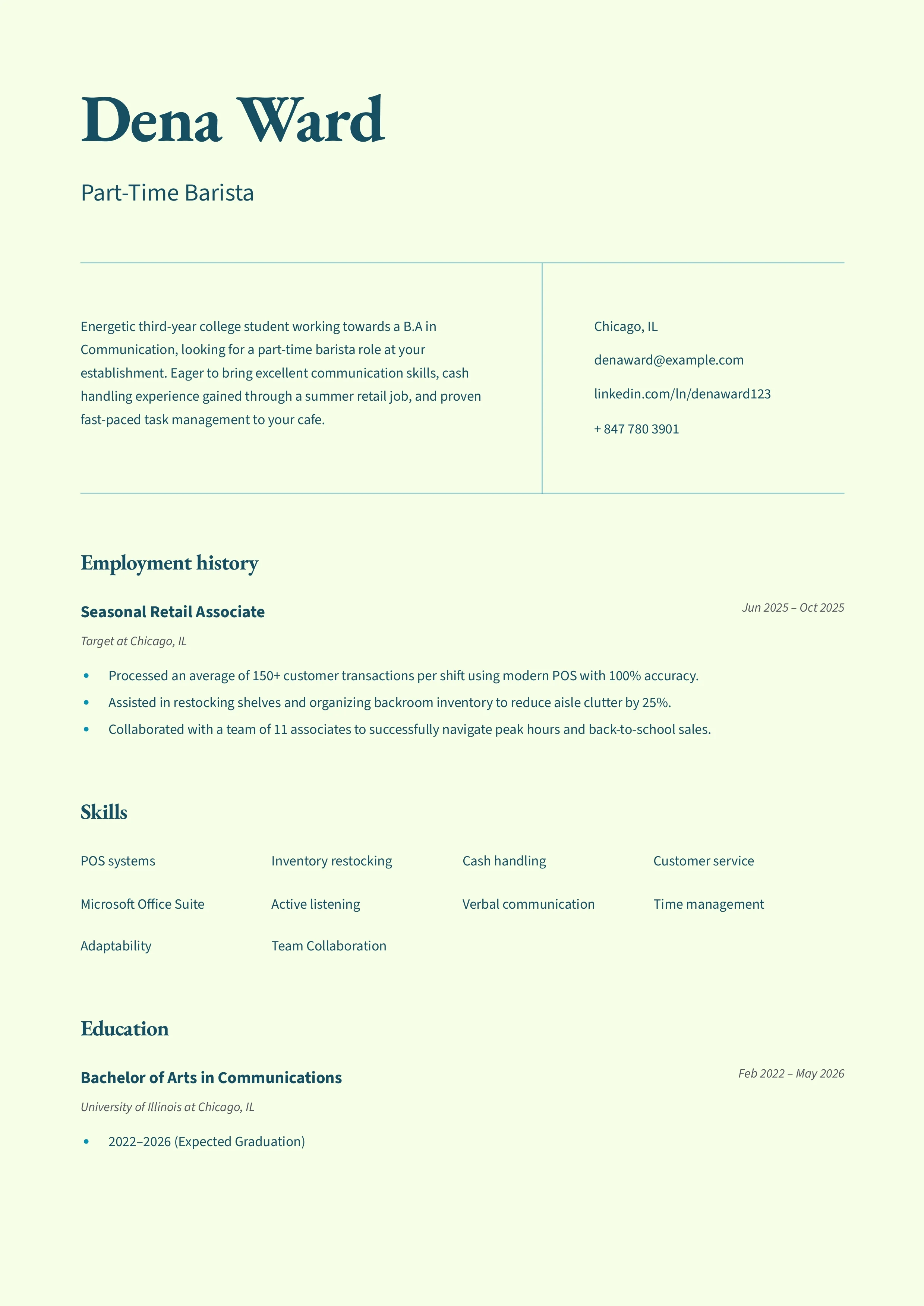
Part-Time Job Resume Example for a Student
Let’s start with a part-time job resume example for a student:
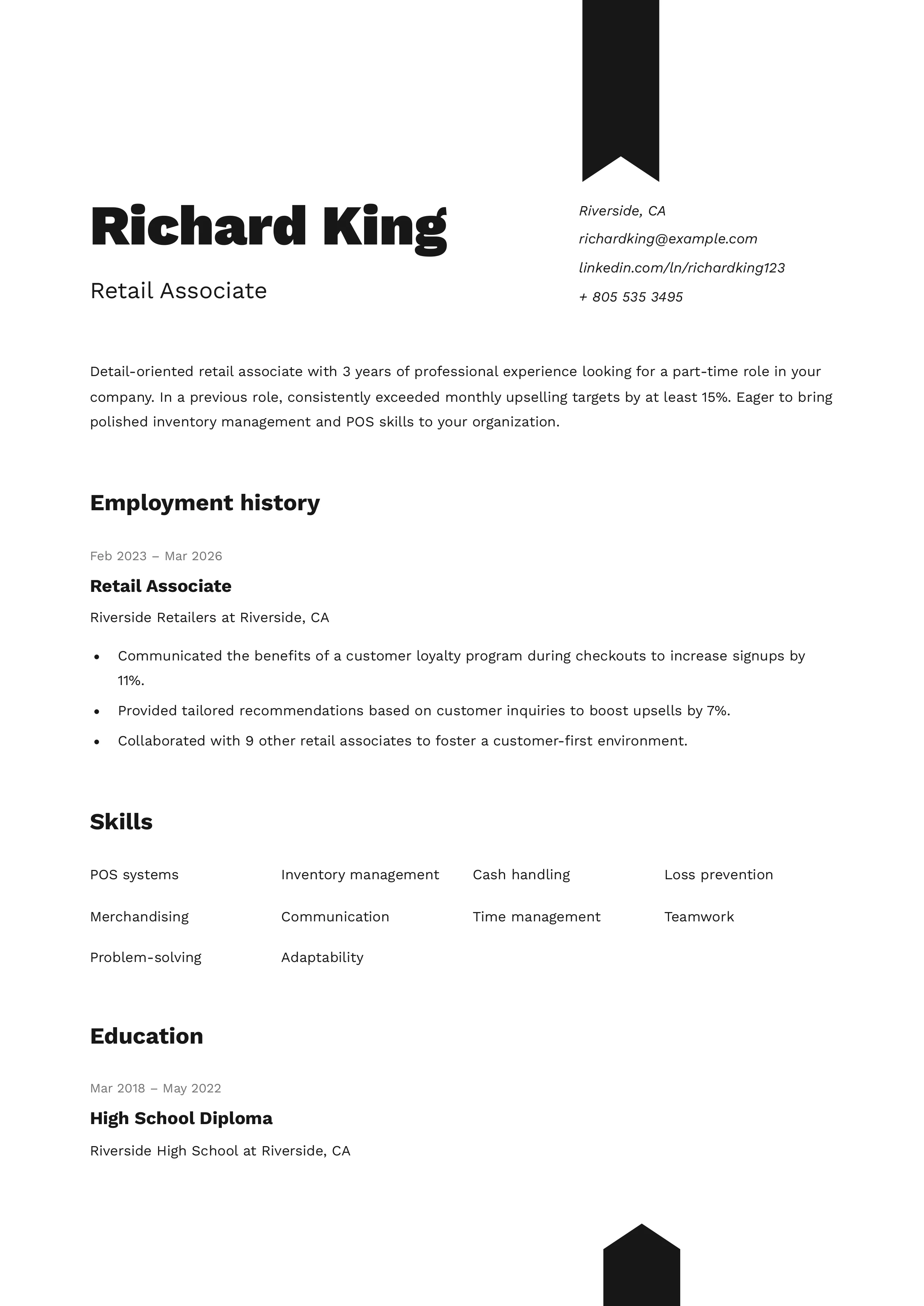
Part-Time Job Resume Example for a Retail Associate
Now let’s see a part-time job resume example for a retail associate:
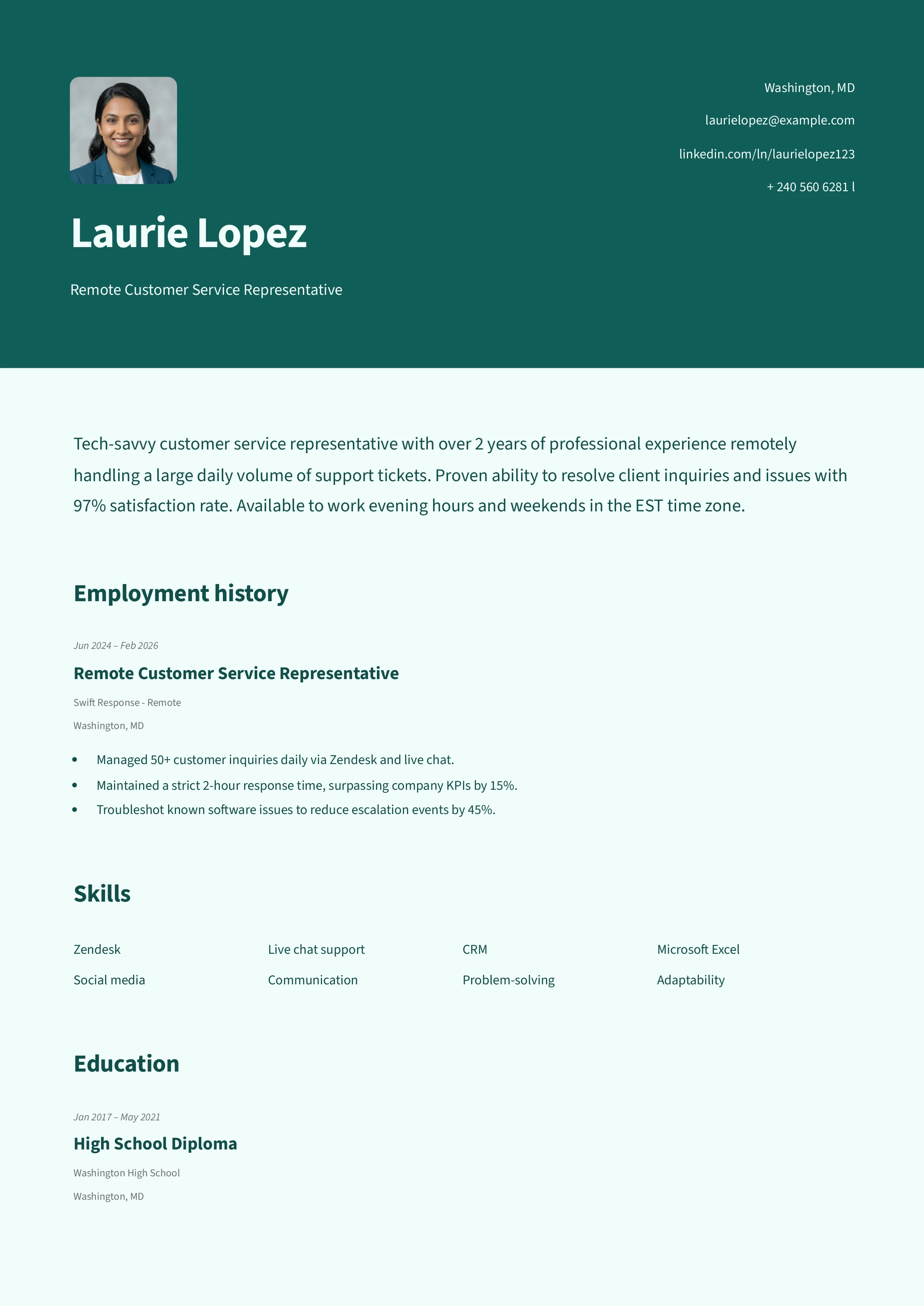
Part-Time Job Resume Example for a Customer Service Representative
Lastly, here’s a resume example for a remote part-time role of a customer service representative:
What’s the Best Format for a Part-Time Job Resume?
In most cases, the best format for a part-time job resume is the chronological resume format. This format is universally recognized and preferred by most employers since it provides a clear insight into your career’s progress.
The chronological format revolves around highlighting your most recent work experience first and going backward from there. Such an organized structure makes it easy for recruiters to assess your current level of expertise. Plus, most ATS platforms are set up with this format in mind. However, you need to have a consistent work history to get the most out of this resume.
If you’re an entry-level professional, you can go with the skill-based, functional resume format. Professionals with no prior experience can use this format to emphasize their skills as their biggest strengths.
Lastly, the combination (hybrid) resume format blends the features of the previous two formats to create versatile resumes. It highlights skills, but it backs up each one with a list of work-related accomplishments listed in reverse-chronological order. This format works well if you’re an experienced professional but have gaps in employment.
5 Important Sections for a Part-Time Job Resume
There are five important sections that every resume for a part-time job must have, and they are:
Contact information
Resume summary or objective
Professional experience
Education
Skills
Once you’ve added those, you can strengthen your application with optional sections, like:
Language skills
Volunteer work
Certifications
Hobbies and interests
Since you’ll be juggling a lot of different sections, you can simply pick one of our professional resume templates, fill out the details, adjust the layout, and download a finished product. Our AI will enhance your writing, while our ATS resume checker will help you get the perfect score.
How to Add Your Contact Information
You add your contact information at the top of your part-time job resume. Simply list the following details in the resume header:
Your name
Email address
Phone number
Depending on the job that you’re after, you can also include some optional information, such as:
Your city and state
LinkedIn profile
Link to a portfolio
Personal website
Relevant social media page
You should avoid adding:
Irrelevant social media accounts
Funny job titles
Unprofessional email addresses
Resume photo
Let’s put all this into practice by taking a look at a good example of a contact information section:
Contact Information Section Example
Richard King Retail Associate + 805 535 3495 richardking@example.com Riverside, CA linkedin.com/ln/richardking123
Part-Time Job Summary vs. Resume Objective
A resume summary and objective section is the document’s elevator pitch. Its purpose is to grab the reader’s attention in a few concise sentences packed with details about your biggest strengths. Which section you should write depends on your experience.
If you’re a beginner with no work history, you should write a resume objective. Use it to emphasize your skills and goals. This allows you to highlight competence while emphasizing long-term thinking and motivation.
Here’s a good example of an objective for a part-time resume:
Resume Objective Example
Motivated business administration student with strong organizational skills seeking a part-time administrative role at [Company Name]. Reliable communication and data entry skills developed through university group projects. Eager to contribute to your operations while gaining experience for a full-time position.
For contrast, here’s a bad example:
Bad Example
Looking for any part-time job to pay for my college tuition. I have no experience, but I’m a fast learner.
Experienced professionals looking for part-time roles should write a resume summary. Its focus should be on one or two most notable work-related accomplishments, highlighting expertise from the get-go.
Let’s start with a good example of a part-time job resume summary:
Resume Summary Example
Detail-oriented retail associate with 3 years of professional experience looking for a part-time role in your company. In a previous role, consistently exceeded monthly upselling targets by a minimum of 15%. Eager to bring polished inventory management and POS skills to your organization.
Lastly, here’s a bad example of a resume summary that doesn’t showcase any notable accomplishments:
Bad Example
Experienced retail associate looking for a part-time job. I am good with people and need extra income.
How to List Your Professional Experience
You should list your professional experience in reverse-chronological order. Start by putting your latest job first (since it is typically the most relevant and represents the most accurate representation of your current skill level), and go back from there.
The work experience section is the central part of your part-time job resume, so you need to polish it to perfection. To achieve this, make sure to include the following details for each previous job:
Your role
Company name
Dates of employment
List of achievements
Make sure to focus on accomplishments and results over everyday assignments and responsibilities. This helps you show what you’re truly capable of, setting you apart from other professionals who did the same job.
Here are some tips to make your list of achievements more prominent:
Use bullet points instead of blocks of text, and include 3–5 per each job.
Leverage numbers and statistics to quantify your efforts and add measurable value.
Implement action verbs and power words to make your writing more impactful.
Let’s put all that into practice and check out an example of a work experience section:
Work Experience Section Example
Work Experience
Retail Associate Riverside Retailers Riverside, CA February 2023–March 2026
Communicated the benefits of a customer loyalty program during checkouts to increase signups by 11%.
Provided tailored recommendations based on customer inquiries to boost upsells by 7%.
Collaborated with 9 other retail associates to foster a customer-first environment.
For comparison, here are some bad examples of bullet points that focus on responsibilities and don’t use numbers or action verbs:
Work Experience Bullet Points Bad Example
Assisted customers during shopping.
Promoted our loyalty program.
Collaborated with other employees.
What Should You Include in the Education Section?
In most cases, you should only include your highest degree in the education section. This is enough to validate your qualifications, provided you have enough work experience.
Here are the details to include:
Your degree
The institution that issued it
Years of attendance
And here’s an example of what that looks like in practice:
Education Section Example
Education
High School Diploma Riverside High School, Riverside, CA 2018–2022
If you have no work history (e.g., you need a part-time job resume for students), you can add more details to this section. To do this, include a bullet list of academic accomplishments relevant to the role that you’re applying for, like a high GPA, relevant coursework, or extracurricular activities.
Which Skills Should You Include in Your Part-Time Resume?
Your part-time job resume skills need to align with the job that you’re applying for. That’s why it’s important to read the job ad and research the company. This will help you determine which abilities recruiters are looking for in candidates.
Create two brief but relevant lists—one for your hard skills and another for your soft skills.
Following that, you should also mention a couple of key skills throughout your resume. Add them next to notable accomplishments in your resume summary or work experience sections to substantiate your expertise.
Hard Skills
Hard skills are job-specific. Which ones you should include depends on your field of expertise and the role you’re after.
Hard Skills Examples
For instance, retail associates may include:
POS systems
Inventory management
Cash handling
Loss prevention
Merchandising
On the other hand, customer service professionals can add:
Product knowledge
Data entry
Technical support
CRM
Outbound calling
Soft Skills
Soft skills are also called transferable skills since they are used in every profession. You can use them to emphasize that you work well with others.
Some of the highly sought-after soft skills include:
Soft Skills Examples
Communication
Time management
Teamwork
Adaptability
4 Additional Sections You Can Add to Your Resume
If you have extra space on your part-time job resume after including all the mandatory sections, you can add one or more optional sections to strengthen your application. However, it’s essential for them to be relevant to the role you’re applying for.
#1. Certifications
Certifications represent proof that your skills have reached specific industry standards. Anything from a CPR certification for a part-time childcare gig to an AMA Professional Certified Marketer for a remote marketing assistant job can significantly boost your chances with recruiters, showing that you’re a high-quality, low-risk candidate.
#2. Language Skills
Language skills are invaluable in today’s globalized market. Being bilingual or multilingual (even with only elementary proficiency) can be particularly helpful in customer-oriented roles, like retail, hospitality, or remote support.
Make sure to use the established framework of reference (e.g., ACTFL assessments) to quantify your skill levels when listing proficiency in foreign languages.
#3. Volunteer Experience
Having volunteer experience on a resume signals that you’re a driven person who has a strong work ethic. Employers always look for these qualities and soft skills in candidates. Plus, you can leverage your volunteer work to emphasize certain skills through accomplishments, in case you lack professional experience.
#4. Hobbies and Interests
Briefly mentioning a couple of hobbies and interests that align with the role you’re applying for can help you effectively personalize your resume. Plus, they can act as great conversation starters during job interviews.
Should You Write a Cover Letter Along With Your Resume?
You should write a cover letter for a part-time job along with your resume if you want to maximize the chances of impressing recruiters. Cover letters are usually optional, which is why candidates who go the extra mile to write and submit them instantly get ahead of the rest.
A cover letter also gives you more freedom to express your motivation and reasons for applying for that job in particular. However, it should still be a concise and professional document. If you need help writing a part-time job cover letter, check out our cover letter builder.
4 Tips for Creating an Outstanding Part-Time Job Resume
Here are four expert tips and strategies that will elevate your document from good to great:
Part-Time Job Resume Tips
Keep your resume one page long. Hiring managers often review dozens of resumes in a day. Because of that, they often skim through resumes and only focus on candidates with the most relevant qualifications. That’s why you should trim unnecessary information and only keep the most impactful details in your resume.
Tailor your resume to the role. You should never send a generic resume to multiple job ads. Read the job description to extract the keywords (like the job title or the required skills) and implement them organically throughout your resume. This will help you impress recruiters and pass ATS screening.
Use a clean resume layout. Avoid adding too much color or complex graphical elements to your resume. This reduces its legibility and ATS score. Instead, keep the layout clean and professional with sufficient white space to emphasize distinct sections. This allows recruiters to easily find what they are looking for.
Match your cover letter to your resume. When writing a cover letter, don’t repeat the same information you’ve already included in your resume. Instead, take this additional document to inject your application with personality and emphasize additional qualities. Plus, keep the visual style the same to create a cohesive application package.
Want to make an outstanding part-time job resume in minutes?
Create one with our resume builder today!Closing Thoughts
An effective part-time job resume relies on clarity and relevance. You want to emphasize your biggest strengths right off the bat and show the employer that you can contribute quickly and reliably, even in a limited role.
Remember to focus on your measurable achievements and to tailor your resume to each new role that you’re applying for. Following that, make sure that you’ve picked the right resume format and that your layout is clear and easy to read. This will get you ahead of the competition even when you have minimal experience.
Part-Time Job Resume FAQs
#1. How long should a part-time resume be?
A part-time resume should be one page long. Hiring managers often look through resumes quickly and prefer candidates who show the most relevant skills and qualifications. You should only include an additional page if the job ad asks for it and you have decades of experience to highlight.
#2. How to write a resume for a part-time job with no experience?
To write a resume for a part-time job with no experience, you can focus on your skills and education, as well as non-work experiences obtained through volunteering and extracurricular activities. You can also emphasize community involvement or academic projects to show interpersonal and organizational skills required in the workplace.
#3. Should I include my availability on a part-time resume?
Yes, you should include your availability on your part-time resume if the role requires it. Many employers hire part-time staff to fill in the gaps during specific periods. You can emphasize that you’re available during those hours or days in your contact information or resume summary.