
A resume for an internal position should include your contact information, a professional summary tailored to the role, detailed work experience with measurable achievements, relevant skills, and education or certifications that support your candidacy. The goal is to show how your experience aligns with the new role and why you are ready to take the next step.
To do so properly, we’ll show you how to write a resume for an internal position or transfer. By following our guide and resume examples, you can create one that makes it easy for hiring managers to see your fit for the opportunity.
Key Takeaways
Your resume for an internal job posting shares many of the same key sections of a standard resume, but you should focus less on introducing yourself.
It is optional but recommended if relevant to include your certifications, internal projects, leadership experience, and awards and recognitions.
You should attach a cover letter with your resume to explain why you want the role or how your background connects to the opportunity.
Make sure you avoid common mistakes like being too casual, not tailoring your writing, assuming your reputation will speak for itself, and including outdated information.
Practical Resume Examples for an Internal Position
Before we show you how to write a resume and which format to choose, let’s examine two resume examples for an internal application.
What’s the Best Resume Format for an Internal Position?
The best resume format for an internal position is usually reverse chronological because it makes your career path within the company easy to follow. This helps hiring managers to quickly see your promotions, expanded responsibilities, and measurable results.
On the other hand, if you are transitioning into a different team or role, a combination format can be useful. It allows you to lead with relevant skills while still reinforcing your internal experience. The functional format is generally not recommended, as it downplays your track record within the company, which is often your biggest advantage.
To choose between these three formats for your resume, it helps to understand the main internal vs. external resume differences:
Feature | Internal Resume | External Resume |
|---|---|---|
Focus | Emphasizes your achievements, promotions, and internal impact | Emphasizes experience and qualifications relevant to the role |
Career Position | Shows growth within the company and expanded responsibilities | Shows overall career history, often broader in scope |
Skills | Highlights skills proven within the company | Highlights relevant skills, may include transferable skills |
Details | Can include internal projects, awards, and department-specific accomplishments | Focuses on achievements understandable outside the company |
Tone | Professional but familiar with internal context
| Professional and often more formal, assumes no prior knowledge of the company |
5 Key Sections You Should Have in Your Resume

Here are the five key sections to include in your resume for an internal role:
#1. Contact Information
You are not introducing yourself from scratch, so the focus is on making it easy for internal hiring managers to identify you quickly. Include your full name, current job title, department, company email, and phone number. You can also add your internal extension or employee ID if your organization uses them. There is no need to include your full home address.
Below is a good example:
Contact Information Example
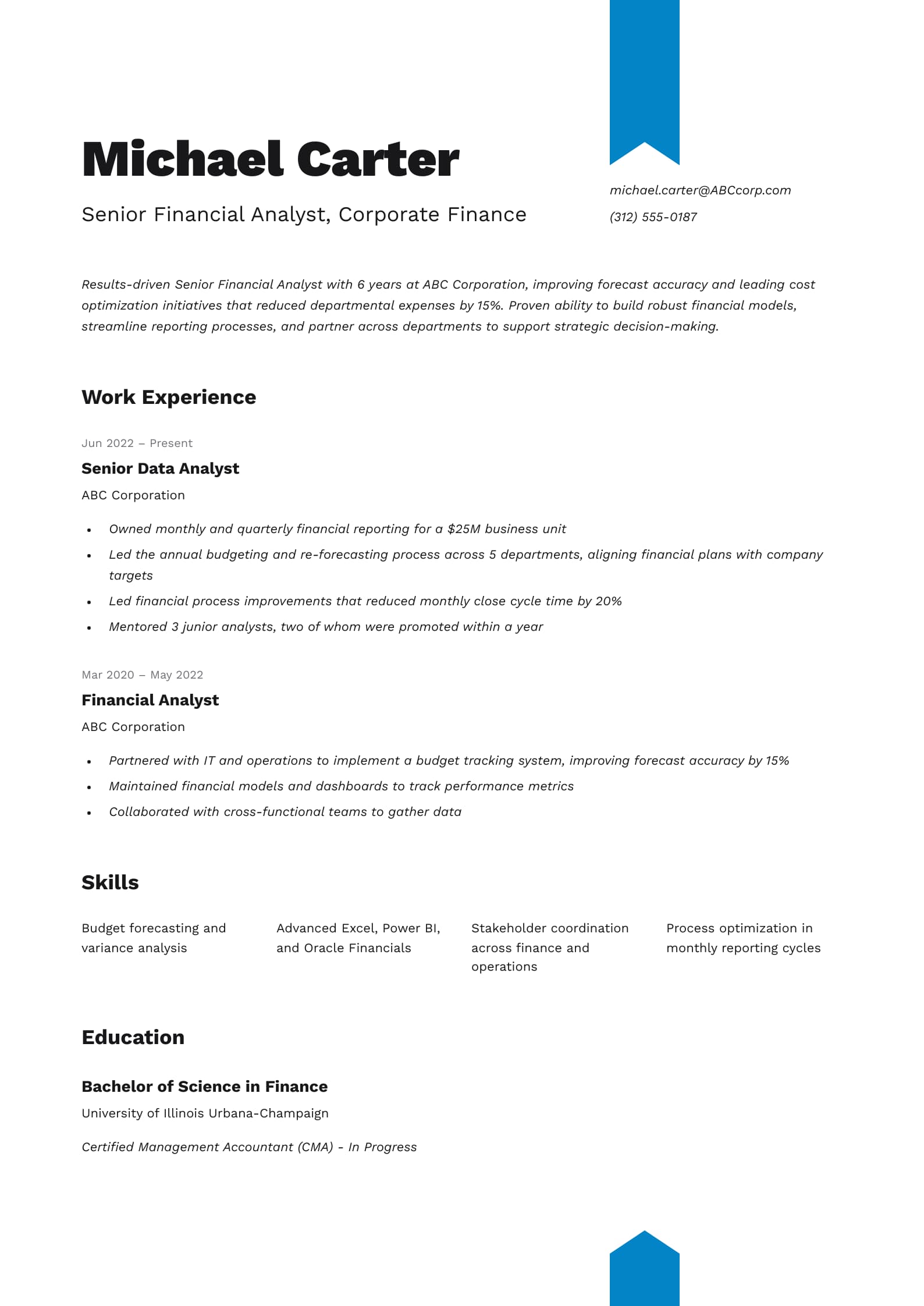
Michael Carter
Senior Financial Analyst, Corporate Finance
michael.carter@ABCcorp.com | (312) 555-0187 | Ext. 2741
You should avoid writing a Contact Information section like this:
Bad Example
Michael Carter
mcarter92@gmail.com | (312) 555-0187
742 Evergreen Terrace, Chicago, IL 60607
Using a personal email or listing unnecessary personal details makes your resume feel like an external application. Keep it concise, professional, and clearly tied to your current position within the company.
#2. Professional Summary or Objective
On your resume for internal transfer, this section should immediately show how your experience within the company supports your next move.
Use a professional summary if you have a strong track record in your current department or a closely related role. This highlights your contributions, performance, and growth within the organization. For example:
Resume Summary Example
Results-driven Senior Financial Analyst with 6 years at ABC Corporation, improving forecast accuracy and leading cost optimization initiatives that reduced departmental expenses by 15%. Proven ability to build robust financial models, streamline reporting processes, and partner across departments to support strategic decision-making.
On the other hand, use a resume objective only if you are making a clear shift, such as moving to a different team, function, or career path. In this case, you are explaining your direction rather than your history. For example:
Resume Objective Example
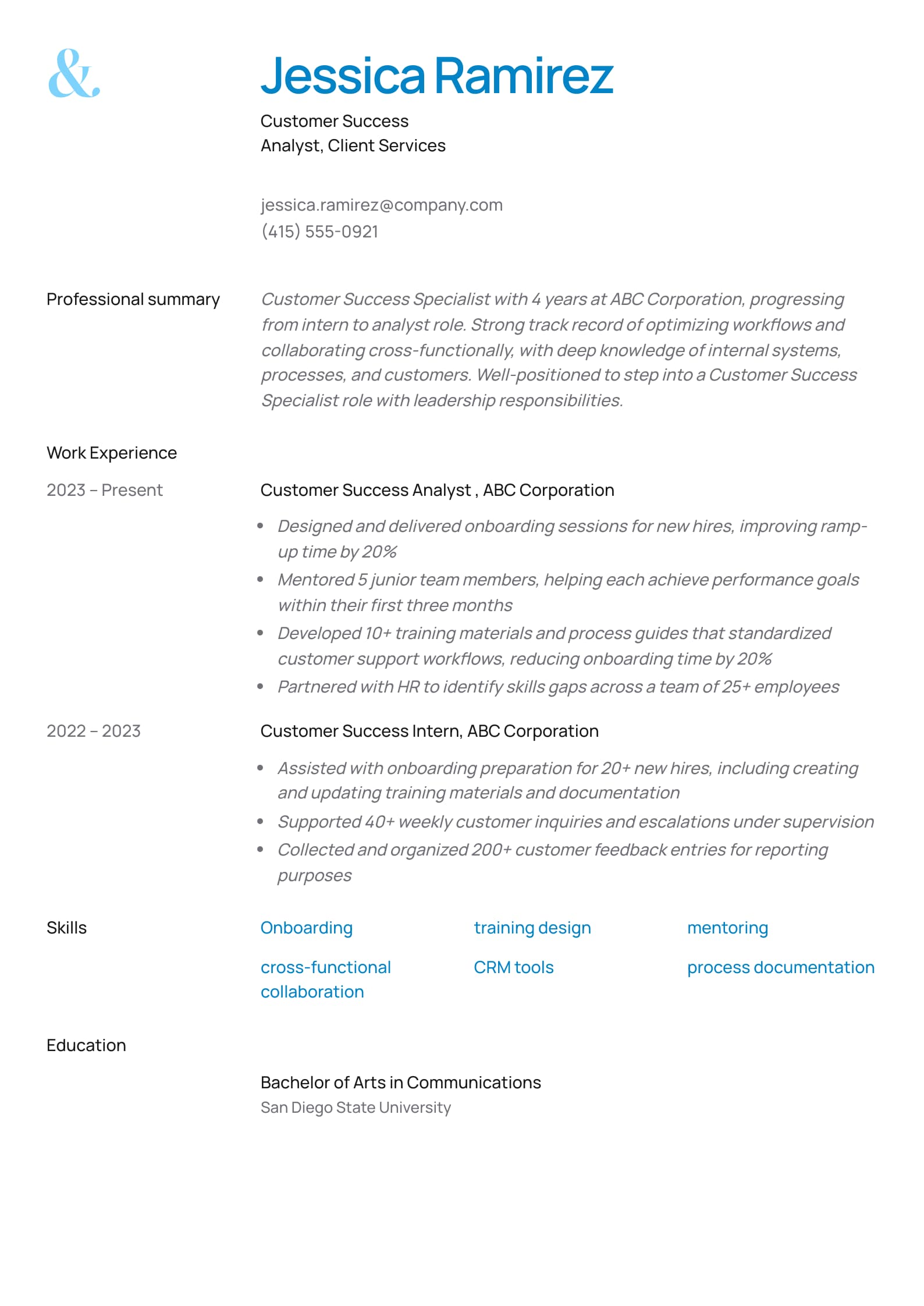
Customer Success Specialist with 3 years at ABC Corporation seeking to transition into a Training and Development role, leveraging hands-on experience in onboarding and mentoring new hires.
#3. Work Experience
With most U.S. employers planning to keep salary increases flat at around 3.2%–3.5% in 2026, internal candidates must rely on clearly demonstrated impact and measurable achievements to stand out.
Emphasize your current role, any promotions, and the results you have delivered. You should go deeper into your internal roles than you would for an external resume. It helps to highlight cross-functional work, leadership, and measurable outcomes that show you are ready for the next step.
Take a look at this good example:
Work Experience Example
Work Experience
ABC Corporation
Senior Financial Analyst | June 2022 - Present
Owned monthly and quarterly financial reporting for a $25M business unit
Led the annual budgeting and re-forecasting process across 5 departments, aligning financial plans with company targets
Led financial process improvements that reduced monthly close cycle time by 20%
Mentored 3 junior analysts, two of whom were promoted within a year
Financial Analyst | March 2020 - May 2022
Partnered with IT and operations to implement a budget tracking system, improving forecast accuracy by 15%
Maintained financial models and dashboards to track performance metrics
Collaborated with cross-functional teams to gather data
On the other hand, avoid listing your work experience like this:
Bad Example
ABC Corporation
Financial Analyst
Responsible for data analysis
Worked with different departments
Helped improve processes
Overall, the best way to list your work experience on a resume for an internal position is to focus on what you achieved, how you contributed, and how your role has evolved.
#4. Skills Section
With the Skills section, you want to highlight capabilities you have already used in the company, especially those that match the role you want next. Keep it tight and intentional rather than trying to cover everything.
You should focus on tools, systems, and competencies that matter in your organization. This could include internal platforms, technical expertise, or cross-functional strengths that hiring managers will immediately recognize.
That said, let’s compare the two examples in the table below:
Good Example | Poor Example |
|---|---|
Budget forecasting and variance analysis Advanced Excel, Power BI, and Oracle Financials Stakeholder coordination across finance and operations Process optimization in monthly reporting cycles | Strong work ethic Team player Great communication skills Problem solver |
While soft skills are important, your internal track record reduces the need to rely on vague claims. It is better to stress specific, job-relevant skills that support your move and are backed by quantified achievements. After all, skill-based hiring is on the rise.
#5. Education Section
This section is mainly to confirm your academic background or highlight any relevant qualifications. Include your degree, major, and school name. You can also add certifications or recent coursework if they directly support the role you are applying for, especially if you are making a shift into a more technical or specialized position.
For example:
Education Example
Bachelor of Science in Finance
University of Illinois Urbana-Champaign
Certified Management Accountant (CMA) - In Progress
Avoid listing outdated or irrelevant details, especially from early education. Keep the focus on qualifications that strengthen your case for the internal role.
Additional Sections for a Resume for an Internal Position
Your experience already carries weight, so only include additional sections if they strengthen your case for the specific role.
Here are the three most useful ones to consider:
Certifications. Include this if the role requires or strongly values specific credentials. This is especially useful for technical, finance, HR, or project management roles.
Internal projects or leadership experience. Great for showcasing initiative beyond your core role. Think task forces, cross-functional projects, or mentoring programs.
Awards and recognition. Internal recognition helps reinforce your performance and reputation within the company because it shows that your contributions have already been noticed and valued.
Skip anything that does not directly support your move. For example, hobbies do not add much to an internal resume. If it does not clearly answer “why you for this role,” it does not need to be included!
Should You Attach a Cover Letter Along With Your Resume?

Yes, you should attach a cover letter for an internal position, even when it is optional.
While your resume shows your experience and achievements, it does not explain why you want the role or how your background connects to this specific move. A cover letter fills that gap. It gives you a chance to clarify your intentions and position yourself as a natural fit.
This is even more important if you are switching teams, going for a promotion, or applying for a role that is not an obvious next step. Without a cover letter, hiring managers may have to make assumptions about your goals.
However, writing a cover letter can be harder than it looks. You need to be clear and direct without repeating your resume or sounding too formal. Our Cover Letter Builder can help you quickly create a tailored, role-specific letter that connects your experience to the opportunity, without overthinking the structure or wording.
7 Typical Mistakes to Avoid on an Internal Resume
Here are seven common mistakes and how to avoid them:
Being too casual. Just because you already work at the company does not mean you can skip structure or polish. Submitting a rushed or informal resume, riddled with spelling mistakes, can signal a lack of seriousness.
Not tailoring your resume to the role. Internal roles still require alignment, so do not just reuse your resume. Highlight the experience, skills, and projects that match the new position, even if they are not the main focus of your current job.
Assuming your reputation will speak for itself. Your manager may know your work, but do not rely on internal visibility alone. Your resume should clearly communicate your strengths, achievements, and readiness for the role.
Including irrelevant or outdated information. Details like old education and unrelated skills can dilute your message. Keep everything focused on your current performance and the role you are targeting.
Overlooking achievements outside your immediate role. Participation in committees, task forces, or special projects can demonstrate initiative, leadership, and versatility. Leaving these out misses an opportunity to strengthen your case.
Using vague language. Phrases like “responsible for” or “helped with” do not show impact. You should use action verbs and results-oriented statements to demonstrate contribution.
Ignoring formatting and readability. A cluttered or inconsistent resume makes it harder for hiring managers to scan. Keep headings clear, bullet points concise, and sections logically organized. A proper promotion resume template can help you do this quickly.
Ready to Move Up the Ladder with Resume.co?
Build a polished, tailored application fast with our resume builder.Closing Thoughts
Now that you know how to write a resume for an internal position and the key internal vs. external resume differences, you can use our minimalist resume templates and present your experience to support your next move.
Make your impact clear, your progression easy to follow, and your fit hard to question. Do not assume your reputation will carry you. Put the right details in front of the right people. When your resume is focused and intentional, it does the heavy lifting for you!
Resume for an Internal Position FAQs
#1. Do I need a separate resume for internal jobs?
Yes, you need a separate resume for an internal job. In it, highlight your relevant achievements, skills, and projects. You should not assume that your current manager or hiring team knows all your contributions.
#2. How long should an internal resume be?
An internal resume can be one to two pages. Internal resumes do not need a full career history but should clearly show your progression, impact, and readiness for the next position.
#3. Should I include all past roles in the company?
No, you should not include all past roles in the company. Leave out unrelated early positions or tasks that do not support your case and prioritize relevance over completeness to keep your resume focused.
#4. How do I handle sensitive company information?
You can handle sensitive company information by never disclosing confidential data, client specifics, or proprietary processes. Frame achievements in terms of results, metrics, or responsibilities without revealing sensitive details.
#5. Can I apply internally without my manager knowing?
You may be able to apply internally without your manager knowing, depending on your company’s policies. Always check HR guidelines first, and be prepared to discuss your interest with your manager if required.