
An international resume is written when applying for a job position overseas and is adjusted to account for different rules and expectations that exist in countries across the world. What works in your home country may not impress recruiters in other regions, and can even result in issues with anti-discrimination laws, so it’s really essential to have all the specific rules in mind.
In this article, we’ll explain why you can’t use the same resume in every country and go through the most common formats that are used across the globe. We’ll also teach you how to write an international resume and cover letter, and what mistakes to avoid while doing so. We’ll also give you several examples of international resumes to help you put everything into context.
Key Takeaways
You need an international resume when applying for a job abroad, as different countries have vastly different rules and expectations for job seekers.
A standard resume format in many countries is chronological, while resume length varies from one to two or three pages, and even more.
Include all the important sections, like your contact details, resume summary, work experience, education, and skills.
Complement your application with a well-written international cover letter to show your drive and motivation.
3 Outstanding International Resume Examples
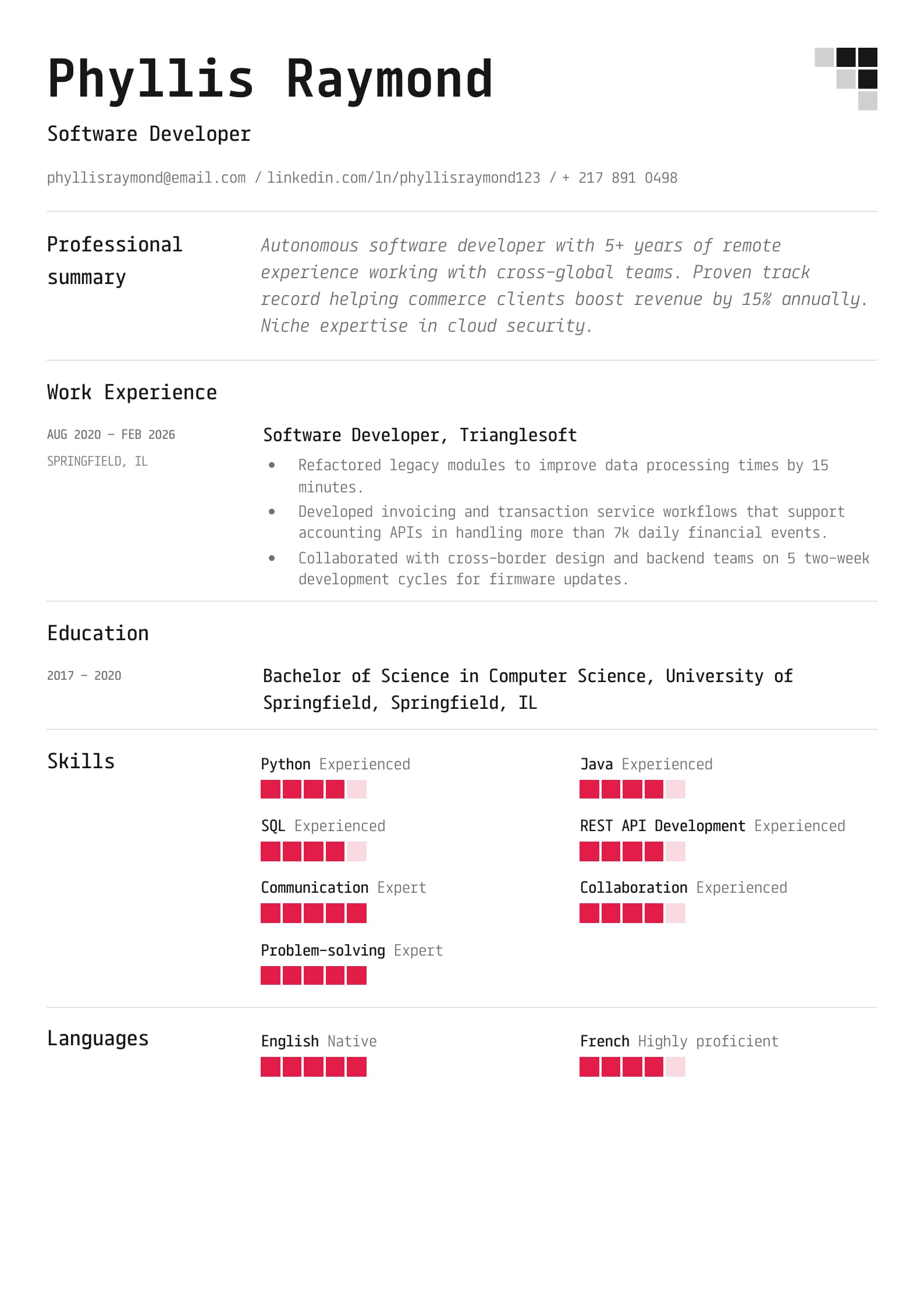
Here are three complete international resume examples that will give you an idea of what this type of document should look like:
Student International Resume
Let’s start with an example of a student's international resume that focuses on their academic accomplishments:
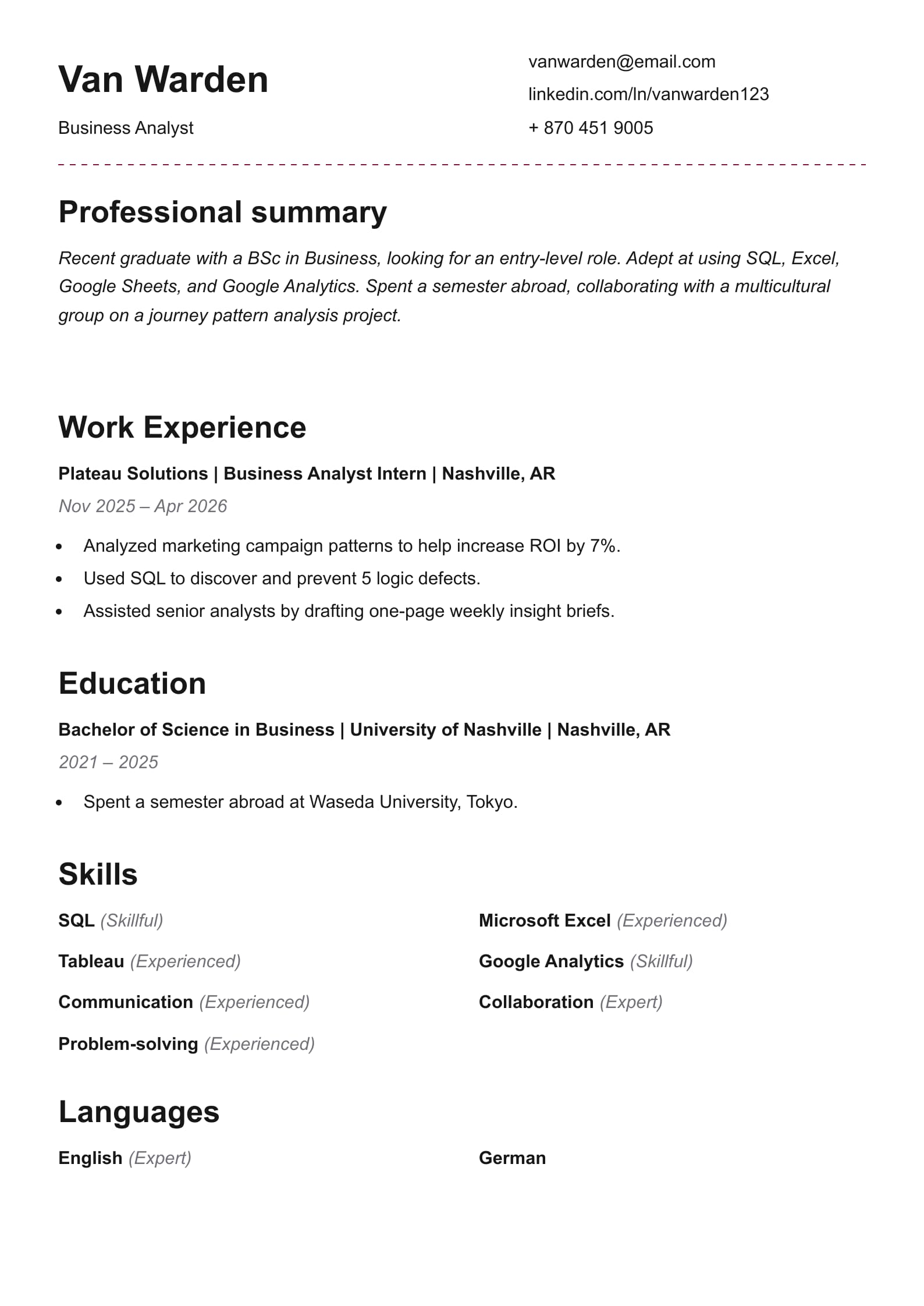
Remote Job International Resume
Here’s an example of an international resume for a remote job:
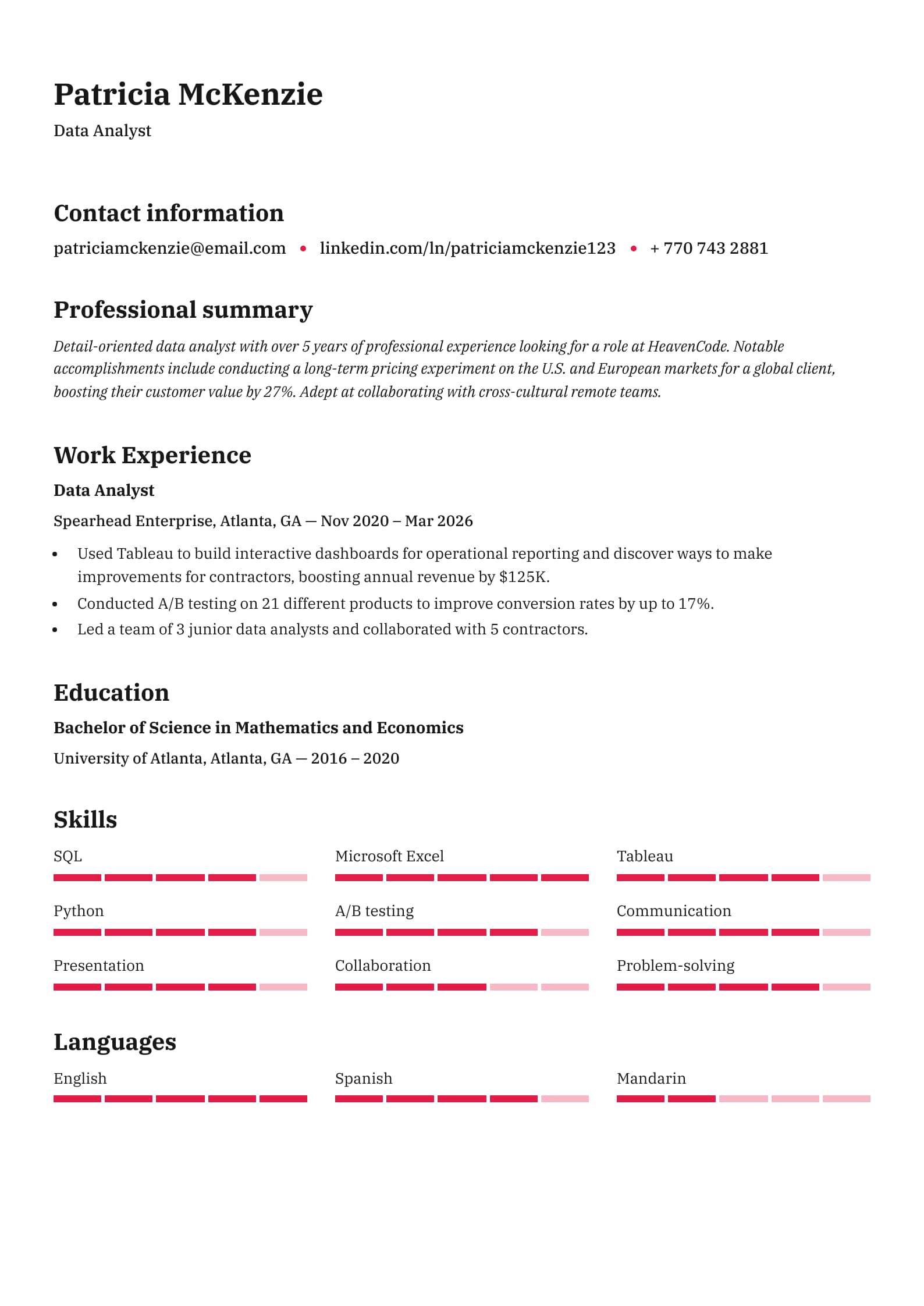
Visa Sponsorship Resume Example
Finally, here’s a resume example for visa sponsorship that immediately highlights sought-after qualifications:
Why You Can’t Use the Same Resume in Every Country
You can’t use the same resume in every country because the hiring practices vary significantly between regions. Different countries have different employment and labor laws, cultural norms, and workplace traditions, all of which are reflected in resume writing, as well.
For example, anti-discrimination laws in the United States forbid adding a photo to your resume or including sensitive personal information (e.g., your race, gender, political and religious affiliations, etc.). Including any of these details will likely force the employer to discard your resume outright.
On the other hand, in some Asian countries, adding your photo, nationality, or date of birth isn’t just encouraged, but it can also be mandatory.
As a result, if you use a U.S.-compliant resume in one of these countries, even if it’s a well-written and professional document, it will likely yield poor results. That’s why it’s critical to localize the document, both in format and content. In addition to ensuring compliance, this will also demonstrate cultural awareness and attention to detail.
International Resume Formats Around the World
Before we dive into the writing guide, here’s a quick overview of international resume formats around the world:
Region | Typical Resume Length | Photo Required | Key Characteristics |
|---|---|---|---|
United State & Canada | 1 page (2 max) | No | Achievement-focused, concise |
United Kingdom | 1–2 pages | No | CV term used, British spelling |
Western Europe | 1–2 pages | Sometimes | Europass CV common |
Australia & New Zealand | 2–3 pages | Rare | More narrative work history |
Middle East | 2–3 pages | Often required | Personal details included |
Asia | 1–2 pages | Often required | Formal structure and personal data |
United States & Canada
In the United States and Canada, a one-page chronological resume format is the standard. While there are also functional and combination formats, and resumes can be two pages in rare cases, most of them are concise and focused on exceptional achievements.
Due to rigorous anti-discrimination laws, resumes in the U.S. and Canada mustn’t contain a photo (even if you’re submitting a model resume) or any sensitive personal information.
Standard resume sections include:
Contact information
Resume objective or summary
Work experience
Education
Skills
UK
In the UK, a resume is referred to as a “CV,” but it is almost identical to a United States resume. This international CV is not to be confused with a CV in the U.S., which is used when applying for academic roles.
The United Kingdom CV should also be one or two pages long, with a focus on professional experience, quantified results, and skills. Similar anti-discrimination laws also dictate that you shouldn’t use a photo or include sensitive information.
One key thing to do is to use British English spelling (e.g., “organise” instead of “organize”); it may seem like a minor detail, but it’s essential, and it shows attention to detail.
New Zealand & Australia
New Zealand and Australia use the terms “resume” and “CV” interchangeably. Unlike in North America and the UK, recruiters in this region prefer more detailed documents.
These resumes are often two to three pages long, going up to five pages for more specialized or senior job positions.
While there are also anti-discriminatory laws, candidates are expected to provide more information about their professional careers. That makes New Zealand and Australian resumes narrative-driven, extending the information they provide beyond just results and KPIs.
Western Europe
In Western Europe, some job seekers typically use a Europass CV format, particularly when applying for EU institutions or cross-border roles. While this format isn’t always mandatory, it’s one of the most recognized and a top choice for most job seekers. It follows the reverse-chronological order, emphasizing work experience followed by education and skills.
Depending on where in Europe you’re looking for a job, your international resume may contain a professional headshot, date of birth, or nationality. However, some companies (especially tech-oriented) are moving away from these practices and are becoming more privacy-oriented.
Eastern Europe
Resume writing conventions in Eastern Europe are slowly transforming to align with those of Western Europe. Some countries and employers still have a traditional approach, requiring longer CVs with professional photographs and dates of birth, while others are progressing toward one-to-two-page Western resumes.
Also, education is often highly valued in Eastern Europe, especially among entry-level candidates. Professionals often list their entire academic history, including a high school diploma, certifications, and other degrees.
Asia
Expectations for a resume in Asia vary significantly between countries due to the size of the continent and the different cultures present. In many countries, candidates are expected to include sufficient personal information in their resumes.
The language typically needs to be formal, and there’s respect for the structure and hierarchy present with different job titles. Apart from that, there can be country-specific requirements (e.g., Japan uses a very specific format called Rirekisho).
Middle East
International resumes for the Middle East (e.g., when applying for a job in the UAE or Saudi Arabia) typically require a blend of regional expectations and international corporate standards.
A Middle Eastern resume is also referred to as a CV. It’s standard practice for it to be two to three pages long and to contain a professional headshot, usually in professional business attire. Personal details may also be mandatory, including nationality, date of birth, gender, marital status, and visa or work residency status.
How to Write an International Resume (Step-by-Step)

To write an international resume, you need to use the information about your career and qualifications and align it with the specific requirements of the country in which you’re applying.
The good news is that there is some overlap in which sections to include and what information they should contain. This means you don’t have to know every resume format by country or start the document from scratch each time, but only adjust what’s necessary.
#1. Choose the Right Resume Format
The first step in writing a resume for an international job is to choose the correct format. For the vast majority of corporate roles worldwide, the chronological resume format is the standard, regardless of the region. It gives recruiters a clear insight into your work history and career progress, helping them assess your experience level and expertise.
If you’re a recent graduate or an entry-level professional, you can check out some of our functional resume templates, but make sure that the format is accepted in the country where you’re applying.
Alternatively, candidates with plenty of experience but irregular work history (e.g., due to gaps in employment or freelancing) can go with the combination format.
#2. Add Appropriate Contact Information
Contact information is a standard section that goes in the resume header, regardless of the region in which you’re applying. However, the contents of this section will depend on the country, its privacy laws, and job market expectations.
You should always include:
Your full name
Professional email address
Phone number
LinkedIn profile (if you have one)
Here’s a good example:
Contact Information Example
Patricia McKenzie
Data Analyst
+ 770 743 2881
patriciamckenzie@email.com
linkedin.com/ln/patriciamckenzie123
Depending on the country in which you’re applying for a job, you may also need to include details like:
Professional headshot
Date of birth
Mailing address
Marital status
Remember that adding some of this information may also be a bad practice in some states, so you should always check local rules.
As a final tip, don’t forget to add your phone number in an international format, using a specific country code. A local phone number won’t work in an international resume.
#3. Write a Global Resume Summary
A resume summary sits at the top of the document, right after your contact information, and it serves as your global elevator pitch.
This section should be concise (usually 2–4 sentences), highlighting what position you’re applying for and emphasizing your most prominent qualifications or accomplishments.
Here’s a good example:
Summary Example
“Detail-oriented data analyst with over 5 years of professional experience looking for a role at HeavenCode. Notable accomplishments include conducting a long-term pricing experiment on the U.S. and European markets for a global client, boosting their customer value by 27%. Adept at collaborating with cross-cultural remote teams.”
For contrast, here’s an example of a bad resume summary that lacks any meaningful information about the candidate:
Bad Example
“Experienced data analyst looking to work for your global brand.”
Pro tip: Avoid using slang or idioms specific to your country in your global resume, as they can confuse recruiters and employers from foreign countries.
#4. Highlight Your Work Experience
Work experience is the focal point of any international resume, as it directly showcases your career and skill levels.
A standard way to highlight your work experience is by listing your previous jobs in the reverse-chronological order. For every entry, you want to include the following information:
Job title
Company name and location
Employment duration
Bullet list with notable achievement
The emphasis should be on quantifiable results over everyday tasks. Use numbers to add measurable value to your efforts and action verbs to make them stand out.
Let’s see that in a good example:
Work Experience Example
Work Experience
Data Analyst Spearhead Enterprise Atlanta, GA
November 2020–March 2026
Used Tableau to build interactive dashboards for operational reporting and discover ways to make improvements for contractors, boosting annual revenue by $125K.
Conducted A/B testing on 21 different products to improve conversion rates by up to 17%.
Led a team of 3 junior data analysts and collaborated with 5 contractors.
For comparison, here’s a bad example that shows how not to list your achievements:
Bad Example
Used Tableau for operational reporting.
Performed A/B testing.
Led teams.
#5. Include Education Section
The education section adds credibility to your knowledge and competence, which is particularly important for recent graduates and entry-level candidates.
The requirements for this section can vary a lot between regions, but so do the education systems. That’s why it’s recommended to use the writing language that’s universally understood, without locally specific terminology. It’s often recommended to use international equivalents to your degree (e.g., Bachelor’s or Master’s degrees).
At a minimum, you should include your highest degree, the name of the institution that issued it, and the years of attendance. Here’s a good example:
Education Example
Education
Bachelor of Science in Mathematics and Economics University of Atlanta, Atlanta, GA 2016-2020
Depending on your circumstances and where you’re submitting your international resume, you may also include other degrees in the reverse-chronological order. Plus, you can include a list of academic accomplishments to add more weight to this section.
#6. Showcase Your Skills

When showcasing your skills, it’s important to have a dedicated skills section that neatly lists your most prominent abilities. By reading the job ad and researching the company, you’ll know which skills recruiters want to see.
Once you know which skills to add to your international resume, you want to list hard skills and soft skills separately.
Following that, it’s also important to include language skills, as they are essential for a global resume. Make sure to use a standardized framework (e.g., the CEFR levels in Europe) or clear terms, like “Native,” “Fluent,” and “Conversational.”
Here’s a good example of a skills section:
Skills Section Example
Hard Skills
SQL
Microsoft Excel
Tableau
Python
A/B testing
Soft Skills
Communication
Presentation
Collaboration
Problem-solving
Language Skills
English (Native)
Spanish (Fluent)
Mandarin (Conversational)
#7. Think About Optional Sections
Optional sections can help your international resume stand out by strengthening your case, but only when the information they provide is relevant to the role you’re after. They should only be included after you’ve added all the mandatory information.
Some optional sections to consider are:
Awards and recognitions
Personal projects
How to Write an International Cover Letter
To write an effective international cover letter, you want to show your why in addition to demonstrating relevant qualifications. This means you should emphasize your drive, motivation, and reasons for applying at that company in particular.
While a cover letter is typically less formal in nature than a resume, it should still be succinct and professional. A typical length is 3–5 paragraphs, but you should look up the local writing etiquette. For instance, employers in Germany may expect a traditional and formal tone, while finding a job in Canada requires a direct and concise approach.
Use the cover letter to connect your past experiences to the needs of your future employer. Highlight any work that required you to adapt to new environments and conduct cross-cultural collaboration and communication, but don’t repeat the information already stated in your resume.
5 Common International Resume Mistakes to Avoid
Here are some of the biggest and most common mistakes professionals make when writing and submitting their international resume:
Using the wrong paper size. The standard resume paper size in North America is the U.S. Letter (8.5 x 11 inches), while almost the entire rest of the world uses A4 (8.27 x 11.69 inches).
Ignoring local laws regarding a photo. Adding a photo to your resume in a country with strict anti-discrimination laws may result in automatic rejection. Not adding it in a country where it’s required shows a lack of appreciation for cultural norms.
Not localizing spelling. Countries like England, Australia, and New Zealand use British English spelling. Ensuring that your resume has accurate spelling shows attention to detail.
Not mentioning your visa status. International employers need to know if you require visa sponsorship, as it involves additional effort on their end.
Neglecting applicant tracking systems. Many companies worldwide use applicant tracking systems, making your international resume’s ATS score important in helping it pass software screening.
Create an International Resume with Resume.co
At Resume.co, we developed a feature-packed resume builder that can help you adapt your current resume for a global market or create one from scratch. Numerous intuitive customization features and an AI-powered writing assistant will help you create a compliant ATS resume for any country where you plan on applying.
Need an international resume for a job overseas?
Create my resumeClosing Thoughts
You need an international resume to apply for jobs overseas. The good news is that it’s easy to create one once you familiarize yourself with local rules and expectations. It’s even easier if you already have a resume, as you can adapt it by adding relevant information or rewriting certain parts.
If you need help and want to automate the process, don’t forget to give our resume builder a go. You can use it to design your document from scratch or to adapt the existing resume into as many variations as you need.
International Resume FAQs
#1. How long should an international resume be?
How long an international resume should be depends entirely on the region. Job seekers in the U.S. and Canada typically stick to one page (two at most). On the other hand, 2–3 page resumes are a standard in Australia and New Zealand. Always research your target country’s expectations.
#2. Should I include a photo on an international resume?
Whether you should include a photo on an international resume depends on the country and its anti-discrimination laws. For instance, North America, the UK, and many countries in Western Europe have strict laws against it. Conversely, a photo may be mandatory in some Asian and Middle Eastern countries.
#3. Can I use the same resume worldwide?
No, you can’t use the same resume worldwide. Different countries have vastly different expectations when it comes to resumes, as well as different resume-writing rules and anti-discrimination laws. A professional resume that works well in one country may be immediately discarded in another for various reasons.