
An Australian resume is in many ways similar to an American resume, as it represents a brief overview of a candidate’s career and qualifications submitted when looking for employment. However, there are several subtle differences between these two that may render an Australian resume ineffective in the U.S., and vice versa.
In this article, we’ll explore those differences before providing a detailed guide on how to write and format an Australian resume specifically. We’ll also give you some expert resume tips on improving the document, highlight the mistakes you need to avoid, and touch on the importance of cover letters.
Key Takeaways
An Australian resume is typically longer than an American one, with more details, information about job responsibilities, and references.
After your contact details, you should write a career profile section to summarize the key points of your resume in 3–5 bullet points.
When adding work history, make sure to include both responsibilities and quantified results, and to use action verbs and power words to make them more prominent.
There are many optional sections you can add to your Australian resume, including references, volunteer experience, certifications, licenses, and hobbies.
If you’re used to writing American resumes, don’t make the mistake of creating your Australian resume too short, of using a Letter paper size instead of A4, or of using U.S. spelling instead of Australian.
Professional Australian Resume Example
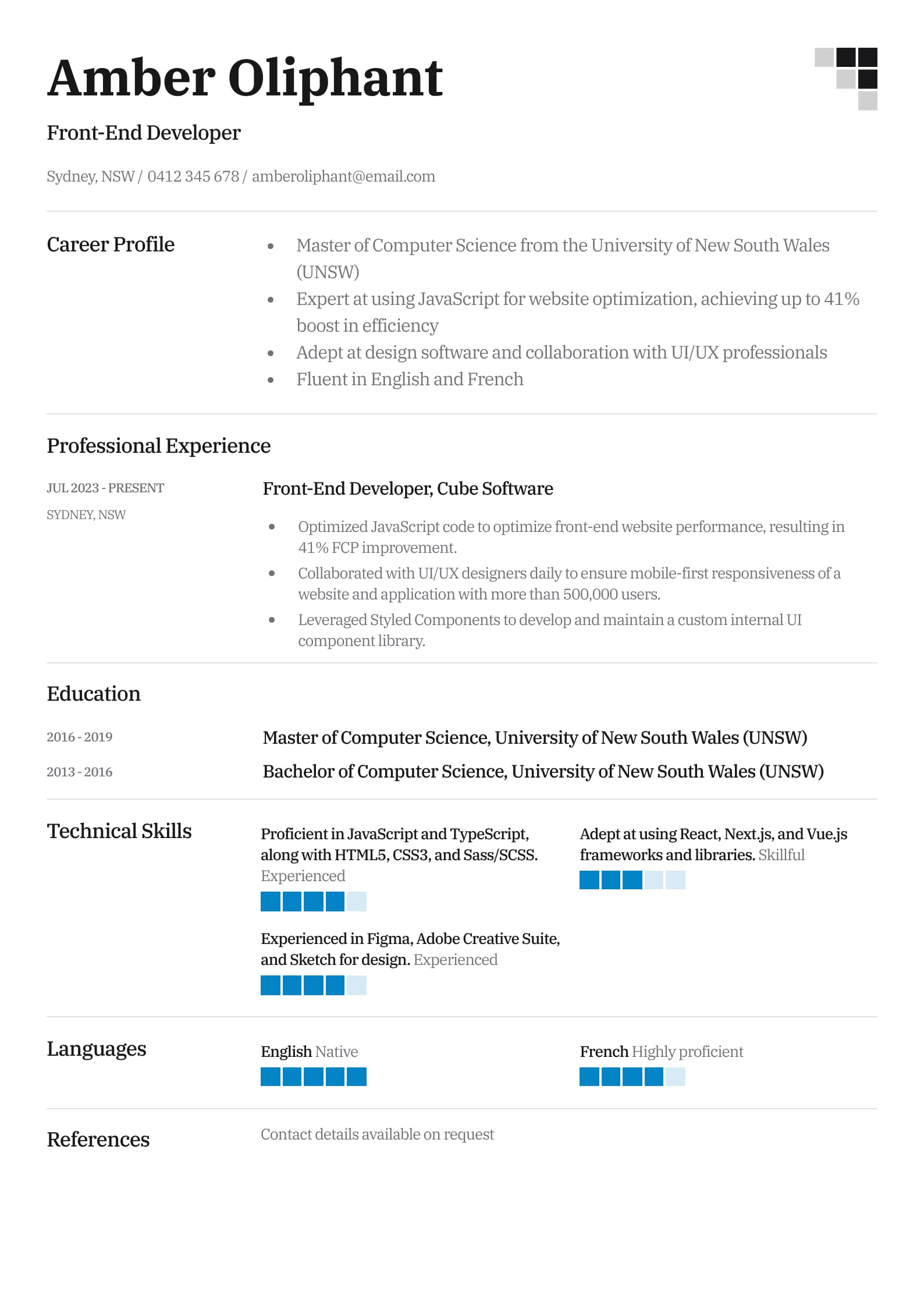
Before we continue with the guide, we’ve prepared a complete Australian resume example that you can use for reference and to better understand what the final document should look like:
Keep reading to find out how to create a detailed and professional resume like this one.
Australian vs. American Resume
Most differences between Australian and American resumes lie in length and content.
For starters, a resume in Australia is also called a CV (curriculum vitae). This is not the same as a CV in the U.S., which is significantly different from a resume and is used when applying for academic positions.
Resumes (or CVs) in Australia are often longer and more detailed than those in the U.S. American ones are typically one page long, and rarely extend to two pages for senior professionals with years of experience.
Australian resumes also focus on both job responsibilities and accomplishments, have a narrative approach, and provide a degree of personal and contextual information. On the other hand, American resumes emphasize quantified results over responsibilities. They are concise and optimized with keywords to be scannable by applicant tracking systems (ATS).
The table below outlines the biggest differences between Australian and American resumes:
Aspect | Australian Resume | American Resume |
|---|---|---|
Terminology | “Resume” and “CV” are used interchangeably | “Resume” is for standard jobs; “CV” is for academic roles |
Length | Usually 2–3 pages | Typically 1 page (sometimes 2) |
Focus | Responsibilities and accomplishments | Primarily accomplishments |
Paper Size | A4 | U.S. Letter |
References | Often included in a list or implied by stating “Provided upon request” | Usually omitted |
Summary | Longer “Career Profile” | Brief “Objective” or “Summary” |
What Format to Use for an Australian Resume
The format you should use for an Australian resume depends on the quality and quantity of your work experience.
The most commonly used resume format in Australia is the chronological one. It provides an established structure for your resume, showcasing your latest efforts and experiences before moving backward through your career. This gives recruiters a clear insight into your current skill level and your recent growth.
If you’ve been changing careers or have one or more employment gaps, you can opt for a combination (hybrid) format. This format puts your skills in the spotlight before backing up each one with a list of relevant accomplishments arranged in reverse-chronological order.
Ultimately, unless employment gaps are significant or there are specific reasons for deviating from the gold standard, you should stick to the chronological format. It’s favored by recruiters and compatible with ATS, ensuring your resume both catches a human eye and passes software screening.
How to Write an Australian Resume
Now that we’ve learned about the basics of formatting and the differences compared to American resumes, let’s go through a step-by-step guide on how to write an Australian resume.
#1. Create a Compelling Resume Header
A resume header is for your contact information. Start with your name as the heading (don’t title the document “Resume” or “CV”) and list additional information about you, such as:
Header Details
Job title
Professional email address
Phone number
Address
LinkedIn profile
You shouldn’t include sensitive personal information, such as your date of birth, gender, marital status, or even a photo. Due to the Fair Work Act of 2009, these terms are considered discriminatory, and employers may discard your resume to avoid getting into legal issues, regardless of your qualifications.
Here’s an example of a well-written resume header:
Header Example
Amber Oliphant
Front-End Developer
Sydney, NSW
0412 345 678
amberoliphant@email.com
linkedin.com/ln/amberoliphant
#2. Write Your Career Profile

A career profile represents a summary of your resume, and it should go at the top of the document. It’s similar to a resume objective or summary of an American resume, but it’s often a bit longer.
A common way to write a career profile is to include 3–5 bullet points with key details about your skills and experience. It’s recommended to write this section last, since that allows you to easily summarize your resume.
Let’s see an example of a career profile section:
Career Profile Section Example
Master of Computer Science from the University of New South Wales (UNSW)
Expert at using JavaScript for website optimization, achieving up to 41% boost in efficiency
Adept at design software and collaboration with UI/UX professionals
Fluent in English and French
#3. Add Your Work Experience
Work experience is the core section of an Australian resume as it directly demonstrates your expertise. To write it, include your previous jobs in reverse-chronological order, and for each one, list the following:
Your job title
Company name
Dates of employment
List of responsibilities and accomplishments
When adding a list of responsibilities and accomplishments, make sure that they are related to the role for which you are applying. Your most recent job should have the most bullet points, as it is the most relevant.
While Australian resumes also highlight responsibilities in addition to achievements, you should still strive to include as many notable results as possible. To make those results pop, quantify them with numbers and make them more prominent with action verbs.
Here’s an example:
Work Experience Example
Professional Experience
Front-End Developer Cube Software Sydney, NSW
July 2023–Current
Optimized JavaScript code to optimize front-end website performance, resulting in 41% FCP improvement.
Collaborated with UI/UX designers daily to ensure mobile-first responsiveness of a website and application with more than 500,000 users.
Leveraged Styled Components to develop and maintain a custom internal UI component library.
#4. Include Your Education Level
The education section of your Australian resume should include relevant qualifications in a chronological order, starting with the most recent. At a minimum, you should include:
Degree
Name of the academic institution
Years of attendance (or expected completion, if you’re still studying).
Let’s see that in an example:
Education Section Example
Education
Master of Computer Science University of New South Wales (UNSW) 2016–2019
Bachelor of Computer Science University of New South Wales (UNSW) 2013–2016
If you lack professional experience, you can include a bullet list with notable academic results and accomplishments (e.g., relevant coursework, extracurricular activities, a high GPA, etc.).
#5. Highlight Key Skills
Highlighting key skills is all about including your abilities that are essential for the job you’re after. This is a short section that primarily consists of technical abilities. Apart from that, you can include language skills and a few soft skills.
It’s important to carefully read the job ad and to research the company to ensure that you’re adding the correct in-demand skills to this section. Once you determine what recruiters are looking for, you can list your resume skills as bullet points while providing brief descriptions for additional context.
Here’s an example:
Skills Section
Technical Skills
Proficient in JavaScript and TypeScript, along with HTML5, CSS3, and Sass/SCSS.
Adept at using React, Next.js, and Vue.js frameworks and libraries.
Experienced in Figma, Adobe Creative Suite, and Sketch for design.
Language Skills
English—Native
French—Fluent
#6. What Other Sections Should You Include?
While the previously mentioned sections represent the core of your Australian resume, there are many other optional sections you can include. Some of them are:
References. References are often included in an Australian resume. You can either list referees or put “Referees available upon request.”
Certifications and licenses. Depending on your profession and skill level, certifications and licenses may boost your chances with recruiters or be legally required in the first place.
Volunteer experience. Employers will value your involvement in the community and likely consider you a good cultural fit.
Additional experience. Due to the longer nature of an Australian resume, you can include additional previous jobs, even if they aren’t entirely related to the one you’re applying for.
Hobbies and interests. A brief line about things and activities you’re genuinely passionate about can humanize your resume.
Formatting Tips for Australian Resumes

Here are some expert tips for Australian resumes to help you perfect the structure and visual appeal of the document:
Use A4 page size. Australia uses the ISO 216 paper size standard, which means your resume needs to be in A4 paper size. If you use U.S. Letter size when creating your document, you can run into issues when printing it in Australia, as margins can be awkward, and some of the content can be cut off.
Choose a professional font. Good resume fonts are clean and easy to read. These are typically sans-serif typefaces, like Arial, Calibri, or Helvetica, set at 10–12 pt. You should avoid overly stylized and script fonts. They are difficult to read and will make your resume look unprofessional.
Be mindful of white space. Margins should be around 1 inch or 2.5 cm on all sides to ensure consistency and give your document an elegant look. Additionally, you should keep the spaces between sections uniform to maximize your document’s readability.
Keep the design minimal. The majority (if not all) of your resume’s content should be text. You should avoid using tables, multiple columns, or intricate graphical elements. They can draw attention away from your skills and qualifications. Plus, this can make your resume incompatible with ATS.
Save as PDF. The final document you save and send to recruiters should always be in PDF, unless the job ad specifies otherwise. PDF is a standard file format that ensures your document can be viewed on any device while maintaining its structure and appearance.
5 Mistakes to Avoid When Creating an Australian Resume
Here are five common mistakes you can make when creating an Australian resume, especially if you’re used to crafting resumes in other countries and continents (e.g., the U.S. or Europe):
Using U.S. spelling. Simple mistakes, like writing “color” instead of “colour” or “center” instead of “centre”, will show a lack of care for your application. For example, the Australian government suggests that its organizations use either the Australian Concise Oxford Dictionary (ACOD) or the Macquarie Dictionary for spelling.
Adding a photo. Adding a photo to your resume may be common in some parts of Europe or Asia, but it’s highly discouraged in Australian job applications. Due to anti-bias laws and regulations, employers may be inclined to ignore your resume to avoid legal issues due to potentially discriminatory practices.
Keeping it too concise. While a resume is supposed to be a brief overview of your professional career, in Australia, many resumes are at least two pages long. While one page is standard in the U.S., this will likely be seen as too short in Australia, as recruiters will want to see more information about you.
Writing a generic profile. Generic profiles (e.g., “Professional seeking a challenging role”) tell recruiters nothing about your qualifications. Instead, you want to write several highly impactful lines that present your key strengths. The goal is to grab the reader’s attention and convince them to carefully analyze the entire resume.
Focusing on duties too much. The longer nature of Australian resumes allows for a more in-depth description of your past employment. Still, recruiters and employers are interested in the results you have achieved and the impact you had in your previous roles.
Are Cover Letters Mandatory in Australia?
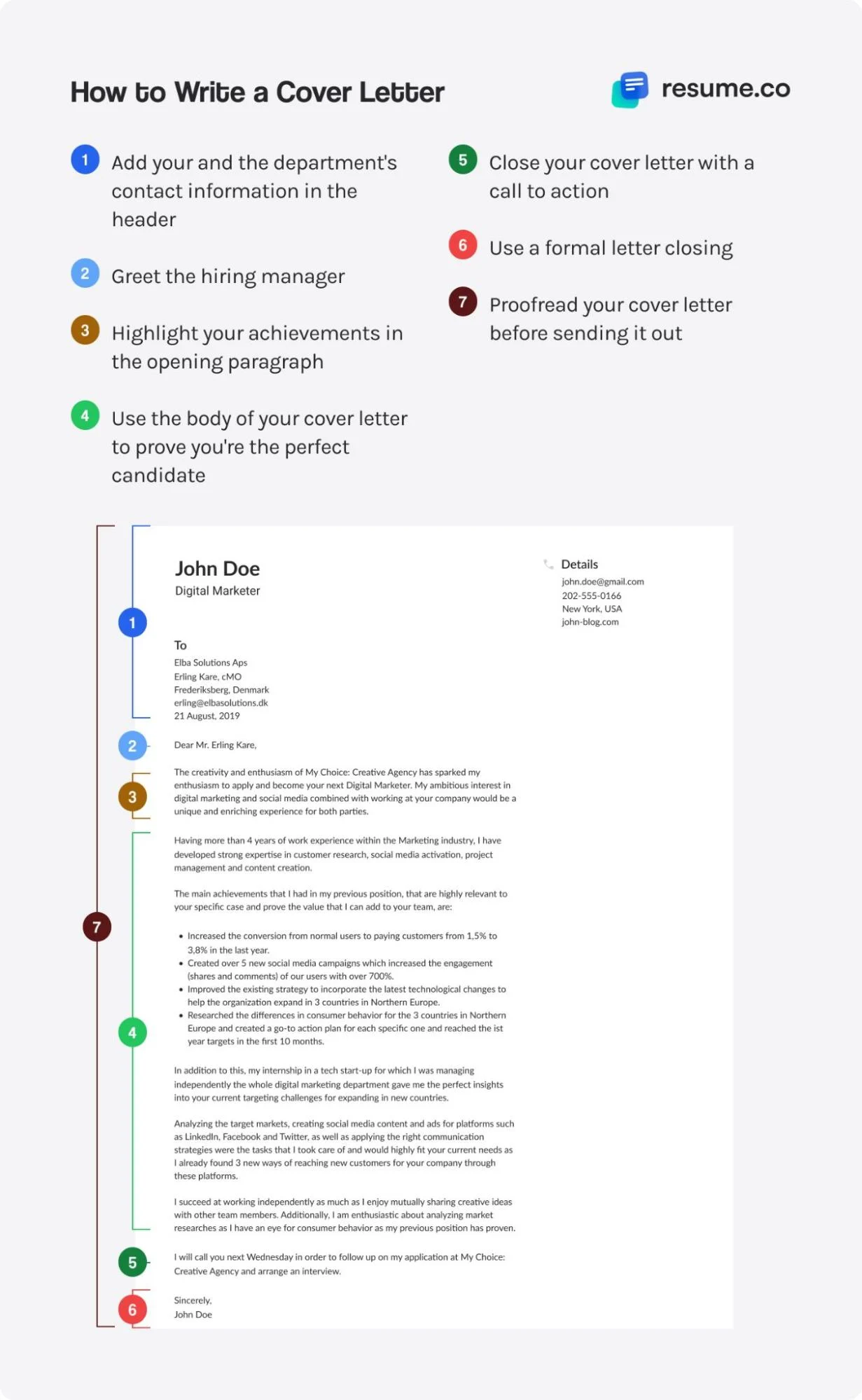
Cover letters aren’t mandatory in Australia, but it is highly recommended to write and submit them alongside your resume. A mere act of writing and sending a cover letter shows your dedication and willingness to go the extra mile.
More than that, a cover letter gives you space to talk about your motivation, qualifications that you didn’t include in your resume, and your reasons for applying. All of this can impress recruiters further and improve your chances of receiving a call back.
Keep in mind that a cover letter should match and complement your resume, both in design and content. It should also be short and to the point, typically between 250 and 400 words.
Effortlessly Craft an Australian Resume With Resume.co
If you want to create an Australian resume in minutes, even if you’ve never done it before, you can use our resume builder. We developed a feature-packed software solution that’s easy to use while always providing exceptional results. The software comes with ready-made resume templates you can adjust to your liking.
Even if you don’t pick an Australian resume template, you can customize the one you choose to add the sections you want, modify existing ones, and rearrange their order. Our AI assistant will polish your writing to ensure it’s aligned with your industry and packed with relevant keywords and action verbs.
Want a job-ready Australian resume in minutes?
Create one easily with our resume builder.Closing Thoughts
As you can see, an Australian resume shares many similarities with the American one, but there are some differences, and it’s essential to be aware of them. Once you understand these discrepancies, you’ll know how to write a detailed Australian resume that leverages the benefits of the concise U.S. style.
Don’t forget to check our website for additional guides on resume and cover letter writing, and on interview questions and strategies. Lastly, give our resume builder a go, as it can help you design outstanding documents in minutes!
Australian Resume FAQ
#1. Do I need to include references?
While you don’t always have to include a full list of references in your Australian resume, you should at least include the “References” section stating “References available upon request.” Employers in Australia often check references before making decisions.
#2. Can I use my U.S. resume in Australia?
You can use your U.S. resume in Australia, but it likely won’t yield the best results. Australian resumes are often longer than American ones and convey information about a candidate in a narrative manner. Localizing your resume shows attention to detail and helps you improve the outcome.
#3. What is the Australian resume format?
The most common Australian resume format is chronological, just like with American resumes. It helps you highlight your professional history and career progress by listing your past jobs and responsibilities in reverse-chronological order.