
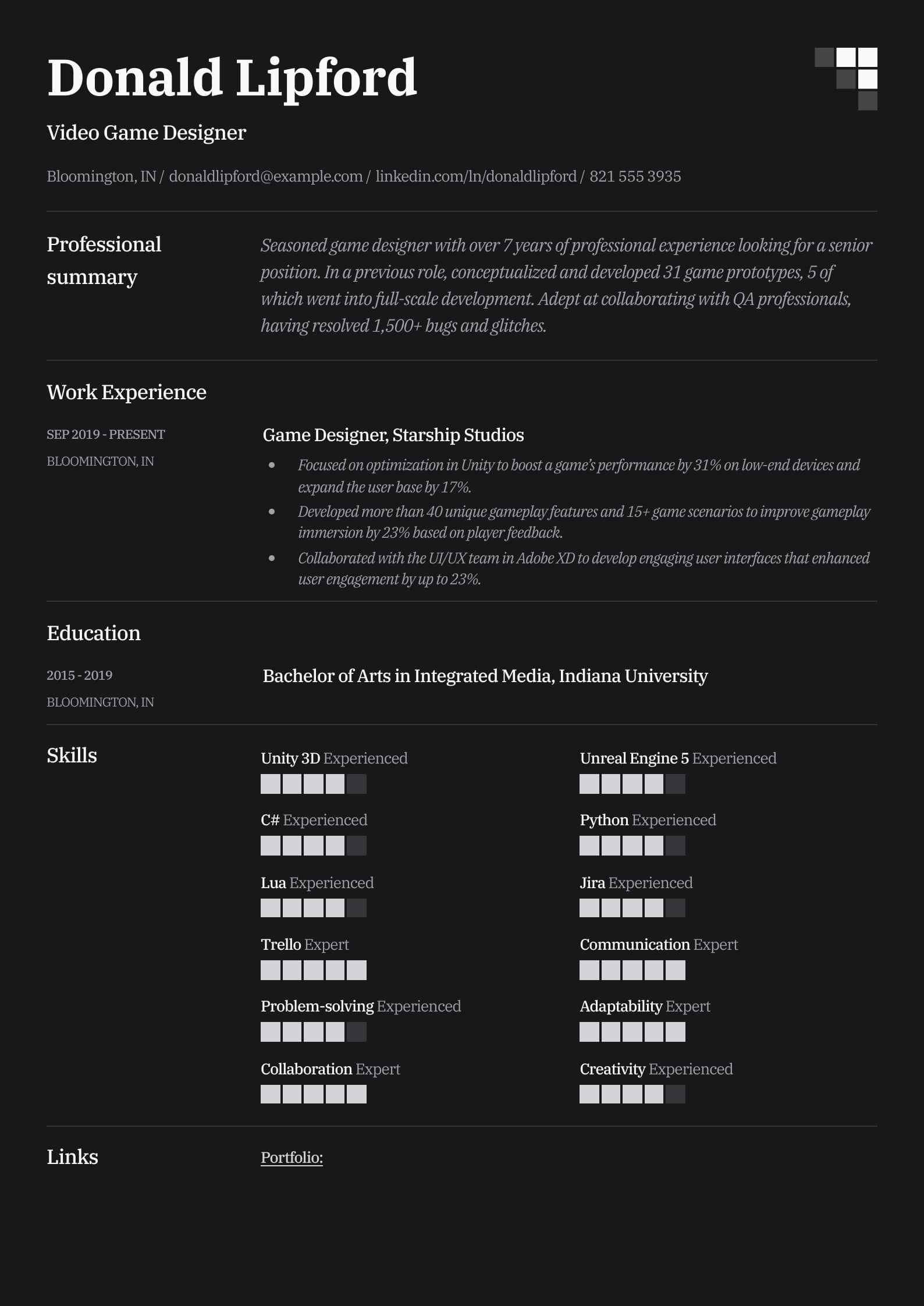
A well-written game designer resume is one of the most important weapons in your arsenal, helping demonstrate your qualifications to recruiters, impressing them with a single page of information, and securing a job interview.
The video game industry is notoriously competitive, making it challenging to get a job and often requiring every tool in a job seeker’s arsenal to be used. This article is a detailed guide on how to write a professional and attention-grabbing resume as a game designer, with complete resume examples and expert tips that will help you get ahead of the competition.
Key Takeaways
The best resume format for most game designers is the chronological one, with functional and hybrid formats being useful on specific occasions.
Your game designer resume should be one page long and have all the mandatory sections; only include optional sections if you have some space left.
Make sure to add a link to your portfolio in your contact information or a dedicated section; don’t forget to turn it into a hyperlink in the digital copy.
When talking about your past achievements in previous roles, quantify each one with numbers and percentages to add measurable value and make them concrete.
Superb Game Designer Resume Example
First and foremost, let’s show you a complete example of a game designer resume to show you what a complete document should look like:
Keep reading to learn how to write a resume just like this one!
How to Format Your Game Designer Resume
There are three established resume formats that effectively convey the details of your document to recruiters. These formats are:
Chronological resume format. This is, by far, the most used resume format in the job market. It presents your past jobs and accomplishments in reverse-chronological order, giving the reader an orderly insight into your career progress and current skill level. The chronological format is favored by most recruiters and is compatible with ATS software.
Functional resume format. The functional game designer resume format focuses on skills over experience. It’s a solid choice for entry-level professionals who haven’t had a job yet and haven’t participated in any notable projects that they could add to a resume. Keep in mind that this format might not be compatible with ATS.
Combination resume format. Also referred to as the hybrid resume format, this one combines the aspects of the chronological and functional formats to emphasize skills and validate them with lists of relevant accomplishments. This makes it good for experienced game designers who have gaps in their employment.
Game Designer Resume Layout
Think of your game designer resume layout as the document’s user interface. It needs to make your document visually appealing and easy to read.
Here are some tips to help you achieve that:
Your resume should be one page long with a focus on quality over quantity.
Choose a professional and legible font for your resume (e.g., Arial, Calibri, Helvetica).
Font size should be 10–12 pt for regular text and 14–16 pt for section headings.
Margins should be uniform on all sides and at least 1 inch.
Line spacing should be 1.0 or 1.15.
5 Mandatory Sections Every Game Designer Resume Should Have

There are five mandatory sections that every game designer resume should have, and they are:
Mandatory Details
Contact information
Resume objective/summary
Professional experience
Education
Skills
However, you can include additional information in your resume in the form of optional sections. These can help your application, provided they are relevant to the role you’re after and you have enough room in your resume. Some optional sections to consider include:
Optional Sections
Portfolio
Personal projects
Volunteer work
Languages
Hobbies and interests
If keeping track of all these resume sections and rules regarding the format and layout ever becomes overwhelming, you can delegate them to our resume builder. We developed a plug-and-play software solution that you can use to create a job-winning game designer resume from scratch and in minutes!
Our custom-made AI will give you suggestions based on your inputs to help you create a professional resume in no time. And if you already have one, you can upload it, and our tool will perfect your document.
Game Designer Resume Template
If you use our resume builder, you’ll get to choose one of the many tech resume templates as your starting point. Here is one as an example:
Template
Name and Surname
Phone number: 000-000-0000 | Email: namesurname@gmail.com | Location: City, State
[Adjective] [your job title] with [years of experience, if applicable] in [your area of expertise, if applicable] looking for a [position] job at [company name]. Eager to apply [relevant skills] gained through [work/volunteer/other experience] to help [company name] [mention what you can do for the company].
Work Experience
Most Recent/Current Job Title Company City, State [Start date] — [End date]
For recent jobs, use 5-6 bullet points to list your top achievements and responsibilities
Use action verbs to make your responsibilities and achievements stand out
Add numbers to quantify your achievements
Previous Job Title Company City, State [Start date] — [End date]
For recent jobs, use 5-6 bullet points to list your top achievements and responsibilities
Use action verbs to make your responsibilities and achievements stand out
Add numbers to quantify your achievements
Oldest Job Title Company City, State [Start date] — [End date]
For older jobs, use 2-3 bullet points to list your top achievements and responsibilities
Use action verbs to make your responsibilities and achievements stand out
Add numbers to quantify your achievements
Education
[Degree] in [Major] [University/college name] [Start date] - [Graduation date]
Skills
Soft Skills
Skill #1
Skill #2
Skill #3
Skill #4
Skill #5
Hard Skills
Skill #1
Skill #2
Skill #3
Skill #4
Skill #5
Additional Sections
Add any relevant additional sections (languages, licenses, publications, hobbies, etc.)
Game Designer Resume Contact Information
Contact information is a standard section for any resume that goes in the header.
At a minimum, it should contain the following details about you:
Name
Professional title
Phone number
Email address
You can also include:
Location (but only city and state)
LinkedIn page
Relevant social media profiles
Personal website or portfolio link
Lastly, you need to avoid adding this to your gamer designer resume contact information:
Resume photo
Unprofessional email address
Irrelevant social media pages
Here’s an example of what a good contact information section looks like:
Contact Information Section Example
Donald Lipford
Video Game Designer 821 555 3935 donaldlipford@example.com Bloomington, IN linkedin.com/ln/donaldlipford donaldportfolio.com
Resume Objective For a Game Designer
A game designer resume objective is a brief introductory paragraph written by junior professionals who want to emphasize their skills and career goals. Think of it as a short description of your game designer resume meant to highlight your key strengths from the start and persuade recruiters to pay closer attention.
Here’s a good example of a resume objective:
Resume Objective Example
“A recent graduate with a bachelor’s degree in integrated media, looking for an entry-level game design position at your company. Proficient in Unreal Engine, Python, Maya, and Adobe Creative Suite. Eager to leverage freelance graphic design experience to contribute to your team on the road to becoming a creative director.”
For comparison, here’s a bad example of a resume objective that focuses on the candidate’s needs and doesn’t point out any of their qualities:
Bad Example
“Entry-level game designer looking for a first job. No experience, but I learn quickly.”
If you have several years of experience in game design, you should write a resume summary instead. This section is similar to the resume objective, except that it should emphasize one or two of your most notable accomplishments in the field.
Let’s see that in a good example:
Resume Summary Example
Seasoned game designer with over 7 years of professional experience looking for a senior position. In a previous role, conceptualized and developed 31 game prototypes, 5 of which went into full-scale development. Adept at collaborating with QA professionals, having resolved 1,500+ bugs and glitches.
How to Add Professional Experience as a Game Designer

Adding professional experience to your game designer resume is all about emphasizing your biggest and most prominent accomplishments. You want to show the impact that your work has had and how it helped your previous employers reach their goals.
That’s why you want to focus on quantifiable results over everyday tasks and responsibilities. If you had multiple jobs relevant to the position that you’re applying for, you should list them in reverse-chronological order. For each one, you should do the following:
Include 3–5 bullet points with your greatest achievements.
Use numbers and statistics to quantify the results, adding measurable value and making them more impactful.
Incorporate action verbs and power words in your writing to make it memorable and attention-grabbing.
Let’s put all that into practice to see an example of a work history section for an experienced game designer:
Work History Section For An Experienced Game Designer
Work Experience
Game Designer Starship Studios Bloomington, IN
September 2019–Current
Focused on optimization in Unity to boost a game’s performance by 31% on low-end devices and expand the user base by 17%.
Developed more than 40 unique gameplay features and 15+ game scenarios to improve gameplay immersion by 23% based on player feedback.
Collaborated with the UI/UX team in Adobe XD to develop engaging user interfaces that enhanced user engagement by up to 23%.
Here’s another example of the work experience section, this time from a game designer resume for a fresher:
Project & Internship Work History for Freshers
Work Experience
Game Design Intern Triangle Games Austin, TX
February 2025–January 2026
Assisted senior designers in game optimization using Maya, reducing file size by 35 mb.
Playtested 7 games to provide detailed feedback to the development team.
Modified 17 game assets in Blender to modify the overall color scheme and improve player satisfaction by 7%, as noted in the survey report.
Game Designer Education Section
The purpose of your game designer resume education section is to provide your academic background and corroborate your skills. In general, this section should be brief, and you should only include your highest degree.
Here are the details to add:
Your degree
The institution that issued it
Years of attendance
Let’s see that in an example:
Education Section Example
Education
Bachelor of Arts in Integrated Media Indiana University, Bloomington, IN 2015-2019
If you’re a recent graduate or have little to no work experience, you can add more information to this section in the form of a bullet list. You can list notable academic accomplishments, ranging from a high GPA to relevant coursework or extracurricular activities.
You can also include your degree even if you’re still a student. You can either put “expected” next to an anticipated graduation date or write “current,” if you’re in the middle of your studies.
17+ Game Designer Skills to Add to Your Resume
When adding game designer resume skills, your main goal should be to mirror the keywords from the job description. By analyzing the requirements written in the job ad, you’ll understand what type of professional they are looking for. For extra points, you should research the company and get even more valuable information to use when tailoring your skills section.
Following that, it’s important to separate hard and soft skills. Since the former are technical and the latter are interpersonal, they should be added to your resume in two distinct lists.
Lastly, you should demonstrate some of your key skills throughout the resume. This is best done in your resume summary and work experience sections, where you can link an ability to a relevant accomplishment.
Hard Skills
Hard skills are job-specific. They are often highly technical and require learning via traditional methods (e.g., going to college or attending a course).
As a game designer, you may list proficiency in game engines, such as:
Game Engines
Unity 3D
Unreal Engine 5
CryEngine
Godot
Then, there are programming languages, like:
Programming Languages
C++
C#
Python
Lua
You may also need proficiency in project management tools, including:
Project Management Tools
Jira
Trello
Asana
Hansoft
Soft Skills
Soft skills are transferable between job positions and even industries that are typically obtained and improved through real-life experience.
Some of the most sought-after soft skills for game designers include:
Soft Skills for Game Designers
Adaptability
Collaboration
Creativity
5 Other Sections to Add to Your Resume
There are many optional sections that you can add to your resume, but you should only include those that offer information relevant to the job you’re after. Here are some optional sections to consider:
Portfolio
If you haven’t included a link to your portfolio in the contact information section of your resume, you can add it to a dedicated optional section. This is also a good idea if you have multiple links to include (e.g., a link to a personal website and a Behance page).
Remember to turn links into hyperlinks in a digital copy of your resume, so recruiters can visit them with one click.
Personal Projects
The personal projects section is an invaluable one for junior game designers. Treat it like the work experience section and describe some of your projects (e.g., an itch.io project, a mod for a game, a game jam entry, etc.).
Volunteer Work

Volunteer experience shows your passion and involvement in the community, both of which are valuable traits that employers look for in candidates. Plus, you can format this section like your work experience and use it to demonstrate your qualifications as an entry-level professional.
Languages
The gaming industry is a global one, with 3.2 billion gamers worldwide, and proficiency in foreign languages may give you a competitive edge. When adding language skills to your resume, you should pick an established frame of reference and list languages in descending order.
Hobbies & Interests
Hobbies and interests can add a touch of personality to an otherwise formal resume. Plus, you can use them to hint at your soft skills, like teamwork or leadership.
Keep in mind that you should emphasize something other than “playing games,” as that is pretty much a given. Instead, you can mention art, music, sports, and so on.
Do I Need a Cover Letter as a Game Designer?

You need a cover letter as a game designer if you want to show your willingness to go the extra mile. A cover letter is often not mandatory, which is why most candidates don’t write one.
By taking the time to write a meaningful cover letter that addresses the reader by their name and conveys more information about your motivation, qualifications, and reasons for applying, you can get ahead of the competition.
Remember that a cover letter, while less formal than a resume, should still be concise and professional. Aim to write between 250 and 400 words that fit into 3–5 paragraphs.
3 Tips for Creating a Professional Game Designer Resume
To finish this comprehensive guide on how to write a game designer resume, we prepared several tips that will help you stand out in the crowd:
Omit personal pronouns from your resume objective or summary. This is a subtle trick that helps you shift focus from you to the employer. Instead of emphasizing your search for employment, you’ll demonstrate what you have to offer and how the company can benefit from hiring you.
Make every link in your resume and cover letter a hyperlink. As a game designer, you understand the importance of user experience. Turning every social media page, website, and portfolio into a clickable link shows attention to detail. It makes it much easier for recruiters to visit the links and find out more about your work.
Match your cover letter to your resume. Tailoring your resume to a job description is essential, but matching your cover letter with it can be just as important. The two documents should represent a cohesive application package, aligning both visually and informationally. Make sure they disclose different details about you without repetition.
Ready to Level Up Your Job-Seeking Efforts?
Design my resumeClosing Thoughts
Game designers and other professionals in the web development and digital design sphere are looking at a 7% job outlook over the next decade. This amounts to around 14,500 projected openings each year. Considering competition can be fierce, you’ll want an exceptional game designer resume to make sure you secure one of those spots.
If you follow this guide, you’ll have an attention-grabbing resume in no time; even faster if you use our resume builder. After that, make sure to prepare your answers to some of the most common game designer interview questions. Acing a face-to-face meeting will put you one step away from your dream job. Best of luck!
Game Designer Resume FAQs
#1. How long should a game designer's resume be?
A game designer’s resume should be one page long in the vast majority of cases. You should only add another page if the job ad requires it or if you have many years of experience and plenty of notable accomplishments that you can showcase.
#2. Do game designers need a creative or traditional resume layout?
As a game designer, you’ll typically be better off with a traditional resume layout. A clean structure will help you convey the information about your qualifications with ease while giving the document a professional look. A creative layout is better suited for artistic roles, such as a UI/UX artist.
#3. Can I use the same resume for different game design positions?
It’s not recommended to use the same resume for different game design positions. You should always tailor your resume to make sure that it perfectly matches the requirements of the job ad. This will give you the best chances of passing ATS screening and grabbing the recruiter’s attention.