
A freelance resume is a brief professional document that self-employed individuals write to showcase their qualifications when applying for a project or a job. This type of self-employed resume typically contains project-based work for one or more clients instead of a steady work history.
Since there’s usually no steady employment timeline, recruiters look at the results freelancers accomplished in their work to gauge their competence.
In this article, we’ll compare a freelance resume to a traditional one before showing you how to create it. We’ll go through all the formats and layouts, mandatory and optional sections, and some tips and tricks that make the writing process simpler.
Key Takeaways
The best format for a freelance resume is either the chronological or combination format.
When adding work experience, you can group multiple smaller projects to create a consistent timeline and focus on results to demonstrate competence.
When adding skills to your freelance resume, list them in a dedicated section and implement them throughout the resume.
You can include a link to your portfolio in the contact information section and add a dedicated section for notable projects.
Write and submit a cover letter alongside your resume to emphasize drive and get ahead of the competition.
Professional Freelance Resume Examples
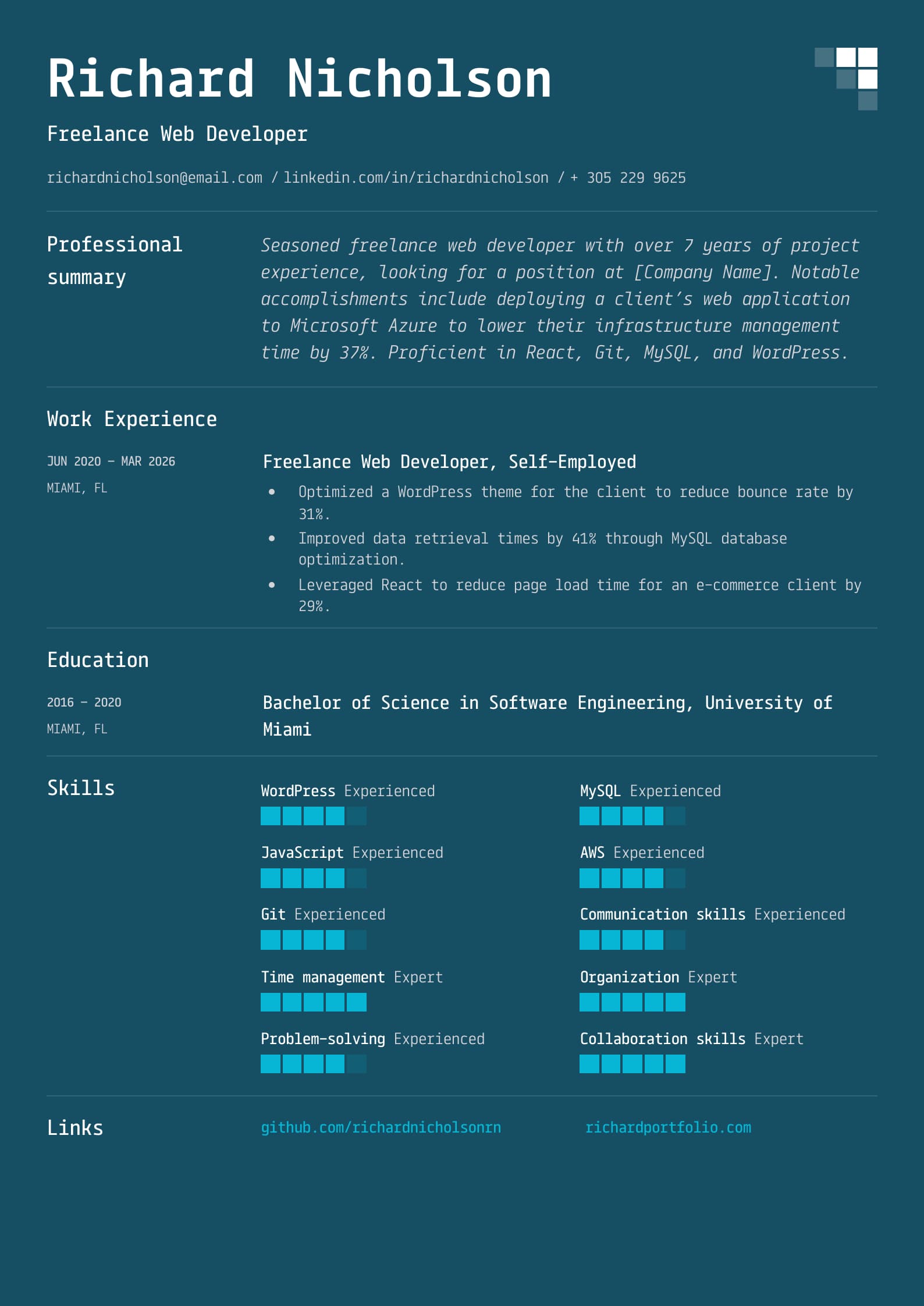
Here are two complete resume examples to give you an idea of what the final product should look like, starting with a web developer resume:
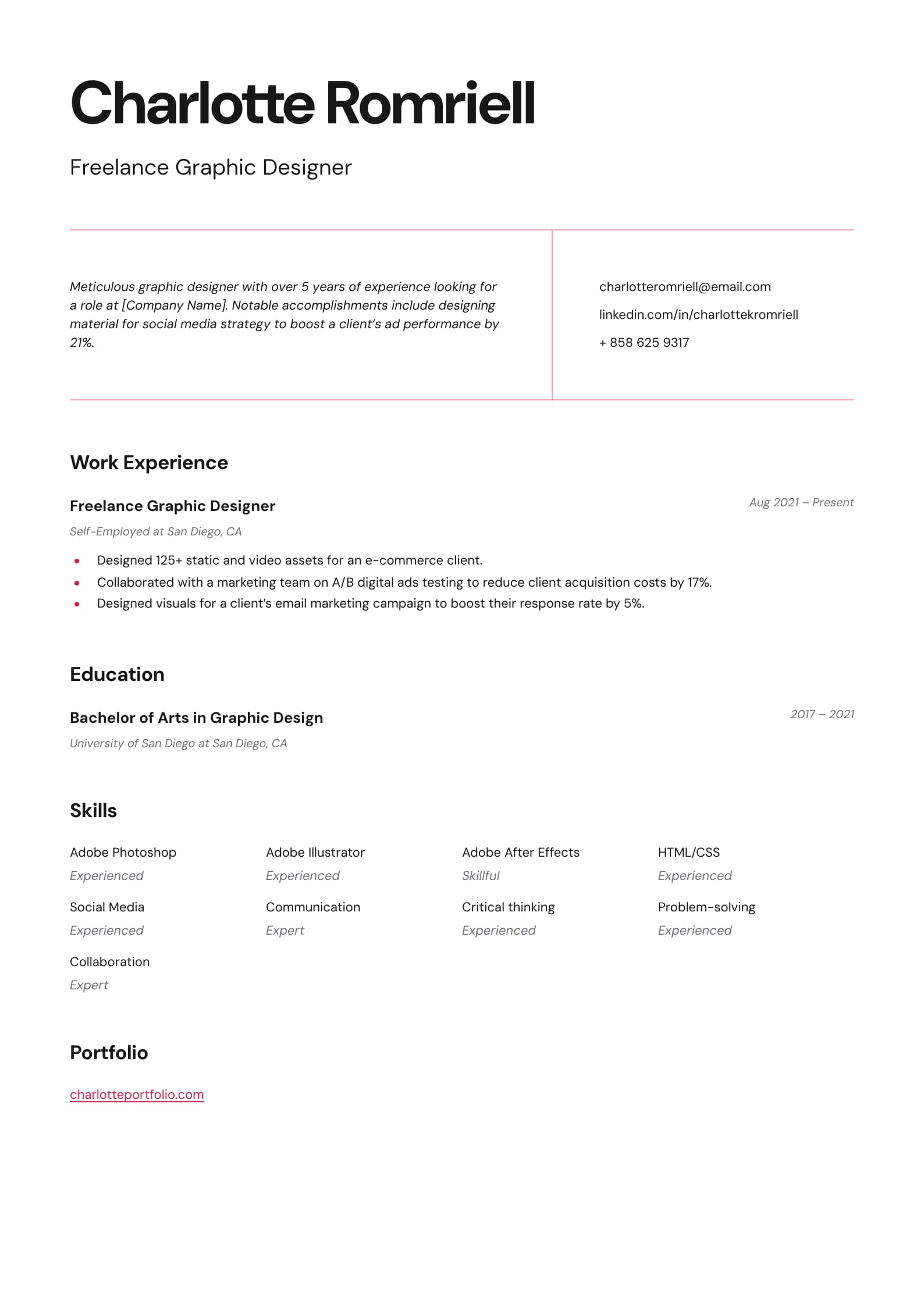
Now, here’s a graphic designer freelance resume example:
Freelance Resume vs. Traditional Resume
The primary difference between a freelance and a traditional resume is its narrative focus.
A freelance resume has a variety of projects and clients as a focal point, compared to traditional resumes, which usually showcase long-term employment and linear career growth.
Meanwhile, the strength of a traditional resume is in its ability to demonstrate a candidate’s loyalty by showing how they worked for multiple years at a single company, helping it achieve its goals while growing with it. Conversely, a freelance resume highlights your ability to tackle problems quickly, find optimal fixes, and deliver immediate value.
A traditional resume is good for emphasizing stability and continuity with an apparent timeline. This can be challenging to do with a freelance one, as it requires carefully organizing the projects together, lining them up visually, and sometimes overlapping them to emphasize cohesion.
Here are the key differences between these two types of resumes, outlined in a concise table:
Feature | Freelance Resume | Traditional Resume |
|---|---|---|
Focus | Skills, projects, and results. | Linear career progression. |
Work History | Project-based work for clients. | Chronological job positions. |
Timeline | May include overlapping projects. | Previous roles are arranged in order and with no overlap. |
Portfolio | Usually required. | Usually optional. |
What’s the Best Format for a Freelance Resume
The best format for a freelance resume is the chronological format; however, many freelancers will have luck with the combination format, as it offers flexibility and allows them to highlight both skills and project experience simultaneously.
Let’s see what each of the three most common options offers:
Chronological resume format. The chronological format is the most common in the job market and a preferred format for traditional employees. It’s favored by recruiters and compatible with ATS, making it a strong choice. However, it can result in a messy resume if you have had many simultaneous projects for small clients to showcase.
Functional resume format. The functional format emphasizes skills over experience. This makes it useful for freelancers who are new to the field, have significant gaps in their work history, or work across multiple industries. The downside of this format is that it can run into issues with ATS.
Combination resume format. The combination (hybrid) format blends a strong skill section with lists of results and accomplishments arranged in chronological order. This makes it suitable for experienced freelancers who have a diverse and valuable skill set and have worked on multiple notable projects.
What Are the Most Important Sections in a Freelance Resume?
The most important sections in a freelance resume are the following mandatory ones:
Mandatory Details
Contact information
Resume objective or summary
Work experience
Education
Skills
You can also include one or more optional sections, based on the role requirements and your qualifications. Some examples include:
Optional Sections
Certifications
Language skills
Volunteer experience
Using a resume builder, like the one at Resume.co, helps you get a proper format and the correct sections without worrying about the details.
We developed robust software that comes with ready-made templates (e.g., tech, functional, and minimalist resume templates), user-friendly customization features, and an AI-powered writing assistant. They can help you craft your freelance resume in minutes and tailor it to any role.
Freelance Resume Template
Let’s take a look at a freelance resume template to give you an example of what you can use if you opt for our resume builder:
Template
Name and Surname
Phone number: 000-000-0000 | Email: namesurname@gmail.com | Location: City, State
[Adjective] [your job title] with [years of experience, if applicable] in [your area of expertise, if applicable] looking for a [position] job at [company name]. Eager to apply [relevant skills] gained through [work/volunteer/other experience] to help [company name] [mention what you can do for the company].
Work Experience
Most Recent/Current Job Title Company City, State [Start date] — [End date]
For recent jobs, use 5-6 bullet points to list your top achievements and responsibilities
Use action verbs to make your responsibilities and achievements stand out
Add numbers to quantify your achievements
Previous Job Title Company City, State [Start date] — [End date]
For recent jobs, use 5-6 bullet points to list your top achievements and responsibilities
Use action verbs to make your responsibilities and achievements stand out
Add numbers to quantify your achievements
Oldest Job Title Company City, State [Start date] — [End date]
For older jobs, use 2-3 bullet points to list your top achievements and responsibilities
Use action verbs to make your responsibilities and achievements stand out
Add numbers to quantify your achievements
Education
[Degree] in [Major] [University/college name] [Start date] - [Graduation date]
Skills
Soft Skills
Skill #1
Skill #2
Skill #3
Skill #4
Skill #5
Hard Skills
Skill #1
Skill #2
Skill #3
Skill #4
Skill #5
Additional Sections
Add any relevant additional sections (languages, licenses, publications, hobbies, etc.)
Freelance Resume Contact Information
Contact information is a standard section for any resume that goes in the header. Writing it is straightforward, but accuracy is paramount.
Here are the details to include:
Resume Header Information
Your name
Phone number
Email address
Depending on your industry and the role that you’re applying for, you can also include:
Additional Header Details
Your location (city and state)
LinkedIn profile
Relevant social media profiles
Personal website
Portfolio
When adding your contact information, it’s important to be precise and professional. Double-check every detail, as a single misspelled digit can result in no callback. Use industry-standard phrasing for your job title (e.g., avoid “Marketing Guru”) and avoid unprofessional email addresses (e.g., surferguy99@email.com).
Here’s an example of a good contact information section:
Contact Information Section Example
Richard Nicholson
Freelance Web Developer
+ 305 229 9625
richardnicholson@email.com
linkedin.com/ln/richardnicholson
github.com/richardnicholsonrn
richardportfolio.com
Resume Summary vs. Resume Objective for Freelancers

Whether you should write a resume summary or a resume objective depends on your level of experience.
Entry-level professionals should write a resume objective to highlight their skills and career goals. Experienced freelancers should write a resume summary to emphasize one or two of their most notable accomplishments. Regardless of what you write, the section should be 2–4 sentences long, concise, and impactful.
Let’s start with an example of a good resume objective:
Good Freelance Resume Objective
Recent graduate with a BA in Graphic Design, looking for a junior position at [Company Name]. Adept at using Adobe Creative Suite and proficient in HTML and CSS. Eager to contribute to your organization on the road to becoming a senior UI designer.
For contrast, here’s an example of a bad resume objective that doesn’t disclose much about a candidate’s qualifications:
Bad Example
Entry-level freelance graphic designer looking for my first real job.
Now, here’s an example of a good freelance resume summary:
Good Freelance Resume Summary
Seasoned freelance web developer with over 7 years of project experience, looking for a position at [Company Name]. Notable accomplishments include deploying a client’s web application to Microsoft Azure to lower their infrastructure management time by 37%. Proficient in React, Git, MySQL, and WordPress.
Finally, here’s an example of a bad freelance resume summary:
Bad Example
“Experienced web developer who did plenty of freelance projects is looking for work.”
Freelance Work Experience Section: How to List it Correctly
The work experience section is usually the central part of a freelance resume. To make it as effective as possible, the golden rule is to focus on achievements and results over responsibilities. Employers and clients want to see the impact of your work and your ability to solve specific problems.
Furthermore, you want to go with quality over quantity. Making a separate entry for every $50 side gig will only clutter your freelance resume and detract from your more valuable efforts. Instead, you should group multiple projects together and list them similarly to how you would add a job that you had in the past. Here are the details to include:
Your role
Location (optional)
Start and end dates
List of achievements
When listing achievements, focus on results over tasks and responsibilities.
Let’s see that in a good example:
Good Freelance Work Experience Section
Work Experience
Freelance Web Developer Self-Employed Miami, FL
June 2020–March 2026
Optimized a WordPress theme for the client to reduce bounce rate by 31%.
Improved data retrieval times by 41% through MySQL database optimization.
Leveraged React to reduce page load time for an e-commerce client by 29%.
Now, here’s a bad example to show you how not to add freelance work experience to your resume:
Bad Example
Work Experience
Freelance Web Developer
Worked with WordPress themes.
Optimized databases.
Improved websites.
If your work experience primarily consists of working on one or more large-scale projects, you can list them in the same manner in reverse-chronological order. However, if you want to include a few highly prominent projects in addition to general freelance experience, you can add them to a separate project section. Let’s see how to do that.
Portfolio or Project Section on a Freelance Resume
If you’re a freelancer in a technical or creative industry, you’ll generally need a portfolio, a dedicated section for projects, or both, to convince recruiters of your expertise.
A common method of adding a portfolio to a freelance resume is to include a link to it in the contact information section. Make sure that the link is clickable in the digital copy of your resume to make it easier for recruiters to visit it and see your work.
Apart from that, you can include a couple of specific and highly impactful projects in your freelance resume (on top of your standard work experience section) to demonstrate competence to recruiters, even if they don’t examine your portfolio.
For each key project that you want to add, you should include:
Project name or goal
Client
Your role
List of results
The structure is the same as with the work experience section, and the key is to use the list of results to emphasize your qualifications. That’s why you should use bullet points for achievements, action verbs to make them more memorable, and numbers for quantification and believability.
How to Write Your Education Section
The education section adds credibility to your skills. This section is typically brief, as it should only supplement your work experience and projects.
In general, you want to include your highest degree, the institution that issued it, and the years of attendance. Let’s see that in an example:
Education Section Example
Education
Bachelor of Science in Software Engineering University of Miami, Miami, FL 2016–2020
If you’re a recent graduate with little to no professional experience, you can add a list of academic achievements to this section. They can contain information about your extracurricular activities, awards, relevant coursework, and similar accomplishments.
How to List Skills on Your Resume as a Freelancer

To list skills on your resume as a freelancer, you need to do two things:
Create a dedicated freelance resume skills section where you’ll list hard and soft abilities separately.
Prove your skills by incorporating them throughout the resume in relation to achieved results.
When adding skills, it’s essential to include the ones that are relevant to the role. That’s why you need to read the job description and research the company. This will help you understand what recruiters look for in candidates and how they set up applicant tracking systems, if they use them.
Hard Skills
Hard skills are specific to each profession and vary depending on what type of freelancer you are.
For instance, a web developer may include the following skills:
Python
Java
JavaScript
AWS
Docker
Git
On the other hand, a graphic designer may add some of the following abilities:
Adobe Creative Suite
Figma
Sketch
Typography
Color theory
Soft Skills
Soft skills are transferable between professions and universally applicable. They are a combination of interpersonal abilities and personality traits, such as:
Time management
Organization
Collaboration skills
3 Other Sections You Can Add to Your Freelance Resume
There are many other sections that you can add to your freelance and independent contractor resume to increase your chances with recruiters. Here are some of the most common:
Certifications
Certifications (e.g., Certified Administrative Professional or Certified Associate in Project Management) represent solid proof of competence and dedication to the craft. They are particularly valuable to entry-level professionals who don’t have a big portfolio to substantiate their skills.
When listing certifications on your resume, make sure to include the name, the institution that issued it, the date you obtained it, and the date of expiration (if applicable).
Language Skills
Language skills are invaluable when working with international clientele or participating in a global market. They can get you ahead of the competition during your job hunt. For some roles, proficiency in foreign languages can even be mandatory.
When adding them to your resume, make sure to pick an established framework of reference and list the languages in descending order.
Volunteer Experience
Volunteer experience is another way to show your skills, but also to demonstrate passion and engagement in the community. This is another valuable section for entry-level freelancers. If you decide to include it, you should format it just like your projects or work experience, with the objective of your volunteering, dates, and notable accomplishments.
Should You Write a Cover Letter Along With Your Resume?
You should write a freelance cover letter along with your resume (even when the job ad doesn’t require it) to show drive and willingness to go the extra mile.
The cover letter should be 250–400 words, and you can use it to talk about your motivation and qualifications that you didn’t include in your freelance resume. If you need help writing it, you can check out our AI-powered cover letter builder.
3 Tips for Creating an Outstanding Freelance Resume
Before wrapping up, here are a few expert tips to help elevate your resume for freelancers:
Keep it short. One page is the norm for most resumes. Recruiters may lose interest if you add more than that, unless the job ad specifically requires it.
Use keywords for ATS. Your professional title and skills act as keywords for the ATS. That’s why it’s crucial that they match the ones from the job description, and that you implement them organically in your freelance resume.
Tailor your resume. Every time you apply for a new position, you should modify your resume to match it perfectly.
Ready to make a job-winning freelance resume?
Create my resumeClosing Thoughts
Knowing how to write a freelance resume involves leveraging your work on various projects to demonstrate your expertise. Focus on the results and match the requirements from the job description to pass ATS screening and impress recruiters.
If you need help with writing, formatting, or overall document generation, don’t forget to check out our resume builder or cover letter generator. You can have a submission-ready freelance resume with an accompanying cover letter in minutes!
Freelance Resume FAQs
#1. How far back should I list my work as a freelancer?
As a general rule, you should go back 10–15 years to list your work as a freelancer. However, relevant experience is usually much more important than a timeline. This means you can go back fewer years if you have plenty of notable projects to showcase that are more recent.
#2. Should I list every freelance client?
No, in most cases, you should not list every freelance client. A freelance resume is about quality over quantity. Listing many small clients and minor projects will clutter your resume, making it harder for recruiters to focus on your most impressive results and highly sought-after skills.
#3. What job title should freelancers use?
As a freelancer, you should use a job title that aligns with the norms in your industry. It’s common to use a standard job title and add the “Freelance” prefix to it (e.g., “Freelance Web Developer”).