
An education cover letter is a document that accompanies your resume, complements it, and strengthens it. It should be formatted like a business letter and include seven key sections to position you as an outstanding candidate.
In this guide, we will explain how each section should be written and provide additional tips to help you leave a memorable impression with your content. Additionally, there are two examples of education cover letters for you to read through to get a clear idea of what yours should look like.
Key Takeaways
The cover letter accompanying your education resume should be properly formatted to ensure readability and present your professionalism.
There are seven key sections that make up a complete education cover letter: header, greeting, introduction, core competencies, reasons for applying, CTA, and conclusion.
Using the same tone of voice as the job description or company you are applying to, as well as universal metrics when sharing achievements, can help highlight your fit for the position.
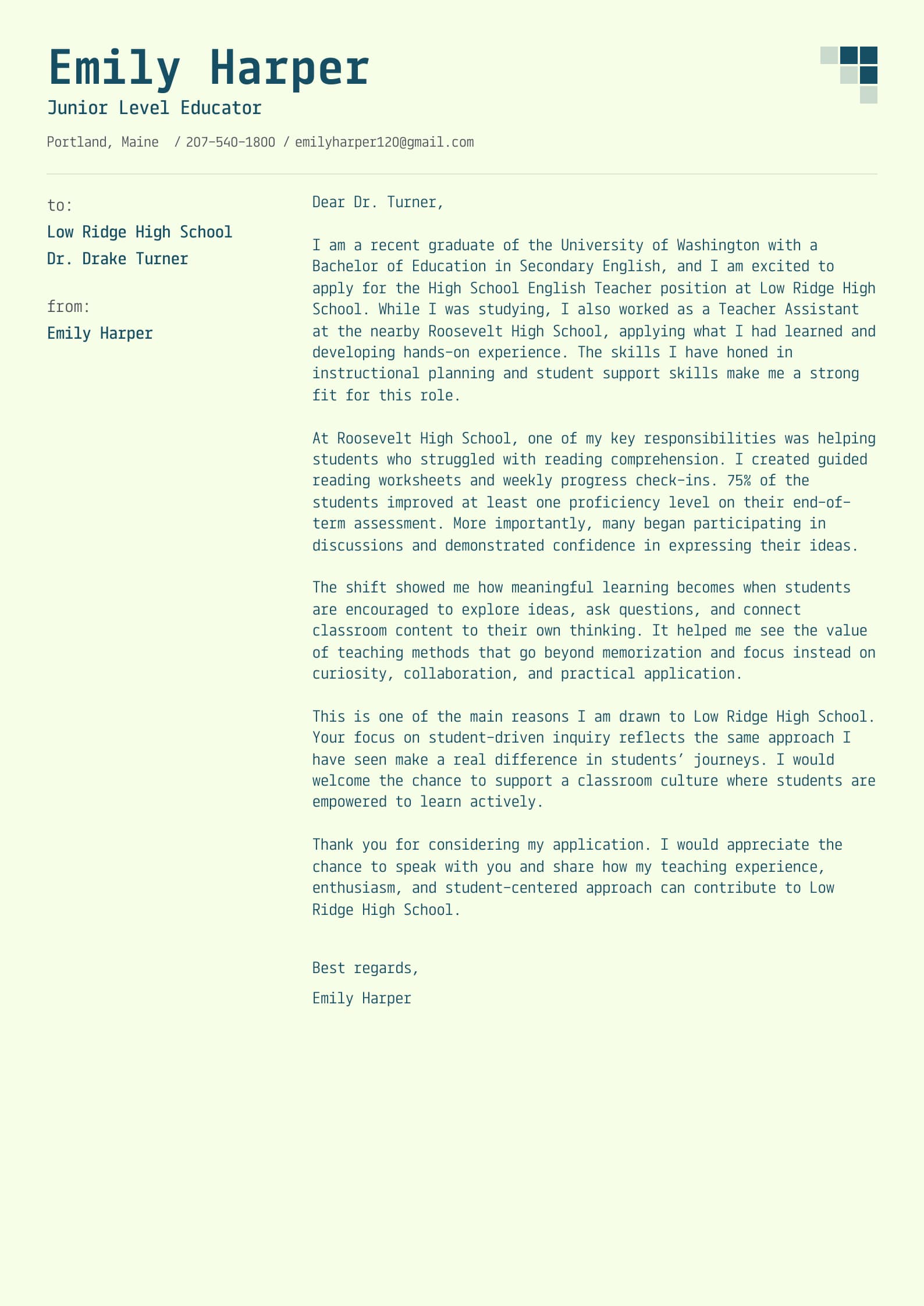
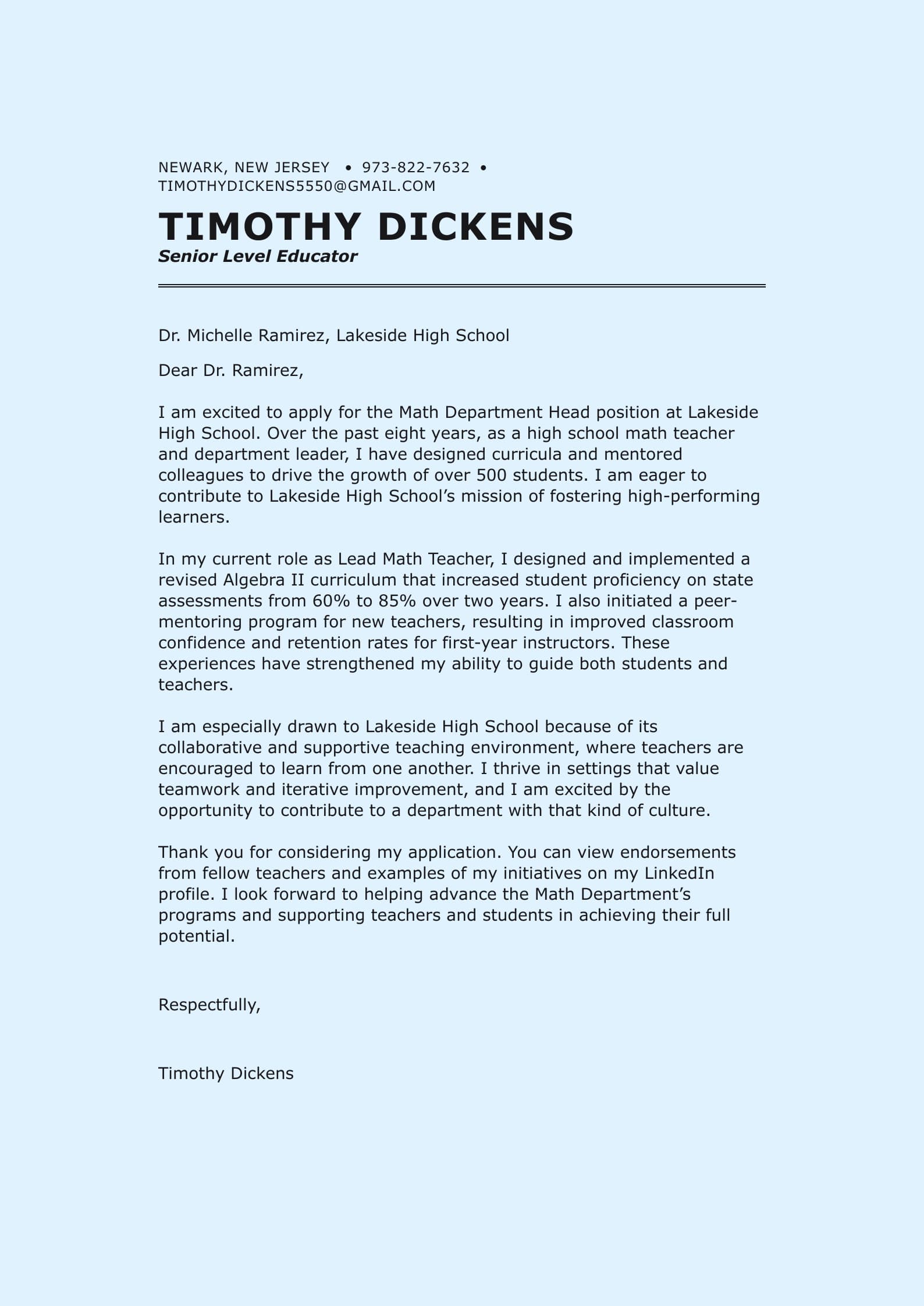
2 Strong Examples of Education Cover Letters
Here are two education cover letter examples:
What Format to Use for an Education Cover Letter
The cover letter format for an education job application letter should mirror that of a business letter. It needs to be short and sweet and well-structured so that it’s easy to follow.
Therefore, as you wouldn’t want poor formatting to overshadow your content, it is important to take some time to ensure the presentation looks professional.
Here’s what you should keep in mind:
Font styles. You should use a standard serif or sans-serif font, such as Times New Roman or Arial, and avoid script style options, which are harder on the eyes. You can also match your resume font for consistency.
Font sizes. The body paragraphs should be between 11 and 12 points, while your name at the top can be slightly larger. You shouldn’t use too many different font sizes, as this can interfere with the content’s hierarchy.
Margins. You should apply one-inch margins on all sides to ensure there is enough whitespace and the cover letter doesn’t appear crowded. If you need more space, you can consider 0.75-inch margins, but don’t reduce them any further.
Spacing. Single spacing is the standard for continuous text reading, so it is also recommended for education cover letters. You can consider adding a space between paragraphs to make the formatting clearer.
Alignment. It is best to align text to the left for readability. Additionally, you should make sure that this applies to the entire cover letter to avoid causing confusion.
File format. Save your cover letter as a PDF, as this file format is best at preserving formatting across devices and operating systems. It is also easy to convert to, regardless of the word processing software you used to write your content.
How to Write an Education Cover Letter: 7 Key Sections Explained
Writing a good education cover letter implies following a structured approach. You should emphasize your skills, qualifications, and motivations for the position you are pursuing. To do so, you need to address these seven key sections in your cover letter:
#1. Header
To set the stage for your cover letter, you will need a header with your contact information and the date.
More specifically, you should include your:
Name
Email address
Phone number
Address
Professional/portfolio links (Optional)
The date
For example:
Good Example
Jacqueline Sommers
jacquelinesommers@gmail.com
480-432-1200
Phoenix, Arizona
December 1, 2025
Employers should be able to easily reach out to you after reading your cover letter, so this section is very important. If they have to go out of their way to find your details, they might simply opt for another candidate.
After your contact information, list the employer’s details in the same format.
#2. Greeting
Following the header is a greeting; for this, it is best to use the employer’s name. You can usually find it by researching the company’s website or LinkedIn.
If you can’t pinpoint a specific name, the next best option for addressing a cover letter is a job title, such as 'hiring manager.’ You shouldn’t settle for a generic greeting, like ‘To whom this may concern,’ as this tends to suggest a lack of effort.
#3. Introduction
Now, onto the introduction, you should state right away the role you are applying for and why you are the candidate they should choose.
Try to use keywords and phrases that match those mentioned in the job description; these will catch the employees’ attention because, after all, they are looking for the best fit.
However, don’t try to stuff too many and risk sounding like a robot. Let your personality shine through while focusing on being both concise and compelling.
#4. Skills, Qualifications, & Experiences
This next section drills down on your strengths and experiences. You should mention both soft and hard skills that are related to the position you are pursuing and provide past examples of how you leveraged them to deliver results.
It is essential to highlight measurable outcomes whenever possible, as doing so helps employers grasp your value more easily. The STAR method, which stands for Situation, Task, Action, and Result, lets you do this clearly. Here is a sample answer for a teaching position application:
Good Example
In my previous Grade 4 classroom, several students were struggling with reading comprehension (Situation), and I needed to improve their skills before the end-of-year exams (Task). So, I created small-group guided reading sessions with weekly progress check-ins (Action). Within three months, 90% of students improved their reading levels by at least one grade (Result).
If you don’t have skills that align directly with the role, emphasize your transferable skills, including in-demand conceptual, interpersonal, and technical skills. Think about what’s current in your field to narrow down on your options if necessary.
Note: One of the most common cover letter mistakes is repeating what’s already on your education resume. Make sure you don’t fall into this pitfall; even if you write about the same experience, it is better to opt for a fresh angle.
#5. Reasons for Applying
In this section, you will explain what you are passionate about and why you want to work with the company. Go ahead and share your story; you might include an anecdote of why you followed your particular career path, for example:
Good Example
My passion for helping young learners develop literacy skills began during my volunteer work at the local public library, where I led storytelling sessions and reading workshops. Joining your team would allow me to combine this passion with my organizational and instructional skills.
Another option is to talk about your career goals and highlight how you can achieve them in the role you are applying for. According to a study from the Journal of Technical Writing and Communication, a candidate's objectives are among the most important factors in a cover letter.
You can write a section like this:
Good Example
I am passionate about inspiring students to explore STEM subjects through hands-on projects and real-world applications. This role will allow me to do just that, leveraging my experience in laboratory experiments to make STEM concepts exciting for all students.
You can also mention the company’s mission, vision, or values, and discuss how you relate to them; you might be committed to the same ideals or have previously worked towards the same goals, for instance.
#6. Call to Action
To start signaling the end of your cover letter, you should include a call to action (CTA) for the employer; it can be interview-focused, portfolio-focused, or follow-up-focused. Here are a few examples:
Good Example
I would welcome the opportunity to discuss how my experience can benefit your curriculum.
Please feel free to review my portfolio to see examples of lesson plans and classroom projects.
I would be happy to meet at your convenience to further discuss how my skills align with your school’s goals.
#7. Conclusion & Sign-Off
Finally, wrap up your educational cover letter with a closing paragraph and sign-off. Reiterate your interest in the position and thank the employer for their time before ending with one of the following and your name:
Kind regards
Best regards
Sincerely
Respectfully
For example:
Good Example
Thank you for taking the time to read my cover letter. I look forward to the possibility of joining the team at Hartwick Institute.
Kind regards,
Jacqueline Sommers
4 Tips for Writing an Education Cover Letter
Keep these four tips in mind when writing your education cover letter:
Mirror the job description’s tone or the company’s voice. By subtly indicating that you ‘speak the same language,’ you position yourself as the better fit compared to other candidates. To do this effectively, spend some time reading through the job description and the company’s content on various channels.
Cite universal metrics. Concrete examples are more convincing, as they help employees envision your value. In a cover letter for a teaching job, for instance, you can share that you ‘introduced a new grading workflow that cut turnaround time from 10 days to 5 and reduced overtime costs.’
Inspire yourself with proven cover letter examples and templates. Our collection of HR-approved examples and templates can give you a clear idea of what yours should look like once it is fully polished. They can also offer inspiration if you are struggling with specific wording and phrasing.
Use a cover letter builder. To avoid stressing over design details and having to manually add margins or set spacing, you can count on Resume.co’s AI-powered cover letter builder to do the heavy lifting. We will take care of all the extra elements while you focus on writing your content. If you need to create a resume to accompany your letter, we also have an easy-to-use resume builder.
Final Thoughts
A strong education cover letter is properly structured and substantial. The former means it is easy to read and conveys professionalism, while the latter ensures it sends a clear message about your competencies.
Your cover letter also demonstrates your writing skills and self-awareness, which are both highly sought-after in teaching, educational leadership, mentorship, and curriculum development roles.
By following the tips above, or using our cover letter generator, and investing time to carefully craft your cover letter, you can make your application stand out!