

Using “To Whom It May Concern” in a cover letter to address the reader significantly increases the chances of rejection. The salutation is generic and detached, which makes it overly formal and disconnected. That’s why using it is an outdated practice, and you should opt for more personal methods of addressing recruiters and hiring managers.
In this article, we’ll elaborate on why you shouldn’t use “To Whom It May Concern” in your cover letters (and mention rare cases in which it’s still acceptable). Also, we’ll give you several professional alternatives to help you address the reader in a more professional and engaging manner. Lastly, we’ll discuss some industry-specific tips for addressing a cover letter.
Key Takeaways
Avoid using “To Whom It May Concern” in a cover letter, as it sounds too detached and shows a lack of intent.
You should personally address the reader with your cover letter, so whenever possible, personally address the reader by their first or last name.
To find out the name of the hiring manager who will read your cover letter, you can read the job posting, look up the company’s website and LinkedIn page, or even contact their representative.
Even if you don’t know the name of the recipient, you can still address them by their professional title (e.g., “Dear Hiring Manager”), or you can address the specific department.
Is “To Whom It May Concern” Still Acceptable in 2026?
“To Whom It May Concern” is not acceptable in 2026 in most cases. Using it in your cover letter is an outdated practice, and recruiters and hiring managers will probably see it as a red flag.
It signals that you’re submitting a generic document without doing research or looking into companies, and tailoring is important. For instance, a study by Wingate et al. tracking real job seekers found that applicants with more detailed, clear, and structured cover letters secured more interviews and landed jobs faster than those who didn't.
However, there are some rare cases in which it may be acceptable to use this salutation. For example, if you’re submitting an entirely anonymous job application (e.g., a blind posting from a recruitment agency where the company name and details are intentionally hidden), you can use “To Whom It May Concern” in a cover letter.
Beyond that, there are other documents in which it can be acceptable to use this salutation. You can include it in formal letters of recommendation intended to be sent to multiple unknown recipients, or in some legal and compliance documents.
Why You Shouldn’t Use “To Whom It May Concern” in Your Cover Letters

You shouldn’t use “To Whom It May Concern” in your cover letter, as this opening is considered antiquated, indifferent, and unenthusiastic.
First of all, it severely lacks personalization. When you address the reader more directly—whether by their name, job title, or in a similar manner—you personalize the letter and build rapport with the recipient.
The connection you build this way humanizes your application and helps you stand out from the competition. Plus, it makes your cover letter more impactful and memorable, increasing the chances that the reader will engage with it. It’s essential to achieve this at the beginning of the document, as it also ensures hiring managers will read the rest carefully.
Another reason to avoid starting your cover letter this way is that it demonstrates a lack of effort. By going the extra mile to find out who is going to read your letter before addressing them directly, you show dedication. This tells hiring managers that you did your diligence and researched the company because you are genuinely interested in the role.
Finally, using a more specific opening instead of “To Whom It May Concern” in your cover letter hints at several valuable soft skills.
Namely, it’s a strong indicator of good communication and writing skills, as well as research prowess and attention to detail.
Does “To Whom It May Concern" Hurt Your ATS Score?
Having “To Whom It May Concern” in a cover letter usually won’t hurt your ATS score. Applicant tracking systems are typically configured to search for specific keywords, job titles, and skills, and not to assess salutations.
However, the phrase can hurt your chances of getting the job once your application reaches a human recruiter. Most recruiters prefer personalized cover letters, since they make your writing appear more thoughtful and demonstrate that you went the extra mile to find out who is going to read the letter.
How to Find Out Whom to Address in Your Cover Letter
Before discussing solid alternatives to “To Whom It May Concern,” we need to determine how to identify the correct recipient in a cover letter.
There are many ways to go about it, so here are three of the most effective and common ones:
Company website. The vast majority of companies today have websites where you can find all the relevant information about their work and employees, including HR professionals and hiring managers who might be reading your cover letter.
Job posting. It’s not uncommon for job postings to have the names of recruiters or hiring managers as part of their contact information. That’s why you should carefully read them to see if there’s a name associated with the email to which you should send your cover letter.
LinkedIn. You can look up the company on LinkedIn to learn about its members. Look for professionals with specific titles, whether it’s “Hiring Manager” or “Recruitment Manager.” The company’s recent posts can also be about hiring, and they might contain details about those in charge of the process.
If these typical approaches yield no results, you can use some of the more involved methods, like:
Contacting the company. You can call the company via phone and politely ask the receptionist for the name of the person in charge of hiring.
Leveraging your network. If you have connections in the company or know someone who does, you can use them to determine the name of the hiring manager.
Searching on Google. When all else fails, a simple Google search might give you the information you need. For instance, you can find the name that you’re after in one of the news articles, publications, blog posts, company announcements, and more.
7 Alternatives for “To Whom It May Concern” on a Cover Letter
Here are seven established alternatives for “To Whom It May Concern” that work perfectly for your cover letter.
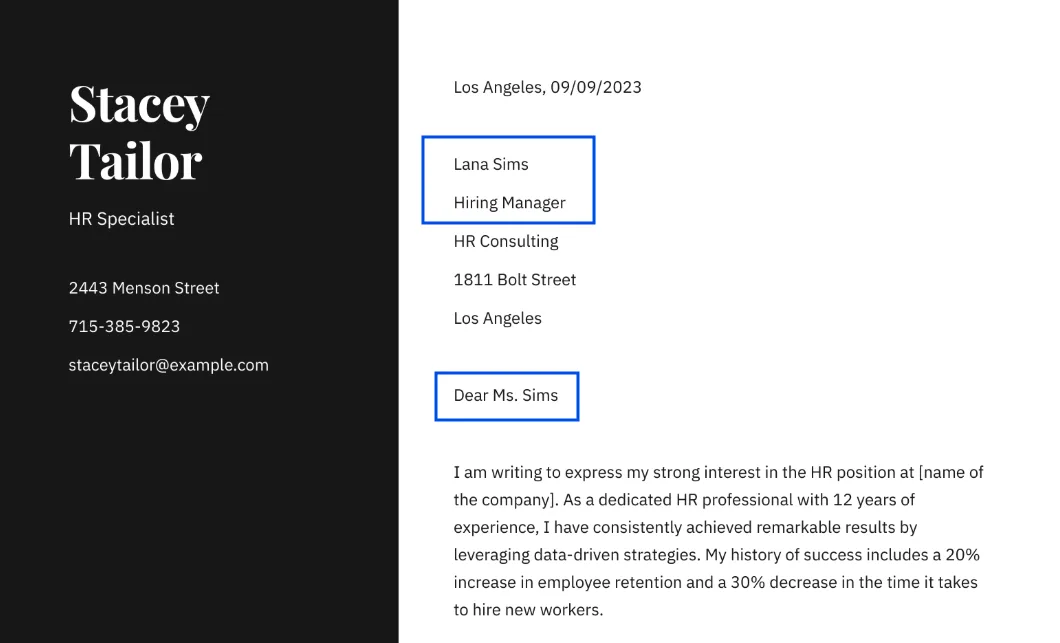
#1. Dear [Name of the Hiring Manager]
Addressing the hiring manager directly is one of the best ways to start your cover letter. This means that the established method of using “Dear” followed by their name makes your letter personal and shows effort.
Depending on the company’s culture, you can slightly customize this opening. For instance, you should determine whether to use honorifics, such as Mr., Ms., Dr., etc. Moreover, you can use the hiring manager’s full name or just their last name. You can even include their name alone, without the “Dear” before it.
This makes it all the more important to do proper research and gain an in-depth understanding of the organization's social dynamics. Getting this part right can significantly boost the effect of your cover letter and portray you as an excellent cultural fit.
#2. Dear [Name of the Recruiter]
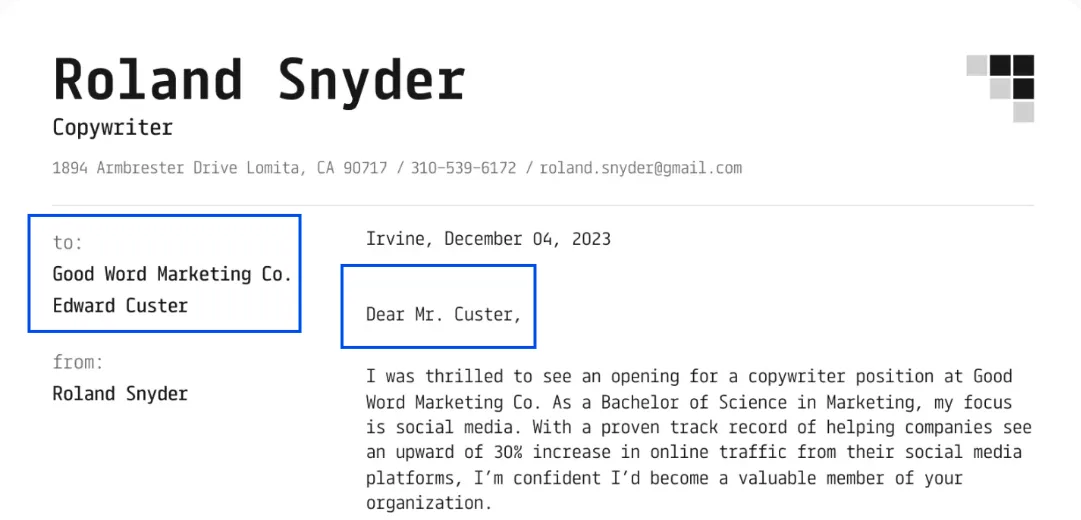
If you can’t find the name of the hiring manager, but you find out who the recruiter is, you can address them and send them your cover letter. Both of these professionals are responsible for hiring, so it’s not uncommon for recruiters to read cover letters, especially since they are in charge of the initial assessment of candidates.
Should you opt for this method, you can follow the same rules as if you were addressing the hiring manager by their name. This includes looking into the company’s culture to figure out whether to use or omit “Dear,” include honorifics, mention the recruiter’s full name or just their last name, etc.
#3. Dear Recruiter/Hiring Manager
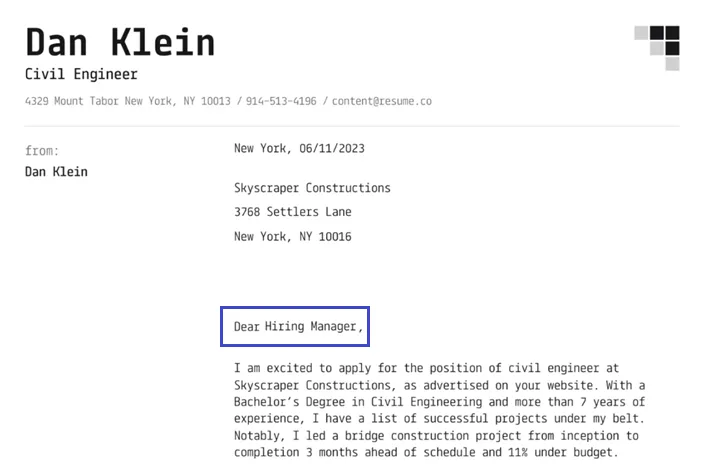
When you don't know a recruiter or hiring manager’s name, using their job titles is an acceptable way of addressing them. It’s a courteous and professional alternative that shows respect for the role and ensures your cover letter gets to the appropriate individuals.
#4. Dear [Name of the Head of the Department]
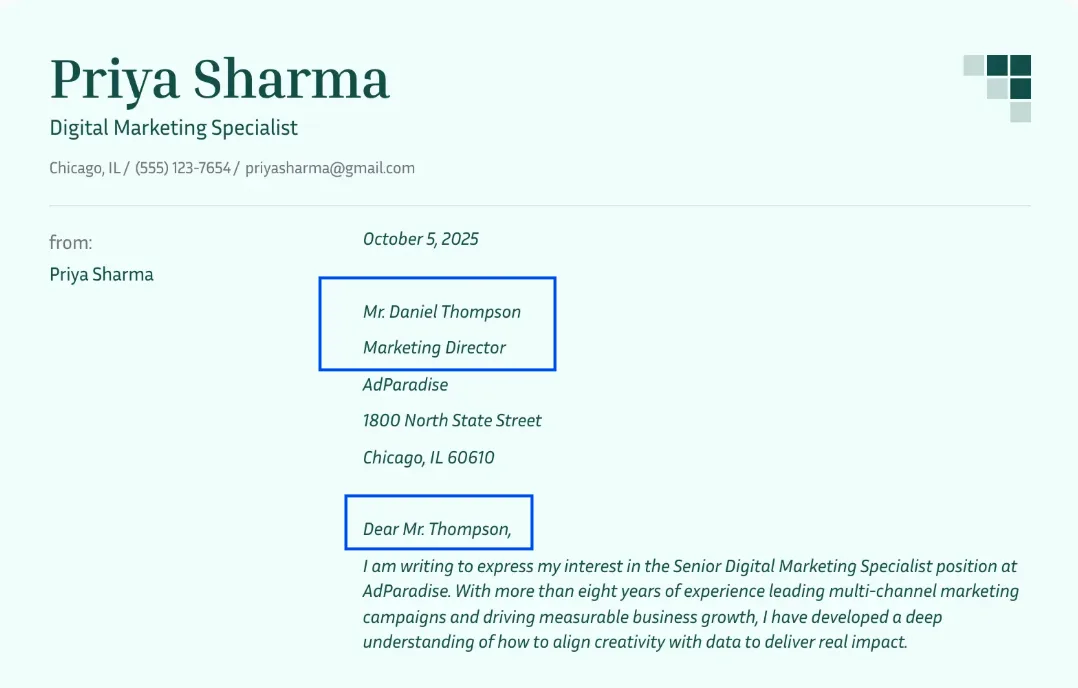
Instead of a generic “To Whom It May Concern” in your cover letter, you can address the head of the department that you want to join. When you’re researching the company, you might be able to find the leader of the department instead of the recruiter or hiring manager.
In that case, you send your cover letter to them and address them by their name, just as if you’d address the hiring manager or recruiter. This way, you’re also demonstrating diligence and willingness to go the extra mile as you’re highlighting your understanding of the company’s hierarchy.
#5. Dear [Name of the Department]
When you can’t find the name of a person, be it the hiring manager or the head of the department you’re applying to, you can address the department itself. Instead of starting your cover letter with “To Whom It May Concern,” you can open it with “Dear IT Department” or “Dear Marketing Department.” While this method isn’t as personal when there’s no reader’s name, it is still targeted and specific, and it shows effort on your end. Moreover, addressing the letter by the name of the department is functional, as it helps your cover letter reach the right person, even if you’re unsure who to send it to.
Here is an example:
“Dear Accounting Department,”
#6. Dear [Recruiting Team or Department]
Some companies have specific names for their recruiting teams, which you can use to address your cover letter. For example, their recruitment team might be called “Talent Acquisition,” in which case you should begin your cover letter with “Dear Talent Acquisition Team.”
This is another approach that isn’t as personal as specifying an individual name, but it shows effort on your end and familiarity with the company’s inner workings and internal terminology. It helps tailor your cover letter to the organization, increasing your chances of making a good first impression.
Here is an example:
“Dear Talent Acquisition Team,”
#7. Dear [Role] Search Committee/Hiring Manager
Another targeted method that doesn’t require the name of the recipient is to address the search committee, team, or hiring manager in charge of the role that you’re applying for. For instance, if you’re applying for the role of a software engineer, you can address your cover letter with “Dear Software Engineer Hiring Committee” or “Dear Software Engineer Search Team.”
While this is a broad salutation, it’s not as generic as using “To Whom It May Concern” in a cover letter. By the role’s search team or hiring manager, you’re targeting relevant parties and showing that you understand that a hiring process is a collaborative effort.
Here is an example:
“Dear Marketing Specialist Search Committee,"
How to Address a Cover Letter if You Can’t Find the Name

In a previous section, we’ve given you concrete examples of how to address a cover letter to an unknown recipient. Even in such situations, you still want to address a cover letter in as personal and targeted a way as possible.
This includes using all the information available about the job title and the company's department that you’re looking to join. Furthermore, you can mention the role that you’re applying for to specify who you’re writing to further.
The first thing to do when you’re unable to find the name of the hiring manager or recruiter is to address them by their title. Another option is to address the hiring team or individual in charge of the role. Finally, if you don’t know who to send your cover letter to, you can send it to the department’s email and address it to the head of that department.
It’s also worth mentioning that there are some alternatives to the “Dear” part of your salutation. Depending on the company’s culture, you can say “Hello” instead. This is a friendlier variant, but it is still professional enough to work in modern companies that practice less formal communication.
On the other hand, you can use “Greetings” as a more formal and respectful way of saluting the reader. For example, “Greetings, Hiring Manager” is a viable option in traditional and highly corporate environments.
Ultimately, “Dear” remains the golden standard of starting cover letters and the one to use unless you’re absolutely sure that one of the alternatives is a better fit.
How to Address a Cover Letter for an Email Submission
When submitting a cover letter by email, you can often skip the formal address block and jump straight into the salutation, without listing your address, phone number, or date. This places it at the top, immediately grabbing the reader’s attention on a desktop or mobile screen.
The salutation still needs to be professional and targeted, though emails are inherently less formal than paper correspondence or separately submitted cover letters. Because of that, you need to find the right balance between a traditional and conversational approach.
Like with standard cover letters, the best approach is to use a personalized salutation. If you know the hiring manager’s name, you should use it directly, like in these examples:
Personalized Salutation
“Dear [First Name] [Last Name],”
“Dear Mr./Ms. [Last Name],”
“Dear Dr. [Last Name],”
If you don’t know the recipient’s name, you can use one of these professional alternatives:
Professional Alternatives
“Dear Hiring Manager,”
“Dear [Department] Hiring Team,”
You should avoid overly casual greetings like:
Greetings to Avoid
“Hey [Name],”
“Hi there,”
“Hello everyone,”
Lastly, you should avoid outdated and generic salutations, such as:
Generic Salutations
“To Whom It May Concern,”
“Dear Sir or Madam,”
Some modern companies and startups find less formal greetings, like “Hello [First Name],” acceptable. However, if you’re not sure whether the company’s culture is informal, “Dear” remains the safest option.
Other Phrases Besides “To Whom It May Concern” You Shouldn’t Use
Apart from “To Whom It May Concern,” there are several other ways to start your cover letter that are just as ineffective and impersonal. Here are a few more phrases to avoid using when writing your cover letter:
“Dear Sir or Madam.” This is as generic and outdated as “To Whom It May Concern.” It is an old-fashioned and overly formal opening that has no place in modern business communication. Furthermore, it makes gender assumptions that may not be inclusive in non-binary workplaces.
“Dear [Company Name] Team.” This opening is so broad that it appears entirely untargeted and unfocused. It won’t demonstrate that you did any research on the company aside from knowing its name. Ultimately, it won’t help you make a connection with the person who might be reading your cover letter.
“Dear Hiring Committee.” This is a variation of the “Dear [Role] Search Committee/Hiring Manager” opening that is much less impactful and personal. A lack of a specified role makes it almost as broad and generic as “To Whom It May Concern” on a cover letter and not any more effective.
“Dear Search Committee.” This is a formal—albeit generic—opening that’s mostly seen in academic settings. Still, just like other phrases on this list, it’s an impersonal and uninspired way of addressing a cover letter that likely won’t grab anyone’s attention. You’ll be much better off showing effort and trying to personalize your application.
When to Use “To Whom It May Concern”?

“To Whom It May Concern” is a poor choice for a cover letter and most business correspondence in general. Still, there are some documents where it is acceptable to use it and it wouldn’t feel out of place.
For example, if you’re writing a general inquiry about a company or organization, you can open the letter with “To Whom It May Concern.” When you have a question in mind that you don’t know who to send, you can address it broadly, and the recipient will forward it to a relevant department.
You can also use “To Whom It May Concern” when you’re writing a letter of recommendation. While a personalized letter is more impactful, you can’t expect a former employer, supervisor, or colleague to write a new one whenever you apply for a different job. In that case, they can use this generic opening to make a letter appropriate for all recipients.
When you’re having a business complaint or giving written feedback, it’s appropriate to use “To Whom It May Concern” if you don’t have a specific person or department in mind. Finally, you can find this opening in various formal public notices or legal documents that address wide and unknown audiences.
Industry-Specific Tips for Addressing a Cover Letter
Different industries can have different cover letter standards. Tailoring yours to align with the field you’re applying to, even if the change is small, shows attention to detail and strong cultural awareness.
That said, here are the tips on addressing a cover letter for some of the biggest industries:
Finance and banking. This is a highly formal sector that values tradition and professionalism. You should avoid casual openings like “Hi” or “Hello,” especially when applying to banks and large companies. The safest route is to go with “Dear Mr./Ms. [Last Name].” Precision is critical, so do your best to find out the recipient's name.
Technology and startups. Modern tech companies and startups often have a more relaxed and collaborative culture. When applying to many of these companies, you can comfortably use “Hi [First Name]” or “Hello [Department].” You can still use “Dear” as a safe option, but you should focus on showing enthusiasm instead of being traditional.
Creative industries. Talent acquisition professionals from creative industries generally appreciate personal and authentic communication. While you should still keep your salutation professional, you can drop the formal “Mr./Ms.” prefix when addressing the recipient and go with a simple “Dear [First Name].”
Healthcare and medicine. The field of healthcare requires accuracy and professionalism. If the recipient has a professional title like “Dr.” or “Professor,” make sure to use it correctly when addressing them. Avoid generic salutations as they show a lack of attention to detail, which is critical in a medical setting.
Legal. Law firms expect meticulous compliance with formal business correspondence norms. It’s recommended to use salutations like “Dear [First Name] [Last Name]” or “Dear [Mr./Ms. Last Name].” Never use a casual greeting like “Hi” or “Hello,” as it can be perceived as highly unprofessional.
Write a Tailored and Professional Cover Letter with Resume.co
Writing a cover letter from scratch, figuring out the best salutation, and making sure it matches your resume can be tedious, especially if you’re applying for multiple positions. That’s why we recommend you use our AI-powered cover letter generator. Use it to generate standalone documents or upload your resume and let the tool write a tailored letter for you in seconds.
Ready to write a personalized cover letter?
Create my cover letterFinal Thoughts
At first glance, using “To Whom It May Concern” in a cover letter may seem like the ultimate greeting that is comprehensive and professional. However, it does more harm than good, since the purpose of a cover letter is to create a personalized experience for the reader.
You should still write a professional salutation, but address the recruiter or hiring manager by name. In rare instances when you can’t find out the name of the recipient, you can use their professional title, or address your cover letter to the specific department.
A personalized approach helps you connect with the reader, making them more focused on your writing and all the skills and qualifications that you talk about.
“To Whom It May Concern” on a Cover Letter FAQs
#1. How do you address a cover letter to an unknown person?
To address a cover letter to an unknown person, you can use the recipient’s professional title or a department name. Salutations like “Dear Hiring Manager” or “Dear Recruiting Team” sound more targeted and personal than a generic “To Whom It May Concern.”
#2. Does a generic salutation affect your chances of getting hired?
A generic salutation may negatively affect your chances of getting hired. While it usually won’t result in an automatic disqualification by the ATS, it will reduce your chances of impressing recruiters. A generic salutation signals a lack of effort and indicates that you are mass-applying without specific intent.
#3. Can you start a cover letter without a salutation?
You should not start a cover letter without a salutation. While it may be possible to do so in highly casual environments, omitting a greeting makes your cover letter feel abrupt and incomplete. Even if you don’t know the recipient’s name, you can still use a “Dear Hiring Manager” instead.
Related Articles
Do I Need a Cover Letter in 2026? Is It Necessary or Outdated?
How Long Should a Cover Letter Be and What Format To Use
How to Put Salary Expectations in a Cover Letter [w/ Examples]