

Use a one-page resume if you have a focused career history, typically under 10 years of experience, or when applying for entry-level, internship, or early career roles. Most hiring managers spend only a few seconds scanning resumes, so it’s your best shot to make an impression. However, many struggle with fitting everything onto the page without making their resume feel crowded or cutting out important details.
In this guide, we’ll show you how to write a one-page resume, walking you through what to include, what to remove, and how to organize your information. By following our expert tips, you’ll be able to make a resume that’s clear and impactful.
Key Takeaways
You should use a one-page resume when you have a focused work history with less than 10 years of experience or are applying for entry-level or early career roles.
Choose a proper resume format to organize your content clearly and pair it with a strong header to create a professional first impression.
Next, write a compelling summary or objective to highlight your value, and list your work experience with achievement-focused bullet points.
Add your education to show your academic background and include a targeted skills section to highlight the most relevant abilities for the role you are applying for.
Common one-page resume mistakes include overcrowding content, including irrelevant information, failing to tailor your resume, and skipping ATS optimization.
3 Simple One-Page Resume Examples
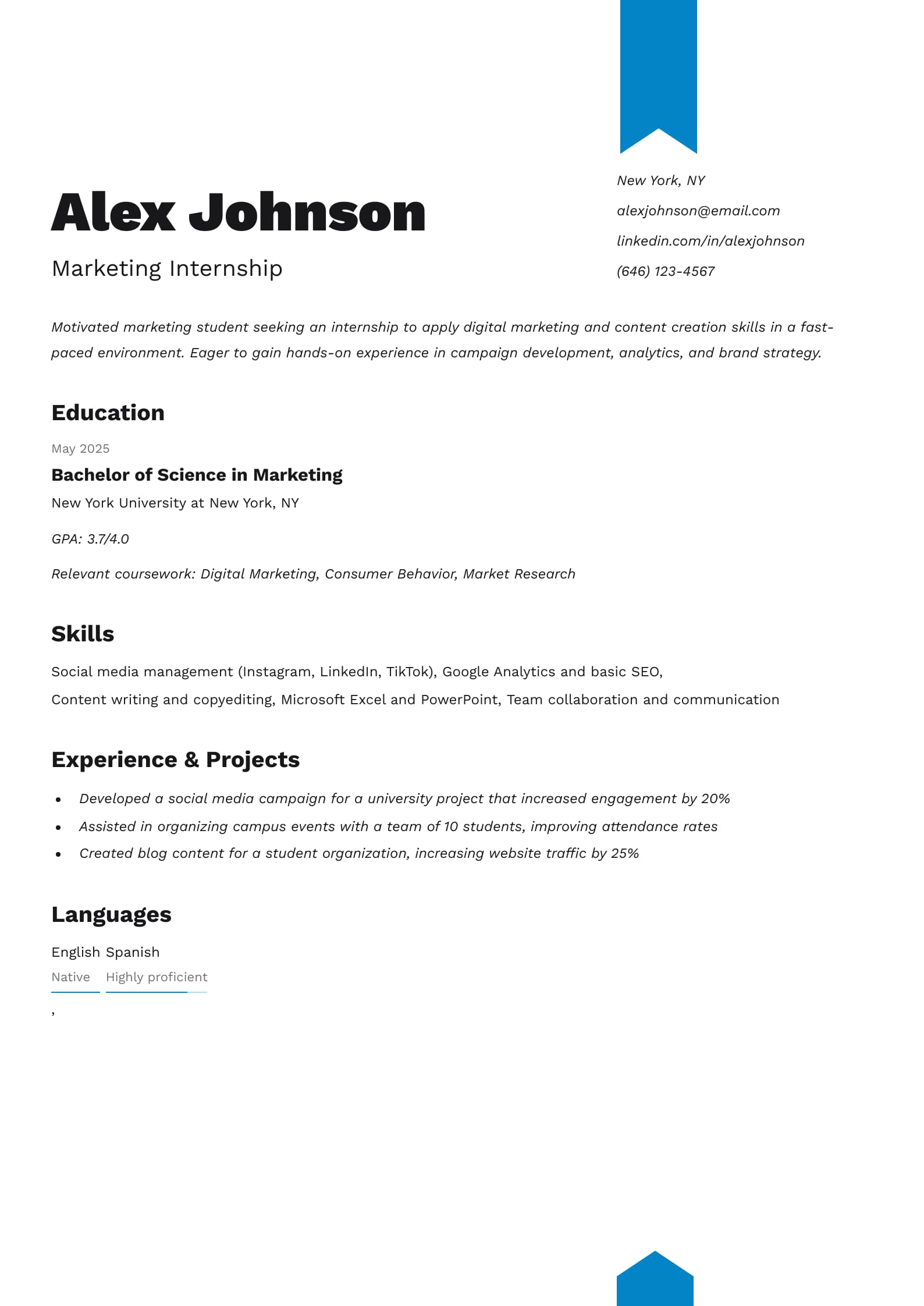
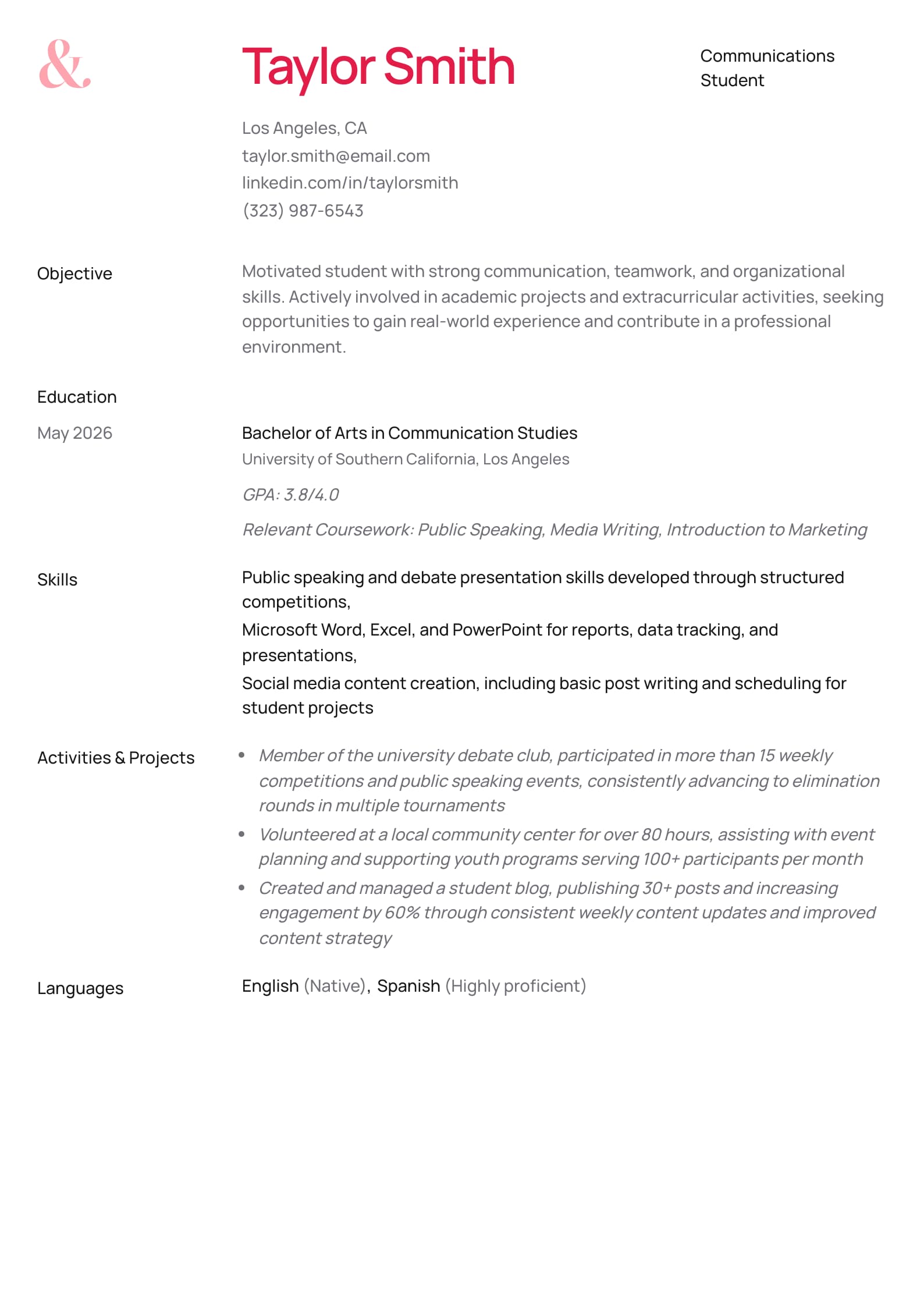
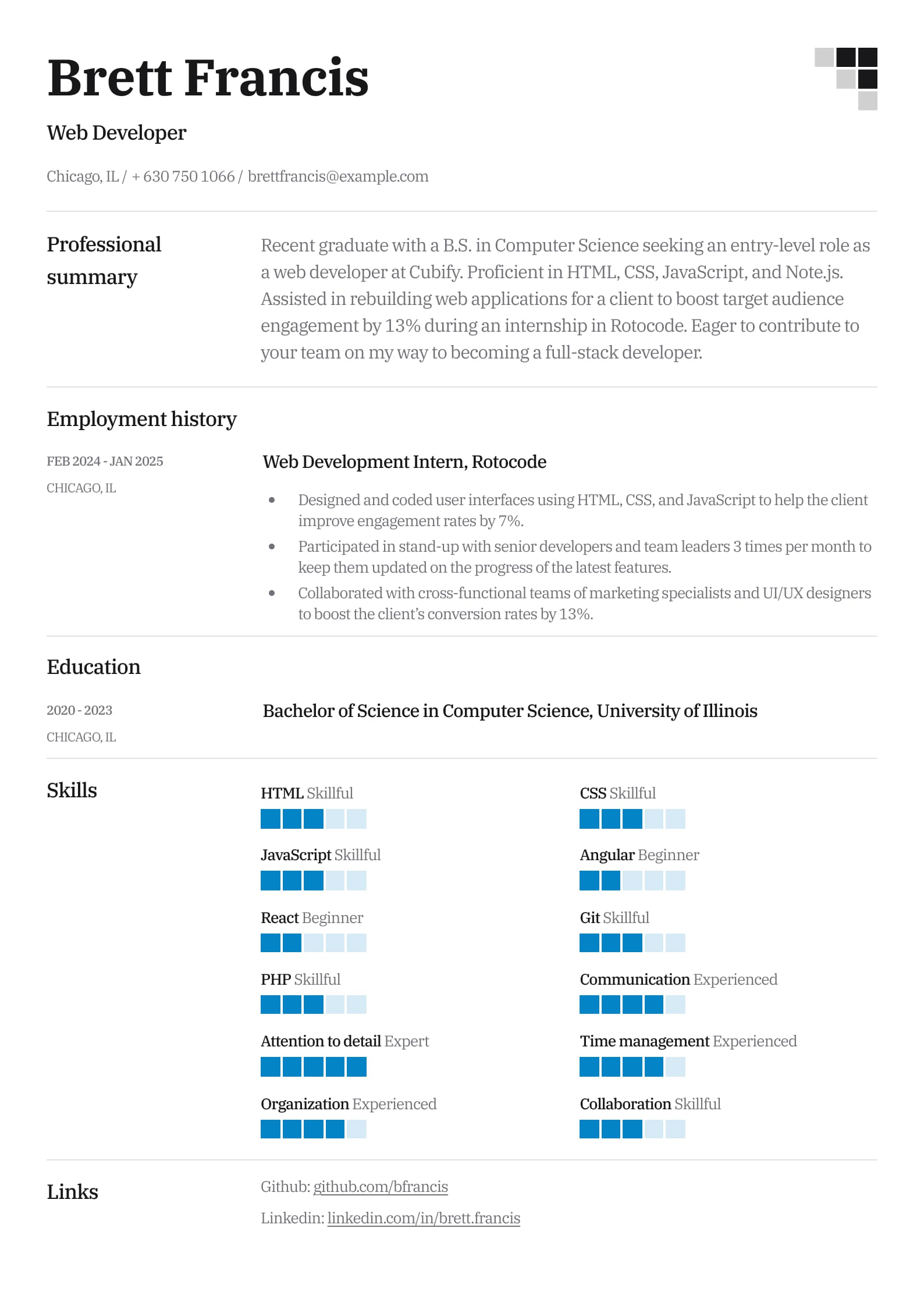
Before we show you how to write a resume, let’s examine three one-page resume examples to get you started, including an internship, student, and first job resume:
Internship Resume Example
Student Resume Example
First Job Resume Example
When Should You Use a One-Page Resume?
You should use a one-page resume when your experience and qualifications can be presented clearly and effectively without overcrowding the page. Recruiters usually spend only 7.4 seconds scanning each application, so keeping your resume concise can make it easier to spot your strongest selling points quickly.
Here are some common situations where a one-page resume makes the most sense:
You have less than 10 years of experience. If your work history is relatively short, a single page is usually enough to highlight relevant roles, achievements, and skills.
You are applying for entry-level or internship roles. Employers hiring for junior positions often expect shorter resumes focused on education, transferable skills, coursework, volunteer work, and internships.
You are a recent graduate. If you are just starting out, your education, academic achievements, projects, and extracurricular activities may be more relevant than a lengthy work history.
The job posting specifically requests one page. Some employers give strict application guidelines. If a listing asks for a one-page resume, following instructions shows attention to detail.
When Is a One-Page Resume Not Enough?
A single-page resume might not be enough in the following scenarios:
You have a longer work history (10+ years). If you have spent a decade or more in the workforce, you may need extra room to showcase relevant positions, promotions, major achievements, and specialized skills.
You work in academia, research, or medicine. These fields often require detailed information about publications, certifications, research projects, presentations, or teaching history. A one-page resume may not provide enough space for these credentials.
You are applying for senior or executive roles. Leadership positions often require a broader overview of strategic accomplishments and high-level decision-making responsibilities.
How to Make a One-Page Resume
To make a one-page resume, tailor every section to the specific job you are applying for, use concise bullet points, measurable achievements, and strong action verbs to make each word count.
That said, let’s examine the practical steps to follow so you can write a one-page resume that stands out.
#1. Choose a Proper One-Page Resume Format
The right one-page resume format helps you organize information clearly while maximizing limited space. Depending on your specific work history and skills, you can choose between three main resume formats:
A chronological resume lists your work experience starting with the most recent role, and is best if you have a steady work history.
A functional resume focuses on skills rather than work history, making it useful for career changers or those with employment gaps.
A combination resume blends both formats by highlighting skills first and then showing relevant experience
For a one-page resume, use clear headings and easy-to-read fonts like Arial, Calibri, or Times New Roman in 10 to 12-point size. You should avoid graphics or large blocks of text to ensure your resume remains ATS-friendly and visually clean.
#2. Start With a Strong Resume Header
Your resume header should make it easy for employers to identify you and contact you quickly. Since space is limited on a one-page resume, keep this section clean. Place it at the top of the page and include only the most important details:
Full name
Phone number
Professional email address
Location
You can also add your LinkedIn profile or online portfolio if they are relevant to the role. For example:
Header Example
Jordan Lee
Houston, TX | jordan.lee@email.com | (281) 321-7890 | LinkedIn.com/in/jordanlee
#3. Write a Compelling Resume Summary or Objective
A resume summary or objective gives hiring managers a quick snapshot of who you are and why you are a strong fit for the role. On a one-page resume, this section is especially valuable because it highlights your most relevant qualifications right away.
A resume summary works best if you have some work experience. It should be two to three sentences that showcase your key skills, achievements, and career highlights. For example:
Summary Example
Results-driven marketing specialist with 4+ years of experience in SEO, content strategy, and social media management. Increased organic traffic by 60% and improved conversion rates through data-backed campaigns.
On the other hand, a resume objective is better for entry-level applicants, recent graduates, or career changers. Here’s a good example:
Objective Example
Recent business graduate seeking an entry-level sales role where I can apply strong communication and customer service skills to drive client satisfaction and growth.
#4. List Your Work Experience
Your work experience section is often the most important part of a one-page resume. It shows employers what you have done, what important skills you have used, and the results you have delivered. Since space is limited, include only the most relevant roles and accomplishments.
For each role, list the following:
Company name
Location
Dates of employment
Also, make sure to use 2 to 4 bullet points that focus on measurable achievements rather than daily duties. For example:
Achievements Example
Marketing Intern, Austin Startup Co.
Austin, TX | May 2024 - Aug 2024
Supported the execution of digital campaigns that increased social media engagement by 25%
Created and scheduled content across Instagram and LinkedIn using a monthly content calendar
Assisted in performance tracking using Google Analytics and prepared weekly reports
If you are a student or recent graduate, internships and co-op roles can be included in this section. For instance, research from NACE shows that internship experience is one of the most influential factors in hiring decisions.
#5. Add Your Education
Start with your highest degree first, including the degree name, school, location, GPA, and graduation year or expected graduation year if you are still studying. If you are a recent graduate or have limited work experience, expand this section slightly by adding relevant coursework, academic projects, honors, or scholarships.
Here’s how that looks in practice:
Education Example
Bachelor of Science in Marketing, University of Texas at Austin, Austin, TX, 2025
GPA: 3.8/4.0
Relevant Coursework: Digital Marketing, Consumer Behavior, Marketing Analytics, Business Communication
#6. Include a Targeted Skills Section
According to a survey, 70% of employers said they use skills-based hiring. This means your skills section has to be strong.
To do so, highlight core competencies that are most relevant to the role. Avoid vague or overly generic skills like “hardworking” or “good communicator” unless they are supported by context elsewhere in your resume.
Here’s a good example of skills on a one-page resume:
Skills Section Example
Social media campaign management across Instagram and LinkedIn
Digital marketing analytics using Google Analytics
Content creation and copywriting for marketing posts, blogs, and promotional materials
Marketing strategy development supported by competitor analysis via Ahrefs
Optional Sections for One-Page Resume

Optional sections can help strengthen your one-page resume, but only if they directly support the job you are applying for. Consider including the following sections:
Certifications
Volunteer experience
Projects
Honors and awards
On the other hand, avoid sections like hobbies or references just to fill space. If something does not strengthen your application, leave it out. On a one-page resume, every line should support your fit for the role.
5 One-Page Resume Mistakes to Avoid
To avoid common pitfalls, keep these five resume mistakes in mind:
Shrinking everything to force fit it. Trying to squeeze too much content onto one page by reducing font size, margins, or spacing makes your resume difficult to read. You can avoid this by reviewing resume examples that show how to balance content and spacing effectively on a single page.
Including irrelevant or outdated information. Listing old roles, unrelated responsibilities, or outdated skills takes up valuable space that should be reserved for your most relevant achievements. You should focus only on experience that directly supports the job you are applying for.
Not tailoring your resume to the job: Tailoring your resume means adjusting your summary, skills, and bullet points to reflect the specific qualifications and responsibilities listed in the job description. This shows employers you are a strong fit and improves your chances of getting an interview.
Ignoring ATS formatting and optimization: Even a well-written resume can be rejected if it is not compatible with Applicant Tracking Systems (ATS). Common ATS mistakes, such as using tables, columns, graphics, or unusual fonts, can cause important information to be missed. With our ATS resume checker, you can quickly spot technical issues and pass initial screening.
Overloading with design elements or visuals: Adding too many colors, icons, charts, columns, or graphics can make a one-page resume harder to read and less compatible with ATS systems. With a proper resume template, you can ensure your application stays simple and structured.
Ready to Build Your One-Page Resume?
Create a clean one-page resume with our AI-powered resume builder.Closing Thoughts
When you focus on tailoring your content, highlighting measurable achievements, and optimizing for both recruiters and ATS systems, you increase your chances of getting noticed.
Follow our resume tips, keep formatting simple with Resume.co’s help, and make every section serve a clear purpose. Done right, a one-page resume becomes a focused snapshot of your value and a powerful step toward landing interviews.
One-Page Resume FAQs
#1. How do I fit my resume on one page?
To fit your resume on one page, focus on the most relevant experience, skills, and achievements while removing outdated or unrelated details. Prioritize concise bullet points and strong formatting. Managing your resume length effectively ensures every section adds value.
#2. What is the ideal format for a one-page resume?
The ideal format for a one-page resume is a clean, easy-to-scan structure using reverse chronological order. Include clear headings for summary, experience, education, and skills. A simple layout with consistent spacing improves readability for recruiters and ATS systems.
#3. Can a one-page resume have two columns?
Yes, a one-page resume can use two columns if it is designed carefully. This layout can help organize information efficiently, especially for skills or certifications. However, it should remain ATS-friendly, meaning content must stay readable and not rely on graphics or complex formatting that disrupts parsing.
#4. Is a one-page resume better than a two-page resume?
No, a one-page resume is not always better than a two-page resume. It is ideal for entry-level candidates, recent graduates, or professionals with under 10 years of relevant experience. A two-page resume is often better for senior-level professionals or those with extensive experience, certifications, or technical qualifications.