

To put freelance work on a resume, you should list the same details as you would for any other job: your title, dates of work, and bullet-point achievements with measurable results. The only difference is that you can mention high-profile clients (if not restricted by NDA) and projects to boost your standing.
It’s important to distinguish between a freelance resume and a regular one that includes some freelance work. The former is focused exclusively on freelancing, while the latter contains other types of experiences, too.
In this article, we will examine the latter and show you how to put freelance work on a resume effectively, where to include this information, and which mistakes to avoid. We will also share two examples to better illustrate this.
Key Takeaways
A resume with freelance jobs isn’t solely focused on freelancing, but it does play an important role in the application.
You can put freelance work in the work experience section, a separate “Freelance” or “Projects” section, or describe and showcase its outcomes in the skills and portfolio sections.
To list freelance work on your resume, choose a clear job title, add your business name, include dates of work, highlight key projects or clients, and create a bullet point list of achievements.
Avoid being overly vague, treating freelancing as less important than regular work, including irrelevant jobs, and not updating regularly.
2 Resume Examples With Freelance Work
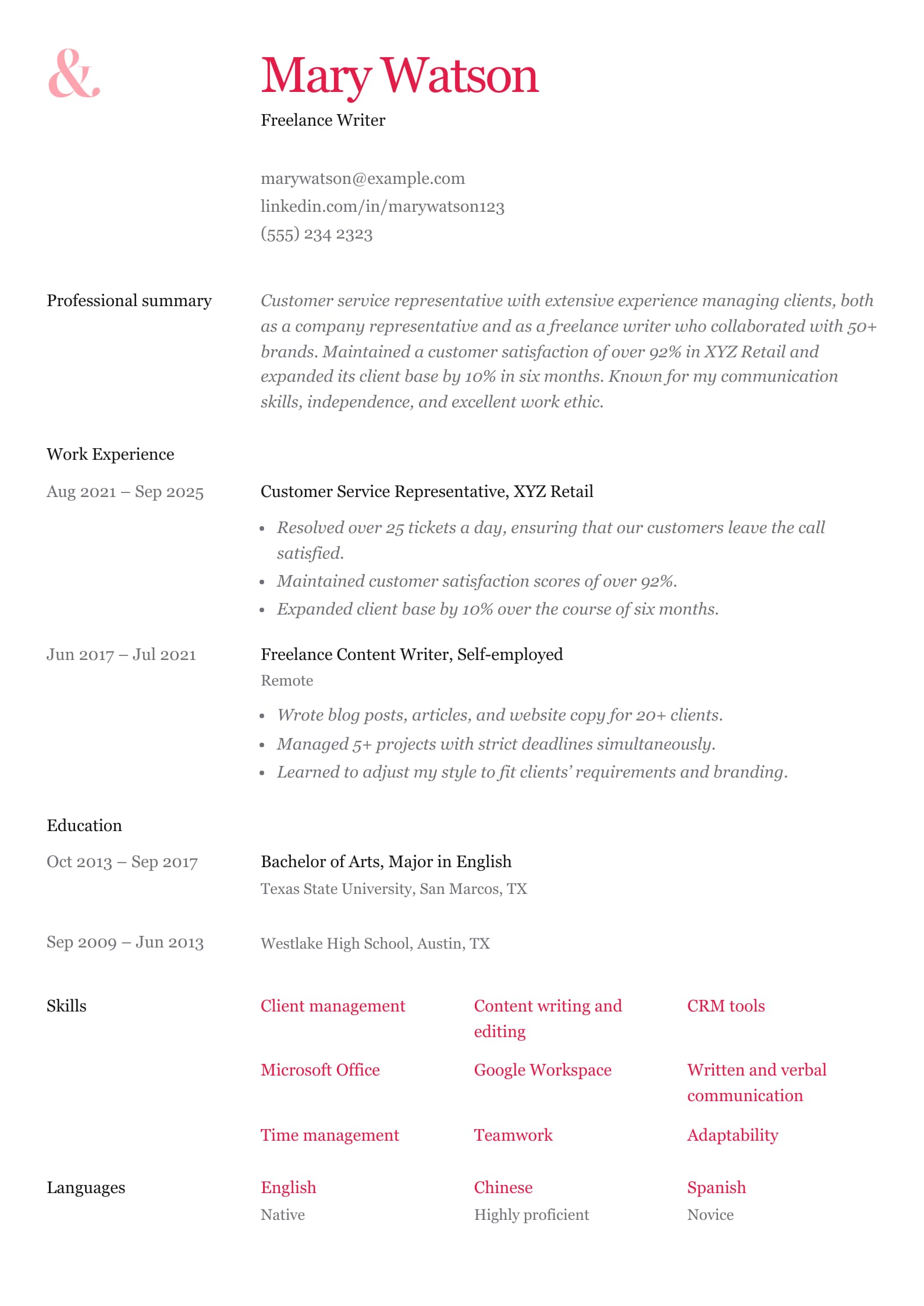
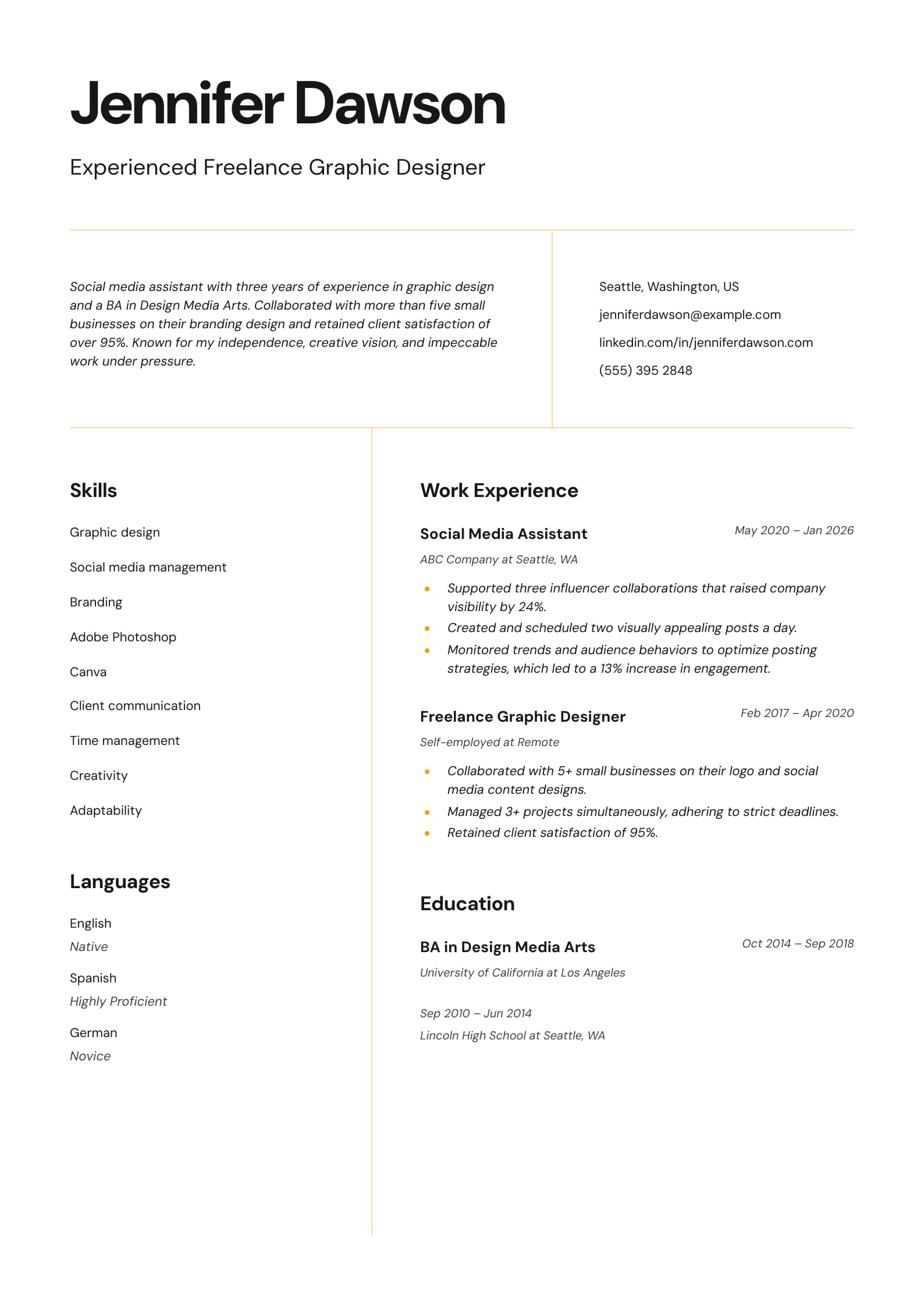
Before we explain how to put freelance work on a resume, we will show you two resume examples with freelance work, i.e., a writer resume and a graphic designer resume.
Should You Include Freelance Work on a Resume?
Yes, you should include freelance work on a resume in situations where it’s relevant to the position you’re applying for or demonstrates a particular skill. This is important nowadays especially, when freelancing is on track to become the U.S. workforce majority by 2027. Even beyond the U.S., there’s a worldwide shift toward the gig economy, which is projected to be worth $2,1450 billion by 2033.
That said, here are four reasons why you may want to add freelance experience to your resume:
Filling in employment gaps. If you’ve spent years working as a freelancer without any official employment, you should definitely include this experience. This closes that gap in your resume and shows that you weren’t sitting idly during that time.
Highlighting your independence. As a freelancer, you have to be highly organized, independent, and an excellent communicator to build and maintain relationships with your clients. Putting freelance work on your resume shows that you are ready to work without much hand-holding, which most employers appreciate.
Working with high-profile clients. If you’ve worked with some big names in your industry as a freelancer, you should emphasize this to gain an edge over other candidates. High-profile clients usually have high standards, and working with them proves that you can meet those.
Emphasizing a particular skill. Even with an extensive employment history, your freelance work may be the best demonstration of a specific skill you possess. In that case, you should highlight it, especially if it will benefit the position you’re applying for.
On the other hand, you don’t need to include it if it’s irrelevant to the job you’re applying for or if you already have extensive work experience that perfectly encapsulates who you are as a professional.
Where to Put Freelance Work on a Resume

You can put your freelance work on a resume in the work experience section, a separate “freelance” or “projects” section, or under skills and portfolio.
Now, let’s share some tips on how to do this effectively.
#1. In the Work Experience Section
Freelancing counts as work as much as official employment, so most people list it in the work experience section, which is perfectly appropriate. If you opt for this, treat it as any other entry; add it in the correct slot in the reverse chronological timeline and include achievement-based bullet points.
In other words, don’t do this:
Work Experience
Customer Service Representative
XYZ Retail
Austin, TX
August 2021–September 2025
Resolved over 25 tickets a day, ensuring that our customers leave the call satisfied.
Maintained customer satisfaction scores of over 92%.
Expanded client base by 10% over the course of six months.
Freelancer
Self-Employed, Remote
Instead, include all the necessary information, like so:
Good Work Experience Example
Work Experience
Customer Service Representative
XYZ Retail
Austin, TX
August 2021–September 2025
Resolved over 25 tickets a day, ensuring that our customers leave the call satisfied.
Maintained customer satisfaction scores of over 92%.
Expanded client base by 10% over the course of six months.
Freelance Content Writer
Self-Employed, Remote
June 2017–July 2021
Wrote blog posts, articles, and website copy for 50+ clients.
Managed 5+ projects with strict deadlines simultaneously.
Learned to adjust my style to fit clients’ requirements and branding.
#2. In a Separate “Freelance” or “Projects” Section
Alternatively, you can create a separate “Freelance” or “Projects” section to organize your resume better and improve its readability. This is especially useful if you have several projects that you want to highlight instead of grouping them all under one title.
In other words, you shouldn’t create a whole new section just to write this:
Freelance
Content Writer
Self-Employed, Remote
June 2017–July 2021
You can, however, do this:
Freelance Section Example
Freelance
Content Writer
Self-Employed, Remote
June 2017–July 2021
Wrote blog posts, articles, and website copy for 50+ clients.
Managed 5+ projects with strict deadlines simultaneously.
Learned to adjust my style to fit clients’ requirements and branding.
Content Editor
Self-Employed, Remote
October 2018–July 2021
Edited and optimized 500+ articles, ensuring that they fit the client’s style and branding.
Collaborated with clients to refine content strategy and ensure it aligns with marketing goals.
Implemented basic SEO strategies to improve outreach.
#3. Under Skills or Portfolio
Lastly, rather than discussing your freelance experience outright, you can include its outcome in the skills or portfolio sections. Essentially, you’ll list the skills you’ve gained from freelancing or add links to the best samples of your work.
However, remember to still be specific; your skills should describe precisely what you can do in a single word, and your portfolio link should come with a one-sentence summary. So, avoid doing this:
Skills
Freelancing
Writing
SEO
Portfolio
maryywrites.com
Instead, try something like this:
Skills & Portfolio Example
Skills
Content writing
Copywriting
Content editing and proofreading
SEO optimization
Client communication
Time management
Portfolio
maryywrites.com – a collection of my health and fitness blog articles
How to List Freelance Work on a Resume
To list freelance work on a resume, you should choose a clear job title, add your business name, include dates of work, highlight key projects or clients, and write achievement-based bullet points.
Let’s examine each of these steps:
#1. Choose a Clear Job Title
Don’t simply write “Freelancer” on your resume; this job title is too vague and doesn’t actually describe what you’re doing. Instead, use the “Freelance [Job Title]” format that better conveys your expertise, such as “Freelance Content Writer” or “Freelance Editor.”
If you’ve had several freelance roles in your career, you can list them separately, consolidate them using an umbrella term, or pick the most relevant one. Generally, we recommend the first and third options, as consolidating can be tricky if the roles are very different.
#2. Add Your Business Name or “Self-Employed”
When writing about regular employment, you put the company name right under your job title, but this obviously can’t be the case with freelancing. So, instead, use your business name or add “self-employed.”
Using a business name doesn’t necessarily mean you own a business; you can create one simply to sound more professional in your application. A common practice is to write your name and add the type of service you provide. For instance, “Mary Watson Freelancing” or “Mary Watson Content Writing” works just fine.
#3. Include Dates of Work
Every entry in your work experience section should be dated, and freelancing is no exception. Add the start and the end month and year, or write “Present” instead of the end date if you’re still freelancing.
Also, remember to follow the reverse chronological format with freelancing, too. There’s no need to list it separately from other entries in your work experience section; find its place based on the years you’ve started and finished doing it.
#4. Highlight Key Projects or Clients
You should include a short bullet-point list under each entry, where you can highlight key projects you’ve worked on and clients you’ve collaborated with. That way, your employer can see what niches you’re experienced in and better understand what they can expect from you.
#5. Write Achievement-Based Bullet Points
Finally, the bullet points mentioned above are the perfect spots to include your achievements and demonstrate why you’re the best pick. Remember to be as specific as possible and include actual numbers whenever you can. This will add a personal touch to your resume and make it sound far more convincing.
4 Common Mistakes to Avoid When Putting Freelance Work on Your Resume
Here are four common mistakes to avoid when putting freelance work on your resume:
Treating it as less important than other employment. Freelance work has just as much of a place in your experience section as any other type of work, so don’t put it at the bottom or avoid including it. Place it properly with other entries and elaborate on it as much as on anything else.
Vagueness. As mentioned before, generic titles like “Freelancer” aren’t particularly useful and may actually affect your resume’s quality. Always be specific, both in your job titles and your bullet-point achievements.
Including irrelevant jobs. If you’ve had many different gigs as a freelancer, you should only list those that are the most relevant to the job you’re applying for. For example, there’s no reason to include working as a photographer if you’re trying to become an accountant.
Not updating your resume regularly. If you’re still freelancing while applying to other jobs, you should keep adding the latest information. This is especially important if you’ve recently gained a high-profile client or begun working on a very relevant project.
Not sure how to list freelance work on your resume?
Let our resume builder help you!Closing Thoughts
Listing freelance work effectively is simply a matter of applying the same standards as any other role—specificity, dated entries, and achievement-based bullets. With this step-by-step guide on how to put freelance work on a resume, you’ll be able to list your freelance experience effectively and professionally.
However, if you still struggle, you can use one of our resume templates. That will save you plenty of time and trouble.
How to Put Freelance Work on a Resume FAQs
#1. Is it better to say freelance or self-employed on a resume?
Neither is better. ‘Freelance’ is more specific, while ‘self-employed’ can sound more formal in some industries. Freelancers work on multiple projects for different clients and frequently sign contracts for the duration of their services. On the other hand, self-employed individuals run businesses, can hire others, and aren’t necessarily under anyone’s jurisdiction.
#2. How do I list multiple freelance clients?
You can list multiple freelance clients in bullet points under the freelancer entry by writing the clients’ names and adding one measurable achievement for each. However, make sure that publicly announcing who you collaborated with doesn’t go against an NDA.
#3. What are the top 5 freelancing jobs?
The most in-demand freelancing jobs are web/software development, graphic design, content writing and copywriting, digital marketing and SEO, and video editing. These fields offer strong earning potential and consistent demand across industries worldwide.