
A web developer cover letter is a short and concise document that explains how your technical skills, project experience, and problem-solving abilities meet the needs of a specific employer. Its purpose is to provide space to explain the way in which your knowledge can contribute to the company’s projects.
More than anything, it should add context to your web developer resume rather than repeat it. This includes explaining some relevant achievements, demonstrating that you understand the role, and showing how you approach building functional, user-friendly, and reliable websites or applications for different purposes.
Regardless of your experience level, this guide walks you through the entire section-by-section writing framework and formatting rules that keep your letter sharp.
Key Takeaways
You should match your web developer cover letter to the specific technologies and requirements listed in the job posting.
Open with a clear value proposition instead of a generic greeting.
Use standard business letter format: header, greeting, three to four short paragraphs, and a sign-off.
Highlight measurable results rather than just listing programming languages you know.
Keep the letter to one page, even when writing a web developer cover letter with no experience.
2 Professional Web Developer Cover Letter Examples
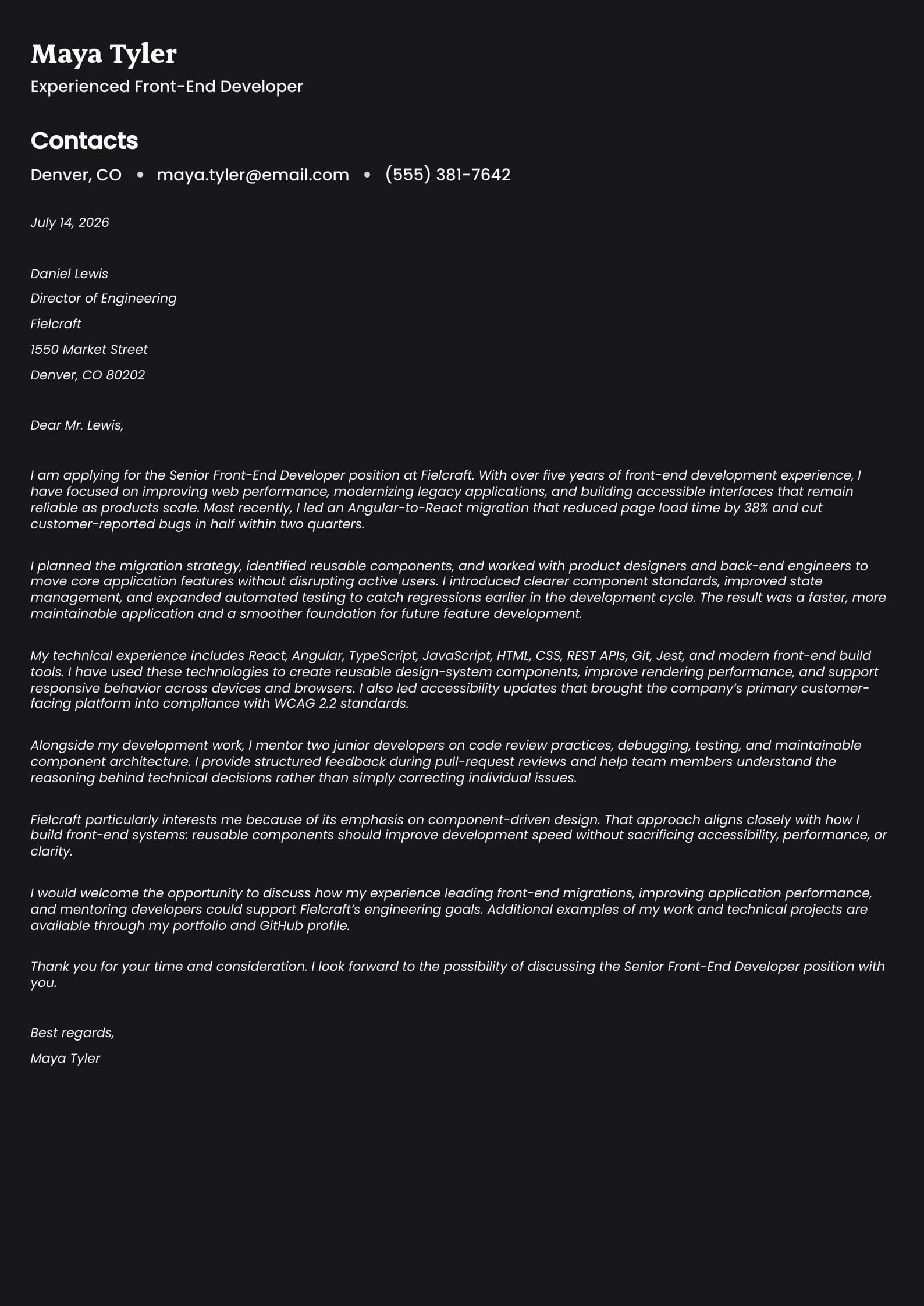
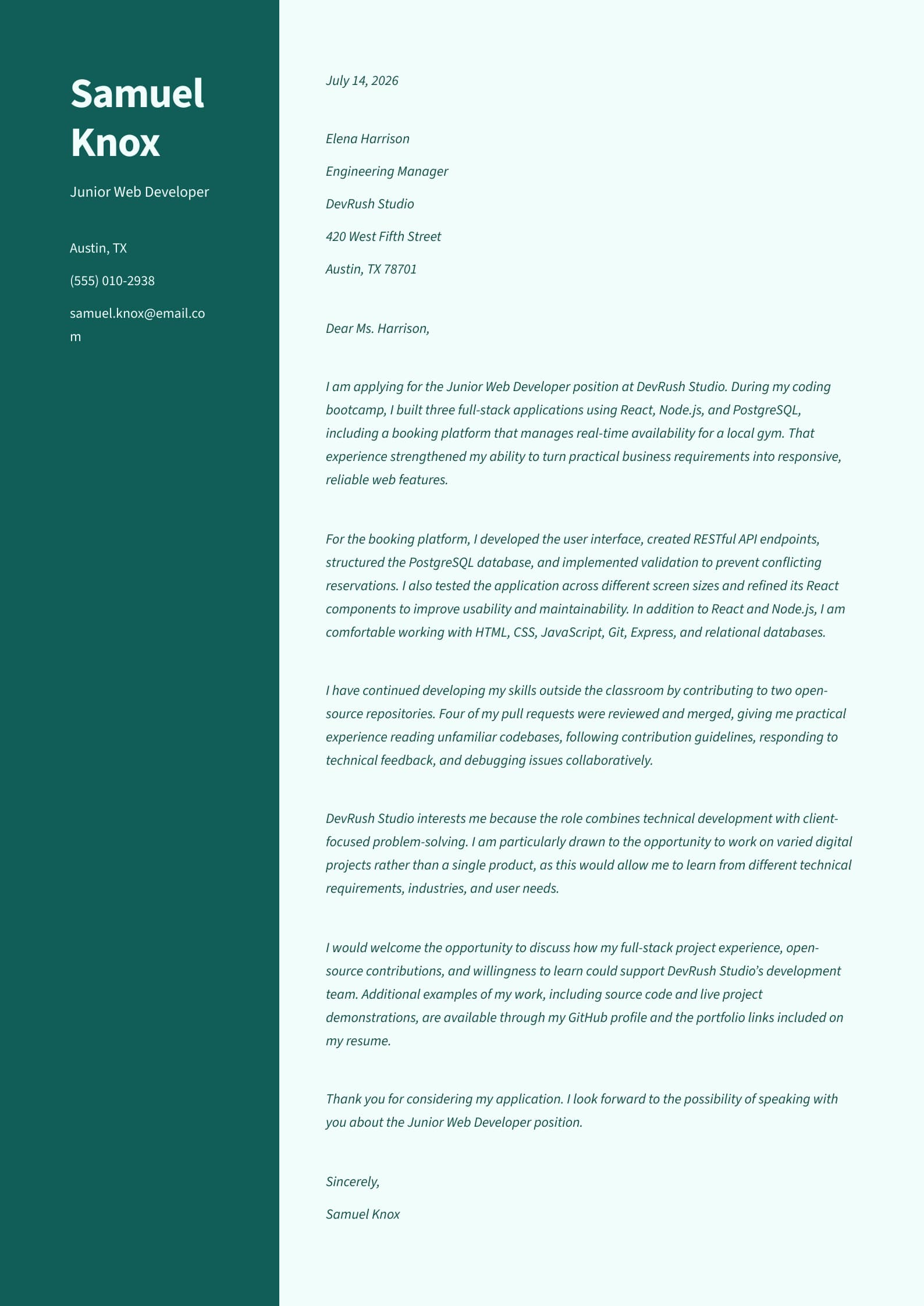
First of all, let’s take a look at two cover letter examples for a web developer, written for two different experience levels:
How to Format Your Web Developer Cover Letter

You should format your web developer cover letter in a way that emphasizes your strengths, skills, and qualifications and positions you as a competent candidate, which is why this aspect matters as much as the content.
The structure you should follow is similar to a standard business letter format and includes:
Header (name and contact details)
Date
Employer's contact information
Formal greeting
Three to four short body paragraphs
Sign-off
Besides sticking to the proven structure, you should also:
Use a professional cover letter font like Calibri, Arial, or Georgia (an unusual cover letter font can distract from your message rather than showcase it)
Set the font size to 11 or 12 points
Set one-inch margins on all sides
Single-space your text
Add a blank line between paragraphs for readability
Save the final file as a PDF so formatting stays consistent across devices and email clients
Give it a clear file name that includes your own name
In case you'd rather not build the layout from scratch, you can rely on a web developer cover letter template that can handle the structure while you focus on the content. Resume.co gives you a head start; the formatting in our cover letter templates is already set, and all you need to do is add the necessary information to customize your document.
How to Write a Web Developer Cover Letter: Explained
Here's how to write a web developer cover letter and what sections your document should contain:
#1. Heading
Begin with a proper header that should consist of:
Your full name
Phone number
Email address
Link to your portfolio or GitHub profile
LinkedIn profile (optional)
Date
Hiring manager's name, title, and the company's address
This part should match the one on your resume so your application looks cohesive across every document you submit. This also makes it easy for a recruiter to file your application correctly and reach you without digging through an inbox full of applicants.
Cover Letter Header
Emma Parsons
(555) 684-2197
emma.parsons@email.com
Columbus, OH
linkedin.com/in/emaparsons123
github.com/emmajparsons123
July 14, 2026
Michael Potter
Web Development Manager
Brightwell
780 North High Street
Columbus, OH 43215
#2. Greeting
In this part, you should greet a specific person. The best way to approach this is to take a quick look at the job posting, company site, or LinkedIn and try to find the exact name of the hiring manager.
Greeting Example
Dear Mr. Potter,
If you truly can't find a name, it’s acceptable to use a title like "Hiring Manager" instead of guessing incorrectly and risking an awkward first impression.
Alternative Greeting
Dear Hiring Manager,
#3. Introductory Paragraph
Next, you should start your cover letter by naming the exact position you're applying for and briefly mentioning a skill or achievement you’re proud of that could catch hiring managers’ attention right away. What you should avoid is restating your job title alone, since you should give the reader a reason to keep reading in the first two sentences.
In return, a good opener sets the tone for the rest of the letter. It should feel confident, not boastful, and it should connect directly to the specific job description you're responding to.
Cover Letter Opening
I am applying for the Web Developer position at Brightwell. Over the past three years, I have built and maintained responsive websites for small businesses and digital clients, with a focus on performance, usability, and clean front-end code. In the position I work in now, I redesigned a client’s e-commerce website and reduced its average mobile load time by 31%, contributing to a noticeable increase in completed purchases.
#4. Achievements and Skills Paragraphs
Here, it’s time to start listing the technical skills and experience most relevant to the job description, such as specific programming languages, frameworks, or platforms.
Rather than just naming tools, you need to describe how you used them. It’s a great opportunity to mention a project where you applied your hard skills to solve a real problem, and include some numbers or favorable outcomes when you can (e.g., faster load times, fewer bugs, or a feature you shipped end-to-end).
Employers weigh a candidate's web developer skills and qualifications heavily at this stage, so specificity matters more than length here.
Achievements and Skills Example
My technical experience includes HTML, CSS, JavaScript, PHP, WordPress, React, Git, and MySQL. I have used these tools to build custom themes, create reusable components, connect front-end interfaces with back-end systems, and resolve cross-browser issues.
For a recent WordPress redesign, I simplified the site structure, improved mobile responsiveness, and rebuilt the appointment request form. Within two months of launch, form completion increased by 24%, while booking-related customer inquiries dropped by 17%.
I also collaborate with designers, content teams, and project managers to turn design concepts into functional pages. By introducing reusable templates and a clearer testing process, I helped shorten average development time by 20% across six client projects.
#5. Reasons for Applying
In the part that follows, you should explain why you want to work in this company specifically. You could reference a product, an engineering blog post, a value that resonates with your own career goals, or anything else you encountered while researching the company and think you should mention.
Reasons for Applying Example
Brightwell appeals to me because of its focus on building websites that support measurable business goals. Your work on conversion-focused redesigns closely matches my interest in combining development, usability, and performance improvements.
#6. Call to Action
Before you end the letter, conclude the body paragraphs by inviting the hiring manager to take the next step. This means asking for an interview, pointing to your portfolio or GitHub for further proof of your work, and making it easy for the employer to reach you.
Call to Action Example
I would welcome the opportunity to discuss how my experience with responsive development, WordPress customization, and front-end optimization could support your team. My portfolio and GitHub profile include additional project examples and source code.
#7. Conclusion & Sign Off
Finally, thank the reader for their time and write a professional sign-off, such as "Sincerely" or "Best regards," followed by your full name.
Sign Off Example
Thank you for your time and consideration.
Sincerely,
Emma Parsons
4 Extra Tips for Crafting a Great Web Developer Cover Letter
Now that you know how to write the document and what to pay attention to primarily, here are some more cover letter tips that apply regardless of the experience level or role variations.
Replicate the job posting's language in your letter. If the listing mentions terms like responsive design or REST API integration, use those exact terms where they genuinely apply to your experience, since applicant tracking systems and human readers both scan for them closely.
Lead with outcomes instead of duties. Clear numbers that illustrate your achievements so far say way more than vague, unsubstantiated claims, and they give a hiring manager something concrete to remember later.
Tailor a front-end developer cover letter differently from a back-end one. Emphasize UI/UX collaboration, accessibility, and browser compatibility for front-end roles; for back-end or full-stack positions, it’s best to highlight databases, APIs, and system design instead.
Always proofread twice. You may think that details such as typos or any other writing errors couldn’t risk a developer's credibility, but it’s exactly the opposite, especially since precision is part of the job itself. Checking for some common cover letter mistakes before you submit the document can help you catch missteps that spellcheck hasn’t.
Ready to create your polished document?
Try Resume.co's cover letter builderFinal Thoughts
As you can see, a well-crafted web developer cover letter is all about combining your technical skills with context a resume can't provide: your reasoning, motivation, and fit for the team.
The examples and framework we provided above can serve as a great head start, but it’s also rather important to tailor the details to each job posting. With web developer roles projected to keep growing (7% over the next decade according to the U.S. Bureau of Labor Statistics), a solid letter is one more way to stand out in this complex and competitive field.
Web Developer Cover Letter FAQs
#1. How long should a web developer cover letter be?
A web developer cover letter should be one page long, which roughly equals around 400 words. Just like your resume, it should be concise, comprehensible, and clearly illustrate your best competencies.
#2. Do I need a cover letter for a web developer job with no experience?
Yes, you need a cover letter for a web developer job with no experience. In fact, it matters even more when your resume is thin on professional history, as it gives you room to highlight bootcamp projects, personal apps, and transferable skills that a resume alone can't fully capture.
#3. What should I avoid in a web developer cover letter?
In a web developer cover letter, you should avoid bland templates that don't mention the company or role by name, walls of text without paragraph breaks, and listing skills without examples of how you've used them.