
Artificial intelligence is transforming many industries, with the job market being impacted just as much. If you’re looking for employment, you need to know how to identify AI-generated resumes because recruiters have learned that, as well. They are good at distinguishing who used AI to polish their professional story and who used it to create a generic resume.
In this article, we take an in-depth look at AI-generated resumes to understand what separates those that impress recruiters from those that end up discarded immediately. We’ll explore the tell-tale signs of poorly written AI documents and teach you how to use this potent tool to create high-quality job applications ethically.
Key Takeaways
AI-generated resumes aren’t inherently bad, but they can be if they show a lack of effort and attention to detail.
Most of them are either copy-and-paste chatbot outputs, drafts polished by AI, or professional resumes designed by specialized AI solutions.
Some of the most common signs that a resume is AI-generated include the overuse of buzzwords, a lack of personal voice, inconsistencies, generic accomplishments, slip-ups, unedited placeholder texts, irrelevant content, keyword stuffing, and bad layouts.
If you’re a recruiter who’s unsure how to check AI-generated resumes, you should focus on the results and role-specific skills, look for personal touches, and examine candidates during interviews.
Are AI-Generated Resumes Bad?
AI-generated resumes are not bad when they are created and used properly. AI is a tool and, like any other technology, it can help you produce exceptional results when you know what you’re doing.
“Bad” AI resumes are usually a product of laziness. If a candidate uses a generic chatbot and a basic prompt to quickly generate a resume for their job application, they will likely end up with a poor result. This resume will feature robotic language with buzzword phrasing and be barely relevant to the specific role, which tells recruiters nothing about the person behind the application.
On the other hand, when a candidate understands that AI is a tool, they can use it to its full extent and create exceptional resumes. It can be used to refine their phrasing, improve the formatting, implement the right keywords and metrics, and more.
High-quality AI resume builders know which structure works for a resume. They also allow job seekers to optimize their writing and implement the right keywords for applicant tracking systems (ATS), helping them optimally communicate their value.
Types of AI-Generated Resumes
AI-generated resumes can be broadly categorized into three types:
Chatbot copy-paste resumes. These are the “lazy” resumes where candidates use simple prompts to get generic results, which they then copy and paste. These types of resumes are usually immediately identified as AI-generated.
AI-polished drafts. With these resumes, AI is used to polish the existing structure and/or writing, but the person has done most of the work. The resume is either completed ahead of time, before using AI for improvements, or the individual uses it to polish one section after another.
AI-enhanced resume templates. These resumes are usually created using specialized generators. They combine robust programming, the power of artificial intelligence, and human input to produce professionally formatted resumes. Generators often come with ready-made resume templates and are capable of tailoring documents to job ads.
9 Common Signs a Resume is AI-Generated
Identifying AI-generated resumes is usually not about spotting a single moment, but more about a combination of multiple elements that signal the person behind it hasn’t put in the effort.
Let’s go through some of the biggest and most common signs of AI-written resumes.
#1. Overly Generic Phrases and Buzzwords
Large language models (LLMs) are trained on vast sets of text and data to provide outputs based on the requests they receive. This makes them favor specific words and phrases much more than others; these may sound professional, but they will often produce writing that sounds “too corporate.”
Common words that AI uses include “pivotal,” “transformative,” “landscape,” and “delve,” as well as buzzword phrases like “results-oriented” and “proactive team player.”
Here’s an example of a resume line written by AI:
I am a results-oriented leader looking to delve into the digital marketing landscape to make pivotal changes in your organization.
Here’s the way it should be written:
Marketing manager with over 5 years of experience leading teams of up to 15 members, eager to increase your social media engagement by 35%.
#2. Lack of Personal Voice or Career Story
If you’re using a generic chatbot to write a resume, chances are it will be very similar to any other resume generated by the same chatbot. The writing will lack a personal touch and your unique way of talking about your accomplishments and the challenges you had to overcome.
Here’s an example of an AI sentence that sounds monotonous:
I am a hardworking salesman who enjoys a good challenge and synergizes well with interdisciplinary teams in achieving optimal outcomes.
When you infuse your resume with personal experience, you may get a line like this:
Experienced salesperson adept at building relationships with customers, having developed a loyalty program that led to a 13% increase in sign-ups.
#3. Inconsistent Details
Generative AI is notoriously bad at maintaining continuity when creating longer text or providing multiple outputs. As a result, it may mix up the terminology (e.g., use one phrase for your job title in the contact information section and another in your work experience), switch between first and third person, use different spelling conventions, etc.
If you don’t proofread your resume after generating it with a chatbot, you may end up with even bigger mistakes, such as improbable achievement scaling. Recruiters often look for someone’s career progress, especially if a resume is in the chronological format, so seeing huge leaps in results in short timeframes may trigger AI-generated resume detection.
#4. Generic Accomplishments

Having generic accomplishments in your resume is one of the most obvious signs of AI writing. If you’re using a multi-purpose AI and you don’t give it precise instructions, it won’t add any metrics to your resume (or it would hallucinate and add wrong ones). Alternatively, an LLM might fill out your resume with lists of duties and everyday tasks instead of results.
Here’s an example of what a generic accomplishment looks like:
Responsible for improving customer relationships and sales strategies.
Here’s a better example that focuses on a quantified result:
Conceptualized and implemented a new CRM outreach strategy to help the company generate $1.2M in Q3 revenue.
#5. “As a Language Model” Slip-Up
Users copying and pasting entire LLM outputs without proofreading happens more often than you think. As a result, job seekers may accidentally include AI phrases in their resumes, like:
“Certainly! Here is a resume summary…”
“Would you like me to generate something else?”
“I can also help you write…”
These mistakes are much more likely to happen to candidates who are mass-producing resumes to apply for numerous job postings at once. The phrases are a direct and irrefutable proof that your resume has been generated by AI.
Moreover, this mistake shows a severe lack of attention to detail and care for your application. This often leads to your resume being discarded on the spot.
#6. Irrelevant Sections
AI may include sections that you don’t need when applying for a particular role, or sections that are outdated entirely. For example, LLMs often include a section about references, even though that’s obsolete in many resumes and can even hurt your chances with recruiters.
On the other hand, AI may omit one of the core sections, like a resume summary or skills section.
#7. Unedited Placeholder Text
If a candidate uses AI-generated text without editing it, they may leave placeholder phrases in, like “insert company name here” or “ insert your achievement here.”
These phrases are a clear sign that a candidate has used AI and show a lack of careful editing while working on a resume.
#8. Keyword Stuffing
If you ask an LLM to insert keywords in your resume, chances are it will force many more of them in than required. This keyword stuffing can hurt your ATS score, reducing your chances of passing software screening; plus, not all keywords may fit in contextually, making your resume awkward to read.
#9. Suboptimal Layouts
Broad-purpose LLMs can’t create professional resume layouts like dedicated generators that have professional resume templates. If you just copy and paste a chatbot output, you’ll get a basic structure at best. More often than not, such a resume will have strange symbols for bullet points, random bolding, and inconsistent font choice and size.
AI-Generated Resume Example
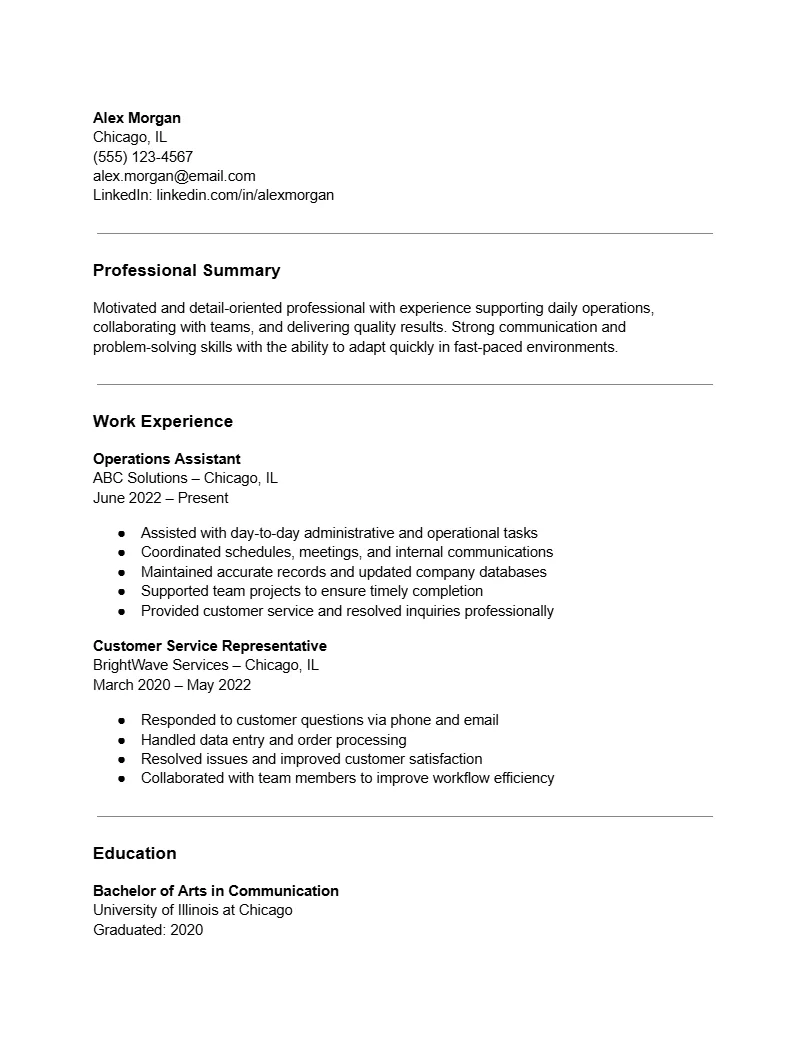
Here is an example of a bad AI-generated resume:
How to Evaluate Resume Quality Instead of Focusing Only on AI Detection
Having a resume that’s generated with the help of AI isn’t a problem on its own; having a low-quality resume is. As a matter of fact, 1 in 4 employers use AI in their HR operations, as well.
HR professionals can use an AI detector as one signal when reviewing resumes, but they should also evaluate whether the document is authentic, specific, and relevant to the role. Here are some tips on what to do:
Focus on impact and results. Instead of looking at whether the candidate used a lot of adjectives and buzzwords to describe their responsibilities, focus on numbers and results. AI can make a stylized sentence about general qualifications, but it can’t know the exact numbers tied to a candidate’s performance, so they are likely genuine.
Look for role-relevant skills. AI might know which general skills are relevant to the industry and profession, but not the specific ones required for the role. If a candidate carefully reads the job description and researches the company, they’ll have a list of skills tailored to the specific role, and not just a generic collection.
Validate through interviews and assessments. If you don’t know how to recognize fake resumes, you can always discover that during an interview. Simply ask a candidate to walk you through their resume or inquire about a specific point. If they respond fluently and confidently and provide a lot of details, the resume is likely authentic.
See whether there’s a personal touch. Look for a section about hobbies and interests, a candidate’s volunteering experience, or even a unique soft skill that’s not a standard part of a professional resume.
4 Best Practices for Job Seekers Using AI Ethically
If you’re a job seeker, using AI to ethically create or improve your resume isn’t cheating; it’s a way to modernize and improve your efforts. Let’s see what the best practices are that will help you do so properly:
#1. Use AI as a Drafting Assistant
The best use of AI is as a drafting assistant that can help you convey ideas more effectively. You can start by giving it all the facts and letting it find different ways to emphasize your skills and qualifications.
You should never let AI write the entire resume without your voice being dominant throughout. Every line that AI gives you may need to be modified to fit into a specific context. That way, you’ll ensure that you’re the writer behind your resume and that AI is just an assistant making sure your message is as clear and impactful as possible.
With Resume.co, you can easily strike this balance. Our AI helps you articulate your experience while keeping you in control of every word. You provide the raw details, and the AI suggests polished, professional phrasing. However, you always have the final say. This means you get the efficiency of AI-powered drafting without losing your authentic voice that makes your resume uniquely yours.
#2. Personalize Every Resume
Even if you go the extra mile to make an outstanding AI-generated resume, you still need to personalize it for every new job application. Recruiters may instantly discard a generic “one-size-fits-all” resume, as a lot of information in it might not be relevant to their position at all.
The most important sections are your resume objective or summary, work experience, and skills; you should go through all of them and manually adjust keywords to match the job ad.
#3. Add Metrics and Specifics
Make sure to include data, numbers, statistics, and concrete accomplishments in your resume. AI can help you with that if you give it the specifics, but you should still have the last say in how you’ll implement that in your writing. This is the best way to demonstrate that you have actual experience.
#4. Proofread and Edit
It’s critical to meticulously proofread your entire resume before submitting it. Review every sentence, as AI can make subtle mistakes and logical errors that are only visible once you pay close attention. For instance, it can state that you have 10 years of experience in software that has only existed for 5 years.
To be extra safe, you should give your resume to a friend, family member, or trusted colleague. A fresh pair of eyes may find resume mistakes that you have overlooked.
Want to make a resume with an AI that specializes in it?
Create my resumeClosing Thoughts
As you can see, knowing how to identify AI-generated resumes isn’t about avoiding artificial intelligence at all costs; it’s about leveraging it to get the best possible results. Many recruiters and HR professionals know how to detect AI resumes, but that doesn’t mean they discard them outright.
What they are looking for is effort, authenticity, and relevance. Therefore, you should use AI as an assistant that can improve your writing and provide you with professional formatting, but don’t forget to infuse the document with your personal touch.
By carefully proofreading and editing everything, you’ll ensure that there are no mistakes and that your resume is the best it can be.
How to Identify AI-Generated Resumes FAQ
#1. Can job recruiters know if your resume is AI-generated?
Job recruiters generally can’t know for sure if your resume is AI-generated, but they can become suspicious. If your resume has a combination of a robotic tone, generic phrases, and overused buzzwords, recruiters may assume that it’s been written by AI.
#2. Is it cheating to use AI for a resume?
No, using AI for a resume isn’t cheating. It can be problematic if you don’t fact-check the writing for accuracy or add a dose of authenticity to the document. Otherwise, it’s smart to leverage modern technology (including AI) to format your document or improve your writing.
#3. Are AI resume detectors accurate?
AI resume detectors are not fully accurate or foolproof. While they can spot some patterns that suggest the use of AI, these can also be false positives, flagging human writing as artificial intelligence. This is especially prominent when using formal language (e.g., when writing a resume).