

A cover letter for a university application is a formal letter that introduces you to the admissions committee and explains why you’re a good fit for the program you’re applying to. It gives you space to go beyond grades and test scores by highlighting your academic interests, relevant achievements, motivation, and long-term goals.
Generally, a well-written university application cover letter should feel personal without becoming overly informal or persuasive. It should also connect your background and ambitions to the specific university or program while showing what you could contribute as a student.
In this guide, we cover what to include, how to format it, and give you a full example you can adapt for your own application.
Key Takeaways
A cover letter for a university application explains why you're applying, what makes you a fit, and what you'll bring to the program.
Most bachelor's, master's, and scholarship applications either require one or list it as optional but recommended.
Don’t let this document exceed one page, address it to a specific person or committee, and open with an impactful first line.
You should follow a clear 7-step structure: research, address, open strong, connect to the program, highlight achievements, show fit, and close with confidence.
Avoid generic cover letter templates and vague statements when writing this document.
University Application Cover Letter Example
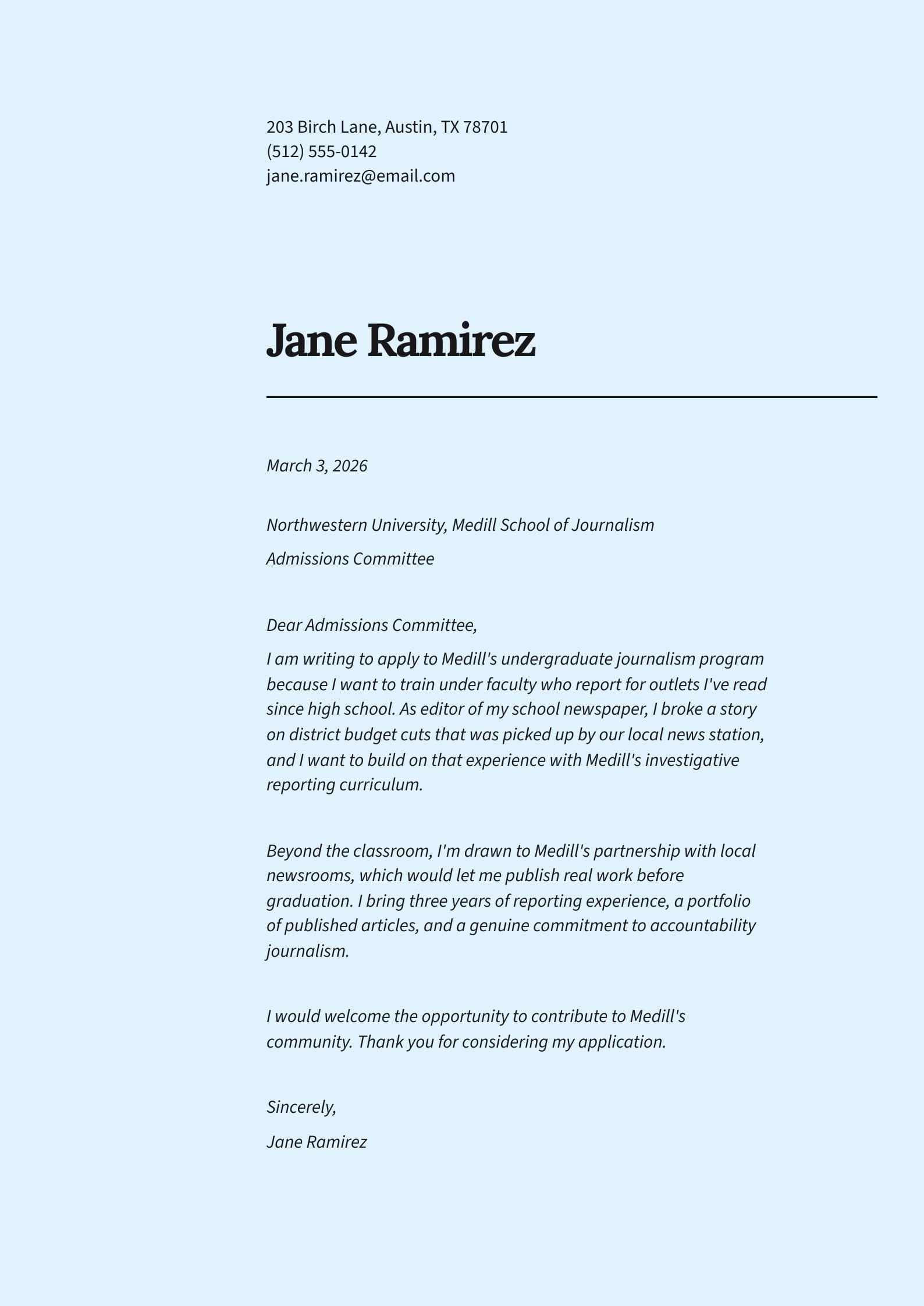
Here's a sample cover letter for a university application from a prospective journalism student applying to a competitive undergraduate program:
What Is a Cover Letter for a University Application?
A cover letter for a university application is a short, persuasive document you submit to explain why you're applying to a specific program and what you'll bring to it.
Such an addition complements your academic record by adding context and personality admissions committees can't get from grades alone. This can be particularly relevant in a holistic review, where admissions officers consider multiple parts of an applicant’s background and application rather than evaluating academic credentials in isolation.
This letter also connects your qualifications to a specific program's goals, and its purpose is to argue your case: why this school, why this program, and why now.
Some schools also call it a university admission cover letter or bundle it with other required materials, but the aim stays the same, and it’s to introduce you before the committee reads the rest of your file.
In the U.S., you'll often see this same document called a college application cover letter or a cover letter for a college application, while some graduate programs stick with university admission cover letters. All three describe the same document, and only the name changes by school.
Cover Letter vs. Motivation Letter vs. Personal Statement
Terms “cover letter for a university application”, “motivation letter”, and “personal statement” are often used interchangeably, but each serves a slightly different purpose depending on the institution and country.
Document | Focus | Typical Length |
|---|---|---|
Cover letter | Introduces you and connects your background to the specific program | Half a page to one page |
Explains your personal motivation and long-term goals, commonly required for European universities, graduate programs, and exchange applications worldwide | One page | |
Personal statement/statement of purpose | A deeper narrative about your background, values, and academic journey | 1–2 pages |
When Do You Need One?
You need a cover letter for a university application for:
Bachelor's or undergraduate programs, especially competitive majors like journalism, business, or the arts
Master's or graduate programs, where committees often expect a cover letter for a university application from postgraduates alongside your statement of purpose
Exchange or study-abroad programs, which often request a short letter explaining your goals
Scholarship applications, where a good letter can influence funding decisions
Competitive or limited-enrollment programs that receive far more applicants than available seats
Some universities require an academic cover letter outright, while others list it as optional but recommended. One thing is for sure, and it’s that reviewers notice when a candidate skips it.
How to Format a Cover Letter for a University Application
To properly format a cover letter for a university application, you need to include the following sections:
Header. Your name, address, phone number, email, and the date, followed by the recipient's name, department, and university address. Same as on the standard cover letter header, which is the exact layout admissions committees expect.
Salutation. Address the admissions committee or a specific staff member by name whenever possible.
Length. Avoid writing more than one page, because most reviewers spend under a minute per letter, so keep in mind how you use the space on your document.
Font and margins. Use a professional cover letter font like Arial or Calibri at 11–12pt, with one-inch margins on all sides.
Spacing. Single-space within paragraphs, and leave a blank line between each section so the letter stays easy to skim.
Because this is an academic cover letter and not a casual note, err on the side of a more formal tone than you'd use for a typical job application.
7 Steps to Write a Cover Letter for a University Application
Once you understand the format, writing a cover letter comes down to following a clear structure. These seven steps will help you write a cover letter for a university application that sounds confident and specific:
#1. Research the Program and Institution

Before you write a single sentence, research the program's curriculum, faculty, and values. Read the course catalog, browse faculty publications, and check the department's recent news. At institutions that consider it, this kind of specificity can also reinforce demonstrated interest, an admissions term for the ways applicants show genuine interest in attending a particular college.
Admissions readers can tell within a paragraph whether you've done your homework or copied a template. The more specific your references (e.g., a professor's research area, a signature course, a student organization, etc.), the more convincing your application becomes.
#2. Address It to the Right Person or Committee
Check the program's website or admissions page for a named contact, such as an admissions director or department chair. If you can't find one, address the cover letter to the Admissions Committee rather than using “to whom it may concern.” When you get this detail right, it implies attention and respect before the reader even reaches your first paragraph.
#3. Write a Strong Opening Statement
Skip overused openers and start with something specific. This may be a moment that sparked your interest in the university, a project you completed, or a direct statement of why this program fits your goals. That said, here’s a good example of how to start a cover letter of this type:
Cover Letter Opening
“When I rebuilt my high school's robotics team from three members to twenty, I discovered I wanted to study mechanical engineering at a school that values hands-on learning as much as I do.”
#4. Explain Why This Program Is Right for You
This section proves you chose the program intentionally rather than just because of its ranking alone. Connect your research from step one to your personal goals and mention specific courses, professors, research labs, or opportunities that align with what you want to study or explore.
Connect the Program to Your Goals
“Professor Chen's lab work on renewable materials matches the research I started in my AP Chemistry capstone, and I want to continue that work at a larger scale.”
#5. Highlight Academic Achievements and Relevant Experience
Choose one or two achievements that support your case. It’s best to focus on results within leadership roles, awards, research projects, or relevant work experience.
Share Relevant Accomplishments
“As captain of my debate team, I led us to our first state championship while mentoring five underclassmen through their first competitive season.”
#6. Show Your Goals and Fit With the Institution's Values
Admissions committees want students who will contribute to campus life. You can mention a club, research opportunity, or value the institution emphasizes, and explain how you'll engage with it. This shows you see yourself as part of the community. For undergraduate applicants, college application consulting can help connect those goals across the cover letter, personal statement and activities list, so each document adds something useful.
Highlight Your Goals and Values
“Your commitment to community-based learning matches my own experience volunteering at a local shelter, and I hope to continue that work through your service-learning program.”
#7. Close With a Confident, Polite Sign-Off
End the cover letter by restating your interest, thanking the reader for their time, and inviting further conversation if appropriate. For example:
Sign-Off Example
“I would welcome the chance to bring my research experience and curiosity to your program. Thank you for considering my application.
Best regards,”
5 Mistakes to Avoid When Writing a Cover Letter for a University Application
Good applicants lose points over avoidable errors that have nothing to do with their qualifications, too. Therefore, you should watch for these five cover letter mistakes before you submit your application:
Using a generic template for a cover letter for university application. Copying a one-size-fits-all letter from the internet is easy to spot, and admissions readers see hundreds of them each cycle. Swap generic praise for specific details about the program.
Writing more than one page. Long letters lose readers before they reach your best points. Therefore, trim anything that doesn't directly support why you're a fit for the program.
Skipping the salutation research. Addressing your letter to the wrong department or a generic “Dear Sir or Madam” suggests you didn't research the program. It’s always recommended to take five extra minutes to find the right contact.
Missing the tone. International applicants should pay particular attention to tone and formality, since conventions around academic writing vary by country. If English is not your first language, having a native speaker review your letter before submission is strongly recommended.
Ignoring proofreading. Mistakes undercut your credibility, especially for programs in writing-heavy fields. Read your letter aloud, then run it through a grammar checker before you submit.
Write This Part of Your University Application in Minutes
Try our cover letter builderClosing Thoughts
The purpose of a solid cover letter for a university application shows admissions committees why you're an intentional, informed choice for their program. If you research the institution, address the right person, open with something specific, and connect your achievements to what the program values, you have good chances of making the best of it.
Also, don’t forget to keep it to one page, proofread carefully, and avoid the mistakes that quietly work against strong applicants. For more inspiration beyond this guide, browse our full collection of cover letter examples across different fields and programs!
Cover Letter for a University Application FAQs
#1. Do all universities require a cover letter?
Not all universities require a cover letter, though many strongly recommend submitting one. Programs with competitive admission or limited seats are more likely to require it, while some list it as optional.
#2. What should you not include in a university application cover letter?
You shouldn't include your full resume, unrelated personal details, or generic statements that could apply to any school. It’s best to skip anything that doesn't directly connect your background to the specific program you're applying to.
#3. How long should a cover letter for a university application be?
A cover letter for a university application should be one page or shorter, typically 300 to 400 words, though some programs prefer shorter letters of 200 to 250 words. Therefore, always check the specific program's requirements first.