
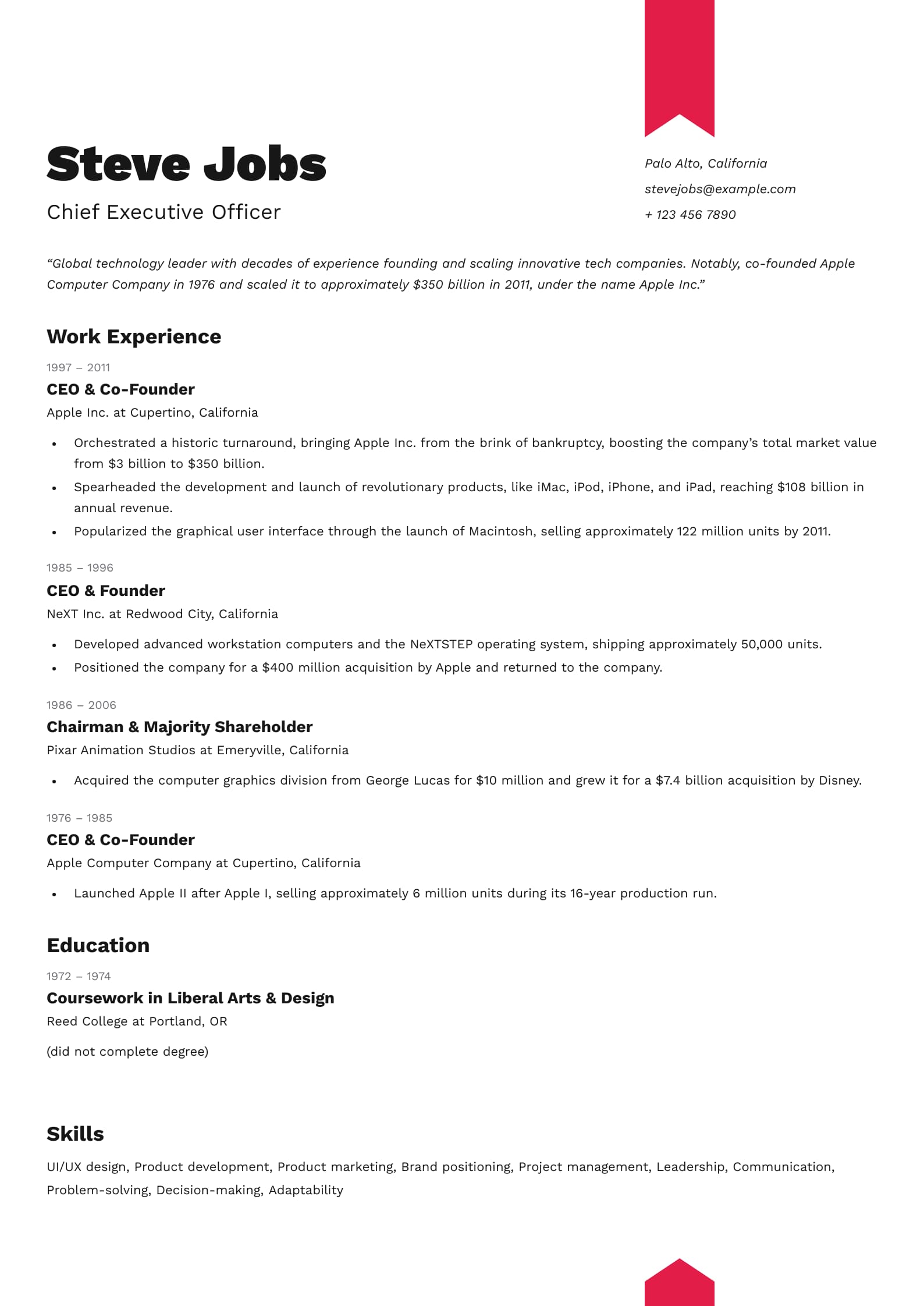
Steve Jobs’ resume (or at least the document he’d create to capture his career trajectory) tells a story of relentless reinvention. It can provide invaluable insight to any professional who wants to elevate their career profile and focus on innovation, vision, and results.
Even if you don’t have accomplishments as impressive as Steve Jobs’, you can take lessons from his work history, creative thinking, and leadership style.
In this article, we’ll go through Steve Jobs’ career history and give you an example of his resume based on it. We’ll see what format he’d use, what lessons we can learn, what skills made him famous, and more.
Key Takeaways
Steve Jobs’ resume would work best using the chronological resume format, though the hybrid format may be a good choice, too.
While he didn’t have higher formal education, Steve Jobs’ career features major milestones, including co-founding Apple, founding NeXT, and owning Pixar.
Steve Jobs possessed a vast array of skills, ranging from visionary thinking and brand development to leadership, communication skills, and resilience.
To make a resume similar to Steve Jobs’, focus on impact, showcase innovation, keep your message simple, and highlight both soft and cross-disciplinary skills.
Steve Jobs Resume Example
Before we dive into a deeper analysis to see what we can learn, we need to see what Steve Jobs’ resume would look like today. His executive resume example demonstrates how his efforts and accomplishments can be translated into a single impactful page:
What’s the Best Format for Steve Jobs' Resume?
The best format for Steve Jobs’ resume would be the chronological resume format, as it would clearly highlight his progression from a college dropout to a technician and entrepreneur to a global business leader.
The chronological format is the best choice for most job seekers. It lists previous jobs and accomplishments in reverse chronological order, giving recruiters a clear insight into a professional’s current skill level and career journey.
Another format that could be suitable for Steve Jobs’ CV or resume is the combination (hybrid) format. This format would help emphasize Jobs’ many impressive skills while still showcasing his achievements.
Steve Jobs Biography
To fully understand Steve Jobs’ resume, we need a concise overview of his professional career. Here are the biggest milestones that shaped him as a visionary and industry leader:
1971: He is still in high school when he’s introduced to Steve Wozniak. Jobs develops an early interest in technology alongside Wozniak
1972: Jobs enrolls at Reed College in Oregon and drops out after just one semester.
1974: Steve Jobs works as a technician and video game designer at Atari, gaining valuable experience in the technology industry. During nights, he’d work with Wozniak on developing the circuit board for the arcade game Breakout.
1976: Steve Jobs, Steve Wozniak, and Ronald Wayne co-founded Apple in Jobs’ family garage and launched the Apple I computer.
1977: They released Apple II, which was one of the first highly lucrative and successful mass-produced personal computers, launching the personal computer revolution.
1984: Apple unveils the Macintosh, which becomes the first mass-market personal computer with a graphical user interface and a mouse. Macintosh became a landmark product that changed the way people interact with computers.
1985: Jobs ends up clashing with the company’s board of directors and CEO John Sculley. He is ousted from Apple and establishes NeXT to develop advanced computer systems and software for the education sector.
1986: Jobs buys the computer graphics division from George Lucas for $10 million and transforms it into Pixar.
1995: He oversees the creation of Toy Story, the first fully computer-animated feature film.
1997: Jobs returns to Apple after it acquires NeXT in 1996 and becomes interim CEO.
1998–2010: Steve Jobs transforms Apple into a global leader by leading the development of the iMac, iPod, iTunes, iPhone, and iPad.
2011: He resigns as CEO due to health problems and passes away later that year.
5 Top Resume Lessons You Can Learn From Steve Jobs
While it’s almost impossible to have a career similar to Steve Jobs’, anyone can take lessons from his resume to strengthen their documents. The core principles are applicable regardless of where you are in your professional journey. Here are the top five lessons you can learn:
#1. Focus on Impact, Not Responsibilities
Steve Jobs’ resume doesn’t describe his day-to-day activities and responsibilities; it emphasizes the biggest and most impressive results that had a lasting impact.
You should do the same thing with your resume. Instead of showcasing your daily duties and basic tasks, use your resume summary and your work experience section to point out your most notable achievements.
Instead of writing “I managed a team,” your bullet points can say “Managed a team of 15 to launch a successful product 30 days ahead of schedule.” Use numbers to quantify your efforts and action verbs to make them more memorable.
#2. Showcase Innovation and Leadership

Steve Jobs was renowned for innovation and leadership. He was constantly pushing boundaries and looking for excellence from those around him.
Even if you’re not writing a tech CEO resume, you can showcase the same mindset by emphasizing instances in which you challenged the status quo. Employers are always looking for creative thinkers and those who take accountability and can rise up to the occasion.
To do this, provide concrete examples of when you adopted new technologies, proposed new strategies that were successful, led teams through challenging periods, and more.
#3. Keep Your Message Clear and Simple
One of the key strengths of Steve Jobs’ resume is its ability to convey impressive information about his accomplishments concisely and straightforwardly. Moreover, Jobs’ entire design philosophy was to avoid clutter and complexity, whether it’s a computer screen or a product’s exterior.
The same goes for your resume, which, in most cases, should be one page long. Make sure to tailor every bit of information (whether it’s a skill or an accomplishment) to the role you’re applying for.
Beyond that, you need a clear and professional resume layout with distinct sections and section headings, plenty of white space, and bullet points rather than blocks of text.
#4. Highlight Valuable Soft Skills
While Steve Jobs had an impressive set of hard skills and technical proficiency, his soft skills helped him overcome setbacks, even after being forced out of Apple. His adaptability and resilience allowed him to push forward, his communication skills to elevate his brand, and his leadership prowess to guide huge teams and companies.
While soft skills can be much harder to prove than hard skills (which can be validated with degrees and licenses), you can still highlight them in relation to notable accomplishments. Write about the times when you rebuilt projects (or even your career) after setbacks, what you learned from failures, how you adapted to sudden changes or market shifts, and so on.
#5. Include Cross-Disciplinary Qualifications
Steve Jobs was a leader in the tech industry, but he famously spoke about its connection with the liberal arts and humanities. His interests in design, calligraphy, and music heavily influenced his work in information technology.
You can do the same when writing your resume. Depending on the job that you’re applying for and your skills and qualifications, you can point out unique intersections to gain an edge over the competition. For instance, a marketer who understands Python or an engineer with a background in psychology may excel in their fields and in cross-functional collaboration.
What Skills Made Steve Jobs Successful?
Steve Jobs possessed a vast array of skills spanning different fields. He didn’t have extensive traditional education in software programming or electrical engineering, but the diversity of his abilities helped him become a global phenomenon.
If Steve Jobs had LinkedIn, some of the core skills that you’d find on his profile include:
Visionary thinking
Strategic planning
Product design
Product development
Innovation management
Skills that allowed Jobs to found or acquire multiple companies and elevate them to a global status include:
Brand development
Presentation skills
Marketing
Public speaking
Negotiation
Business development
Creative thinking
Persuasion
Next, here are some of the interpersonal skills that helped him lead teams and companies:
Team building
Project management
Deal-making
Organizational skills
Finally, personality traits that helped Jobs push through all the setbacks and achieve excellence every time include:
Adaptability
Resilience
Entrepreneurship
Some of Steve Jobs’ biggest strengths came from the way he combined his skills.
For example, he always combined in-depth technical understanding with design principles to create products that were technologically revolutionary yet intuitive.
His focus on user experience, combined with his communication skills, helped him anticipate what customers would want before they could even clearly articulate it themselves. Not only that, but he was able to explain complex concepts to customers who weren’t tech-savvy, helping them understand the value behind his products and ideas.
Lastly, he always maintained a strong vision, using exceptional leadership and strategic thinking to recruit talent, guide his team, and allocate resources where they mattered most.
Build Your Own Steve Jobs-Style Resume with Resume.co
Whether you’re an entrepreneur, senior professional, founder, or executive, you need a resume to help you convey your qualities. At Resume.co, we created a feature-packed resume builder with numerous professional and executive resume templates that you can use to create your document in minutes.
You simply pick a template, use our AI to present your accomplishments like Steve Jobs would, modify the layout with an intuitive interface, and download a finished product. You can also upload an existing resume and edit it, or go through our extensive library of resume examples for inspiration.
Ready to make an exceptional resume?
Create my resumeClosing Thoughts
The lessons you can learn from Steve Jobs’ resume apply regardless of your career level. While the ideas are essential if you’re learning how to write a CEO resume, the core concepts apply to entry-level candidates just as well.
While you can use Steve Jobs’ resume as a template, the example should only serve as guidance. Your resume should be a reflection of your qualifications related to the role you’re after. That’s why you need to tailor it meticulously, focusing on communicating your most impressive accomplishments clearly and concisely.
Steve Jobs Resume FAQs
#1. How did Steve Jobs' career start?
Steve Jobs’ career started in 1974, when he started working as a technician and video game designer at Atari. He worked night shifts to develop video game hardware with his friend, Steve Wozniak. Two years later, they co-founded Apple Computer in Steve Jobs’ family garage.
#2. Did Steve Jobs have a resume?
Yes, Steve Jobs did have a resume, but it was a handwritten application that didn’t look like modern resumes. He created it in 1973, for a job application filed after dropping out of Reed College. The document lists skills like electronics, design, computers, and technology.
#3. How can I add entrepreneurial experience to my resume?
You can add entrepreneurial experience to your resume in the work experience section, similarly to how you’d add a previous job that you had. You should include your company name, your job title, dates, and achievements (e.g., revenue growth, product launches, funding milestones, business outcomes).