
A hospitality cover letter is a short document that formally introduces you to a potential employer and explains why you’re a strong fit for the hotel, restaurant, or guest service role you’re applying for. It also complements your resume by providing more detailed descriptions of how your industry-related skills match the needs of the position and what you achieved.
As hospitality jobs depend heavily on guest experience, your cover letter should make it clear that you know how to stay professional, helpful, and calm in fast-paced situations. Regardless of the type of position (since the industry is broad), the goal is to show that you can represent the business well and make guests feel welcome.
Learn how to write a document like this and how it can help you get your interview invitation!
Key Takeaways
A hospitality cover letter should introduce your best service skills, guest-facing experience, and ability to stay professional in fast-paced environments.
Good formatting matters, so keep the letter on one page, use a clean business-letter structure, and break the content into short, readable paragraphs.
You should use specific examples instead of vague claims, such as resolving guest complaints, improving check-in processes, or using tools like Opera PMS, POS systems, or reservation platforms.
Tailoring the letter to the specific hotel, restaurant, resort, or hospitality brand is a must because it implies genuine interest and basic research.
The best closing will include a confident call to action, a thank-you to the employer for their time, and an easy way for them to contact you for an interview.
2 Outstanding Cover Letter Examples for the Hospitality Industry
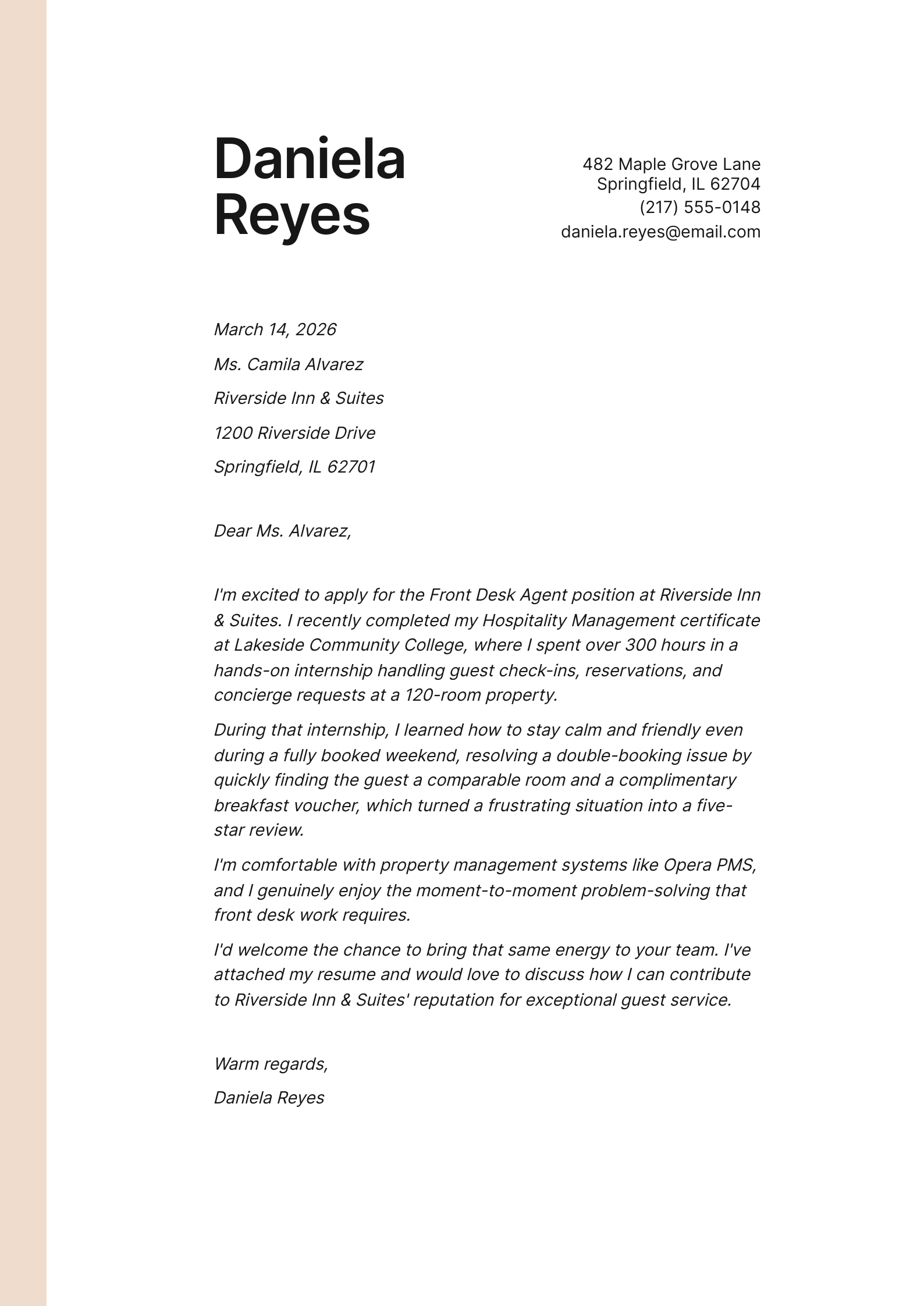
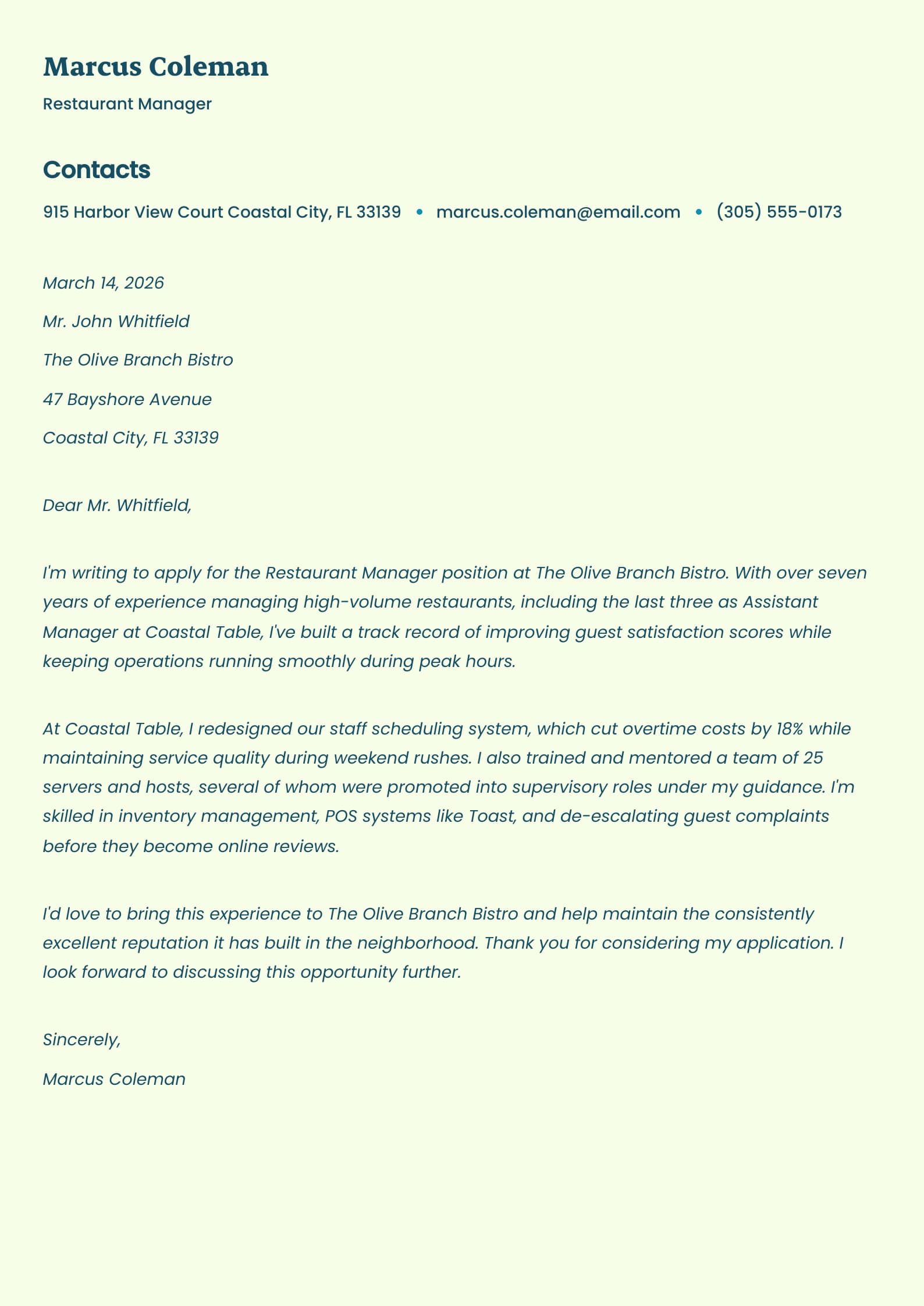
Seeing real cover letter examples before you start writing your own can make the writing process much less intimidating. We bring two samples, one for someone just starting out and one for a more seasoned hospitality professional, that show how to structure and word your own letter.
How to Format Your Cover Letter

You must format your cover letter in a way that will make it read well and look professional, since hiring managers form first impressions fast, often within seconds of opening your application. If they see a cluttered or oddly formatted letter, it could make them discard it even before they’ve read any part of it, so getting the structure right matters just as much as what you say.
When writing a restaurant, resort, or hotel cover letter, it’s best to stick to standard business letter format:
Your contact information at the top
Date
Employer's details
Formal greeting
Body paragraphs
Sign-off with your name
You should use a neat, easy-to-read font like Calibri, Arial, or Garamond at 11 or 12 points, and keep your cover letter header simple rather than overly decorative. Margins should sit around one inch on all sides, and the entire letter should fit on a single page, ideally between 250 and 400 words.
For even better formatting, break your letter into three or four short paragraphs instead of writing one dense block of text. Also, make sure you don’t add any graphics or colors unless you're applying to a boutique or design-forward property, where a little personality in the cover letter font choice might actually help you stand out. When in doubt, simpler is always better, since the goal is to make your document easy to skim and your qualifications easy to find.
Hospitality Cover Letter: Full Writing Guide
Writing a cover letter from scratch is simpler and more manageable if you break it into steps. Here's how to build yours section by section.
#1. Heading
Start the letter with your full name, phone number, email address, and city or general location at the top of the letter. Below that, include the date you're writing it, followed by the employer's name, job title, and the company's address if you have it. This heading establishes a professional tone right away and makes it easy for hiring managers to follow up.
Heading Example
Lena Morris Chicago, IL (312) 555-0186 lena.morris@email.com
June 30, 2026
Ms. Kayla Bennett Hiring Manager The Grand Harbor Hotel 120 Lakeside Avenue Chicago, IL 60601
#2. Greeting
Whenever possible, you should address the letter to a specific person rather than use "To Whom It May Concern." If necessary, check the job posting, the hotel or restaurant's website, or LinkedIn to find the hiring manager's name.
A greeting like "Dear Mr. Tran" or "Dear Ms. Bianchi" is a good option, feels personal, and shows you put in a little extra effort, which matters a lot in an industry built on personal touches.
Greeting Example
Dear Ms. Bennett,
#3. Introduction
Your opening paragraph should state the position you're applying for and immediately highlight one or two relevant hospitality skills and qualifications. Hospitality hiring managers often review dozens of applications, so you shouldn’t just bury the part that should be most captivating in your letter.
Mention your background briefly and let your enthusiasm for the role come through naturally without sounding rehearsed or fake.
Introduction Example
I am applying for the Front Desk Agent position at The Grand Harbor Hotel. With three years of hospitality experience, solid guest service skills, and a calm, solutions-focused approach to busy shifts, I am confident in my ability to help create the welcoming and professional experience your guests expect.
#4. Achievements and Skills

Once you’ve introduced yourself in the opening paragraph, it’s time to list specific skills and experiences tied directly to the job description, and back them up with proper examples whenever you can. For example, this means describing a specific time you resolved a guest complaint or improved a process instead of just stating you have great customer service skills.
If the role requires familiarity with specific software, like a property management system, POS platform, or reservation tool, you should mention your experience with it here.
Listing Specific Skills and Experiences
In my current role as a Guest Services Associate at Riverstone Suites, I handle check-ins and check-outs, manage reservations, answer guest inquiries, and resolve service issues in person, over the phone, and by email. I regularly use Opera PMS to update bookings, process payments, and coordinate room changes with housekeeping. One of my proudest achievements was helping reduce guest wait times during peak check-in hours by suggesting a clearer pre-arrival email process, which made arrivals smoother and reduced repeated questions at the front desk.
I have also learned how important patience, attention to detail, and communication are in hospitality. When a guest arrived to find that their requested room type was unavailable due to an unexpected maintenance issue, I quickly arranged an upgraded alternative, coordinated with housekeeping to prioritize the room, and offered local dining recommendations while they waited. The guest later mentioned the interaction positively in an online review, which reinforced how much thoughtful service can shape the overall guest experience.
#5. Reasons for Applying
Besides hearing about your competencies, hiring managers want to know why you specifically want to work for them rather than with other hospitality employers.
Here, you should mention something about the company's reputation, values, location, or guest experience that genuinely appeals to you. This shows you've researched the property or restaurant rather than sending the same generic letter to every job posting.
Mentioning the Reasons for Applying
I am especially interested in The Grand Harbor Hotel because of its reputation for polished service and its focus on making both business and leisure travelers feel genuinely cared for. Your property’s location near the lake and downtown attractions also makes it the kind of fast-paced, guest-focused environment where I know my experience and personality would be a strong fit.
#6. Call to Action
You should close your main content with a confident call to action. This means inviting the employer to contact you for an interview, and if relevant, point them toward a portfolio, LinkedIn profile, or additional references. A direct, polite nudge here makes it easy for the hiring manager to take the next step.
Adding a Call to Action
I would appreciate the opportunity to discuss how my hospitality background, experience with reservation systems, and commitment to excellent guest service can contribute to your team. Please feel free to contact me at (312) 555-0186 or lena.morris@email.com to schedule an interview.
#7. Conclusion & Sign Off
Finally, it’s best to end your letter with a brief thank-you for their time, then sign off professionally with "Sincerely," "Best regards," or something similarly neat, followed by your full name. This section should be short and simple.
Conclusion Example
Thank you for your time and consideration.
Sincerely, Lena Morris
4 Pro Tips on How to Write a Hospitality Cover Letter That Works Best
A few extra touches can take your letter from solid to standout, so keep these four writing tips in mind as you create or revise yours:
Match the brand tone of voice. A luxury resort and a casual diner expect different communication styles, so read the job posting carefully and imitate their tone, be it neat and formal or warm and conversational.
Quantify your impact wherever possible. Numbers (in this case, hospitality performance metrics) have an important role in a reader's mind. Therefore, if you mention that you improved guest satisfaction scores by a certain percentage or managed a team of a specific size, it will give your claims more weight than mere vague descriptions.
Avoid repeating your resume word-for-word. Your cover letter should add context and personality to your job application that a hospitality resume alone can't. Use it to tell a brief story or mention a moment that shows your best skills in action.
Proofread carefully, and then do it again. Errors in your letter are one of the biggest cover letter mistakes and can ruin an otherwise good application, especially in an industry where attention to detail is a must. Reading your letter out loud or asking someone else to review it is often a good idea because it helps you catch mistakes you'd otherwise miss.
How Resume.co Makes Cover Letter Writing Easier
Now that you know what makes an effective hospitality cover letter, the next step is turning those ideas into a professional document. Instead of starting from a blank page, let our cover letter builder do the heavy lifting. Pick one of the cover letter templates we made for you, and get a concise, professional document for your job application in just a few clicks.
Ready to land a hospitality job?
Build my cover letterFinal Thoughts
All in all, you now know that a well-written hospitality cover letter should combine professionalism with the warmth that defines the industry itself.
If you follow a clear structure, mention the achievements you’re proud of, and tailor your message to the employer accordingly, you can give yourself a real edge over candidates who send generic applications. Use the examples and guide above as a starting point, then adjust the tone and details to fit your own experience and the role you're after.
Hospitality Cover Letter FAQs
#1. How long should a hospitality cover letter be?
A hospitality cover letter should be around 250 to 400 words, which means short enough to read in under a minute but long enough to include all relevant skills and experience.
#2. Do I need a cover letter if I have no hospitality experience?
Yes, you need a hospitality cover letter even with no experience. In fact, it’s especially valuable when you lack direct work history because it lets you present your transferable skills like communication, teamwork, and problem-solving while showing genuine enthusiasm for the role.
#3. Should I customize my cover letter for each hospitality job application?
Yes, you should absolutely customize your cover letter for each hospitality job application. You should do it when applying to any specific property, restaurant, or brand, since it shows hiring managers you've researched their business and genuinely want to work there.