
You can write a compelling cover letter for your first job by highlighting transferable skills you have honed as a student, volunteer, and intern, and tailoring the content to the job description.
A well-written one helps you stand out and secure your dream role, even if you don’t have formal work experience. In this guide on writing a cover letter for beginners, we will provide two samples to give you an idea of what yours should look like and explain how to create your own cover letter without hassle.
Key Takeaways
Your cover letter for a first job should have a block format (the one used in business letters) and be easy to read, with a simple serif or sans-serif font.
It should include a header, a salutation section, an opening, two body paragraphs, a closing with a clear CTA, and a sign-off.
Writing a strong cover letter requires you to research the company beforehand and focus on your transferable skills and non-traditional experiences.
Professional cover letter tips to keep in mind include emphasizing your value with numbers, not just repeating the contents of your resume, and demonstrating initiative.
2 Outstanding Cover Letters for First Job
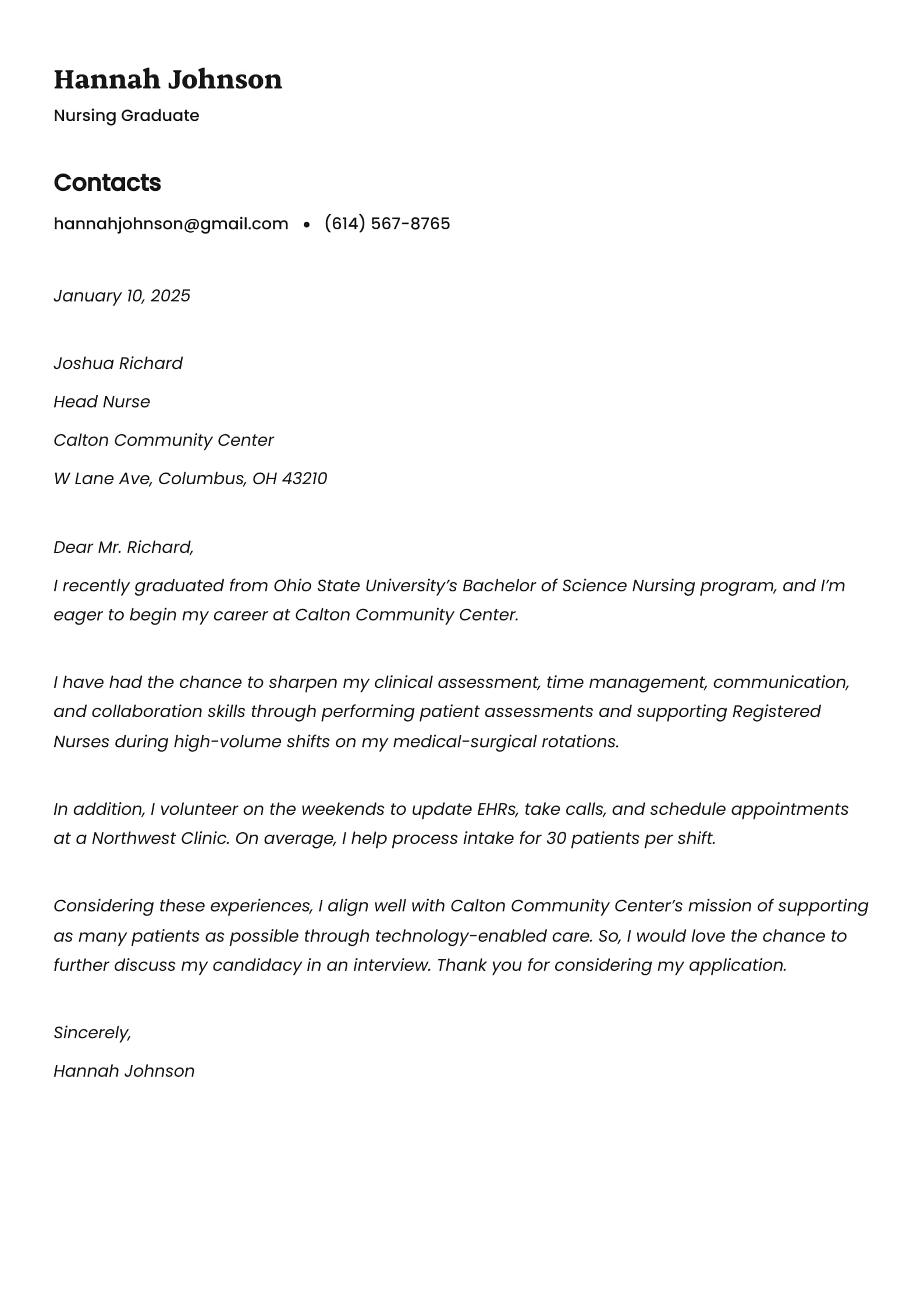
Here is a sample cover letter for a first job in nursing:
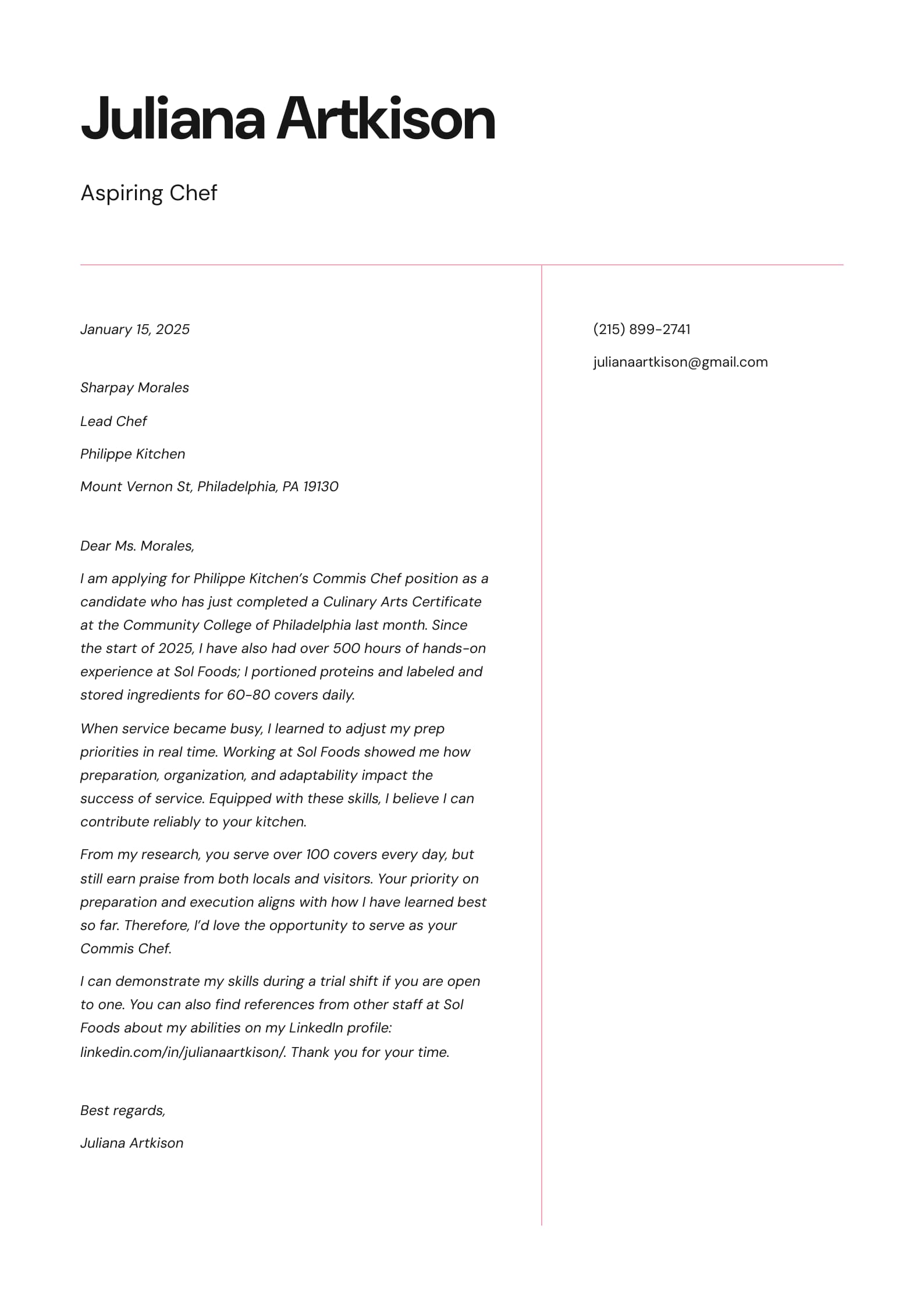
Below is another first job cover letter example; this one complements a chef resume:
How to Structure Your Cover Letter For a First Job
The structure of your first-job cover letter should be similar to that of a business letter. You can use a block format, which means that the text is aligned to the left and single-spaced.
These are the sections your cover letter needs to contain:
Header. Include your full name, phone number, email address, the date, and the employer’s details
Salutation. Greet your employer by using their name and job title
Opening paragraph. Catch your employer’s attention by spotlighting your top skills and achievements; make sure these align with what the employer is looking for
First body paragraph. Elaborate on why you are a strong fit for the role and why you should be selected among other candidates, using examples with measurable results
Second body paragraph. Explain why you want to be a part of the company, tying in your research about their mission, vision, and goals, or why you chose to pursue this career path
Closing paragraph. Thank the employer for their time, reinforce your interest in the role, and include a call-to-action (CTA)
Sign-off. Close your cover letter with a sign-off like “sincerely,” “respectfully,” “best regards,” or “kind regards.”
How to Write a Cover Letter for a First Job
To write a cover letter for your first job, follow these steps:
#1. Research the Company and Role

Before you start writing your entry-level cover letter, you should spend time researching the company that you are applying to. Having a good grasp of their mission, vision, and goals can help you tailor your content.
You should look up their recent press-featured projects, awards, and achievements as well. Don’t forget to find the name of the hiring manager/employer you are addressing the cover letter to, as you will need it for the salutation.
Besides learning about the company through their website, LinkedIn, and social media, you need to dig deeper into your role. You can do this by reviewing existing employees’ bios and LinkedIn profiles and see what they list as their tasks, deliverables, and skills. The goal is to demonstrate that you are able to supplement and complement them if selected.
Simply by using words or phrases that the team already uses or aligning with their tone, you position yourself as a better cultural fit compared to other candidates.
#2. Highlight Transferable Skills
Even if you don’t have many solid, role-specific skills because this is your first job application letter, you can strengthen your writing with transferable ones and let the recruiters know you are eager to learn and develop new abilities.
Here are a few that employers highly value:
Soft skills: communication, time management, creative thinking, adaptability, and similar
Hard skills: computer skills, writing skills, language skills, presentation skills, etc.
According to NACE’s Job Outlook 2025 survey, employers also place particular importance on the ability to solve problems and the ability to work effectively in teams. 88.3% and 81% of recruiters, respectively, view these abilities as key indicators of career readiness.
To make your professional skills more concrete and credible, back them up with examples where you have achieved measurable results, if any. Here, using the STAR method can help you structure your writing more clearly.
#3. Use Achievements From School, Volunteering, Internships, Hobbies, or Side Projects
Your achievements from non-work experiences still have an impact, so draw from activities you have done in school, while volunteering, or as an intern. Just make sure that they showcase your interpersonal, technical, or conceptual skills.
For example, if you were writing a cover letter for a first job in finance, you could say something like this while explaining your competencies:
Competencies Example
At Temple University, I completed a Capstone project that required building Excel models and analyzing company financial statements. I was responsible for interpreting metrics and trends, which helped strengthen my analytical thinking.
During my final year as a Finance major at Temple University, I volunteered as an Assistant Treasurer for a community youth center. I tracked monthly expenses and organized receipts for reports. This helped hone my organizational skills.
While I was an intern at Greenlane Advisory, a small financial firm in eastern Philadelphia, I worked with Excel to maintain client spreadsheets and prepared PowerPoints to support analyst reviews. From then on, I knew that I wanted to build a career in financial analysis.
Hobbies and side projects can also be a source of experience; they may even go further in emphasizing your passion, motivation, and initiative. Here are two examples:
Examples of Hobbies and Side Projects
I developed an interest in cybersecurity after noticing how often people around me were targeted by scams. In my free time, I read about common phishing tactics and tested settings on my own accounts. This helped me explore the field and eventually motivated me to pursue a cybersecurity role.
I redesigned posters for a fundraising event after noticing that the originals were difficult to read. I experimented with layout, typography, and color hierarchy using Canva, and shared a few revised versions with the organizer for feedback. This later led to a freelance opportunity, where I created designs for similar events.
Remember to emphasize your value with numbers, not claims. This means saying, “I increased qualified leads by 45% in three months,” instead of “I was key in driving growth.” Presenting your achievements this way shows you understand your strengths and helps employers envision you delivering results if hired.
Besides spotlighting your skills, you can highlight your drive, self-confidence, persistence, resilience, and empathy through non-traditional experiences. At least half of U.S. employers rate these qualities as very important when assessing candidates, according to research published by the Association of American Colleges and Universities (AAC&U).
#4. Tailor the Cover Letter to the Job Description
A tailored cover letter will help you stand out from other candidates by aligning your skills and qualifications with what employers are looking for. The best way to go about this is to review the job description and pinpoint keywords to include naturally as you write your cover letter.
You should focus on these types of keywords:
Industry-specific keywords. For example, “cannibalization,” “domain authority,” “E-E-A-T,” “meta description,” and “SERP features” in SEO.
Skill-specific keywords. “User journey mapping,” “tree testing,” “rapid prototyping,” and “low- and high-fidelity wireframes,” in UX design, for instance.
Software-specific keywords. For example, “drip campaigns,” “Klaviyo,” “Mailchimp,” and “workflow builders” in email marketing.
Value-based keywords. “Time-to-hire reduction,” “retention improvement,” “headcount optimization,” and “benefit cost optimization,” in HR, for instance.
However, you shouldn’t make a common cover letter mistake—keyword stuffing. Trying to squeeze keywords into 250 to 400 words (which is the ideal length of a cover letter) can make you sound rigid and robotic. And since this is also a chance to demonstrate your communication and writing skills, you don’t want to give employers the wrong impression.
#5. End With a Professional CTA
A professional CTA closes your cover letter by guiding the employer on what to do next and giving them a reason to consider your overall candidacy at a deeper level. Here are a few CTA options you can use for your first job application letter:
CTA Examples
I've attached my portfolio for you to see examples of my work and projects.
You may find more information about my background on my LinkedIn profile.
I'd love the opportunity to further discuss how I could contribute to your team.
5 Important Tips for Writing Your Cover Letter

Keep these five handy tips in mind when writing your cover letter for a first job, whether you’re starting from scratch or using beginner-friendly cover letter templates:
Set the right tone by addressing the cover letter properly. While it is easy to go with “To whom it may concern,” this is generic and can suggest that you aren’t willing to put time and effort into learning about the employer and securing the role. If you can’t find a name, at least reference a job title or greet with, “Dear hiring manager.”
Don’t just repeat what’s already on your first job resume. Instead, you should complement your resume by providing context. For example, you can expand on “Assisted with expense tracking using Excel” by explaining that you used formulas and functions learned through the MO-200 Certification.
Demonstrate initiative. If you want to strengthen your no-experience resume, positioning yourself as a go-getter is one of the best ways to go about it. Employers highly appreciate this attribute because it indicates that you are willing to go beyond simply “getting the job done.”
Use our cover letter builder. We can take care of all the design details so you can concentrate on your content. Our online tool comes with a collection of cover letter examples you can browse to learn the best practices. Going through them also provides you with inspiration and makes showcasing certain skills and abilities simpler.
Format your cover letter professionally. Using a simple font like Arial, Helvetica, or Georgia will work well. For an overall cohesive application, it helps to use the same font as your resume, which you can set with our resume builder. As for margins, the standard setting is 1 inch on all sides to avoid crowding the content.
Need a Cover Letter Template for Your First Job?
Find and customize one right here in Resume.co.Closing Thoughts
Your cover letter for a first job can win over employers, even if you don’t have formal work experience, if it is well-written.
All you should do is research the company before you start, tailor the content with keywords from the job description, and emphasize your transferable skills via school activities, volunteer experiences, and internships.
When you are ready, our cover letter builder will help you put all the sections into one professional, ready-to-send document in a few clicks!
Cover Letter for a First Job FAQs
#1. How long should a first job cover letter be?
Your first job cover letter should be between 250 and 400 words long, which is about 1 page with single-spaced lines. You don’t need to write a lot to make a memorable impression; the goal is to communicate your competencies concisely and clearly.
#2. Should I mention school projects or volunteering?
Yes, you should mention your school projects and volunteer experiences if they highlight the skills that employers are looking for in your role. These can help employers gauge your potential when you don’t have formal work experience.
#3. How do I address a cover letter if I don’t know the hiring manager?
You can address the cover letter to the employer’s job title. If you don’t have this information, it is best to go with “Dear hiring manager.” You shouldn’t opt for “To whom this may concern,” though, as it is seen as low-effort by many.