

Resume keywords are words and phrases that you should use in your application to pass an applicant tracking system scan and show that you’re the right candidate. Most resumes get filtered out before a recruiter even sees them, so it’s important to analyze the job description and weave in these specific terms when writing your resume.
In this article, we will list some of the most common keywords for a resume, explain their importance, show you where to find them, and help you incorporate them into your application.
Key Takeaways
Resume keywords can be different words and terms: job titles, qualifications, skills, methodologies, traits, software, and action verbs.
They are important because they help your application pass an ATS scan, make it more eye-catching, and demonstrate that you’re the right fit for the job.
You can find the right resume keywords by analyzing the job description, researching the company, exploring similar job postings, and using an ATS resume checker.
When incorporating keywords, make sure to avoid keyword stuffing, using generic terms only, forgetting to include variations, ignoring the job description, and placing them in headers or footers.
What Are Resume Keywords?
Resume keywords are specific terms used in the job description that should appear in your application to ensure it passes the applicant tracking system (ATS) scan. Essentially, these scans use automatic filters to locate specific words, and the resumes that have them are selected and forwarded to a recruiter.
There are different types of resume keywords, and here’s a quick overview in the table below:
Keyword Type | Examples | Purpose |
|---|---|---|
Skills | SEO, Python, CRM | Show capabilities |
Job Titles | Content Writer, Analyst | Match role |
Tools | Google Ads, Salesforce | Show technical fit |
Traits | Analytical, Creative | Show personality |
Managed, Developed | Show achievements |
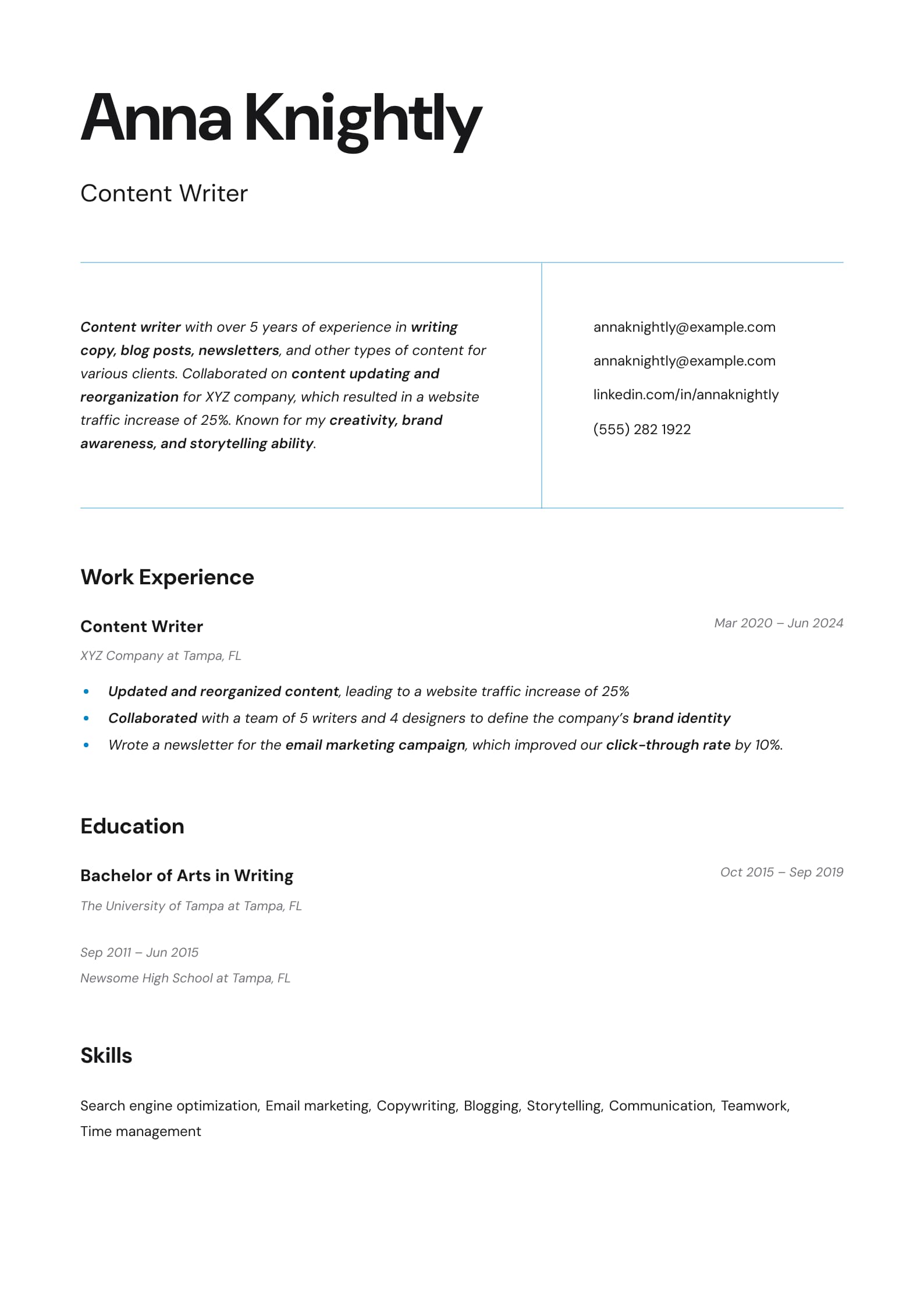
Since there are more than one type, it’s fairly easy to include them. That said, let’s see a resume example with keywords highlighted so you can actually see how they are incorporated:
Why Are Resume Keywords Important?
Resume keywords are important for ATS scans, which can make or break your job application. After all, according to a survey by Harvard Business School, approximately 75% of employers in the U.S. use ATS in hiring. That number is even higher when we examine Fortune 500 companies in isolation: nearly 99% rely on these scans.
So, applications with appropriately placed resume keywords are more likely to succeed than those that don’t utilize them. The latter may be automatically rejected and never reach an actual human being.
Aside from passing an ATS scan, you need resume keywords to:
Catch the recruiter’s eye. Though recruiters don’t look for specific keywords the way ATS does, they are still likely to notice that your resume matches the requirements well. Keywords essentially represent particular skills, qualifications, and traits, which recruiters will be looking for.
Show that you’re the right fit. If your application mostly matches the job description, then you’re a good candidate for the position. Highlight this in your application by using the correct words.
How to Find the Right Resume Keywords: Step-by-Step Guide
To find the right resume keywords, you should analyze the job description, research the company, look at similar job postings, and use an ATS resume checker.
Now, we’ll explain each one of these steps in more detail.
#1. Analyze the Job Description
Your first step should always be to carefully analyze the job description, as that’s where you’ll find most of the resume keywords you need. Read through it once, then highlight the words and phrases that appear frequently. Pay special attention to core requirements, soft and hard skills, and any software mentioned in the job ad.
Here’s a brief job description with highlighted keywords:
Job Description With Highlighted Keywords
Graphic Designer
Join our creative team at the XYZ company as a graphic designer and help us bring compelling ideas to life while working for various leading brands in the industry.
Responsibilities
Producing images, logos, and other visual content that aligns with the brand’s vision
Presenting drafts to clients and revising them according to feedback
Collaborating with interdisciplinary teams to achieve brand cohesion and reach our marketing goals
Requirements
3 years of experience in the field
BA in Graphic Design or Fine Arts
Proficiency in Adobe Creative Suite
Experience with Figma, Sketch, and Canva
Ability to handle constructive criticism, changing priorities, and deadlines
If you meet these requirements and are imaginative, motivated, and eager to work in a dynamic environment, we would love to hear from you!
Of course, you don’t have to include all job description keywords in your resume, but pick a few that suit your application best. And remember to write them exactly as they are in the ad; if the description is using abbreviations, you should use them too.
#2. Research the Company

Researching the company is always advisable when writing your application, partly because it can help you identify keywords to add to your resume. Explore the “About Us” page, as well as any that mention the company's mission or culture. Those sections are usually full of buzzwords that can enrich your resume, like “client-oriented” or “results-focused.”
If you want to take this a step further, find the LinkedIn profiles of employees working for the company you’re interested in and read their descriptions, too. After all, they got hired, so it might be worth using them as inspiration.
#3. Look at Similar Job Postings
If you don’t want to only use keywords from the job description you’re responding to, read postings for similar positions and identify common words and phrases there. Combine these with the original job ad and create a list of keywords to use in your resume. Then, all you have to do is pick those that seem the most appropriate.
#4. Use an ATS Resume Checker
Once you write your resume with all the keywords you’ve identified and included, you can run it through our ATS resume checker to see how it might hold up when you submit it. Our checker will find the keywords, score your resume based on their effectiveness, and suggest areas for improvement. Follow the recommendations to fix your resume immediately, then download the new version to your device.
Where to Place Keywords on Your Resume
Keywords should be sprinkled throughout your resume, so there’s flexibility in where to include them. For the sake of resume keyword optimization, we’ll cover four sections where placing these words will have the greatest impact.
Resume Headline
A resume headline is a brief description placed right under your name at the top of the resume that quickly summarizes your experience and skills. It should grab the reader’s attention immediately while providing key information, just like a newspaper headline.
Since it consists of only a few words, you don’t have much space for including keywords, but you should still add one or two. Here’s an example to illustrate how:
Headline Example
Content writer with 5+ years of experience in copywriting and implementing SEO practices.
Resume Summary or Objective
In some ways, a resume summary or objective plays a similar role as the headline: it provides a quick snapshot of who you are as a professional, so that the recruiters can immediately understand it. However, it’s slightly longer than the headline, so there’s more space for highlighting your skills and most significant achievements.
Of course, this is a perfect place to include a few resume keywords, which are bound to naturally come up anyway. So, here’s what this section may look like:
Summary with Keywords Example
Content writer with over 5 years of experience in writing copy, blog posts, newsletters, and other types of content for various clients. Collaborated on content updating and reorganization for XYZ company, which resulted in a website traffic increase of 25%. Known for my creativity, brand awareness, and storytelling ability.
Work Experience Section
The work experience section is the most important section on most resumes, as recruiters typically pay particular attention to it. It should contain your work history listed in a reverse-chronological order, starting with the most recent entry.
Aside from your role, company name, location, and start and end dates, the work experience section should feature at least three bullet points elaborating on each entry. It’s crucial that you don’t describe your responsibilities here, but instead include measurable achievements using action verbs and numbers.
Here’s an example with highlighted keywords:
Work Experience Example
Content Writer XYZ Company Tampa, FL
March 2020–June 2024
Updated and reorganized content, leading to a website traffic increase of 25%
Collaborated with a team of 5 writers and 4 designers to define the company’s brand identity
Wrote a newsletter for the email marketing campaign, which improved our click-through rate by 10%.
Skills Section
Finally, the skills section is an excellent place to include resume keywords, as it’s quite easy to do so naturally. Simply look at the required skills in the job description, then list them using exactly the same words.
Here’s what that should look like:
Skills Example (with Keywords)
Skills
Search engine optimization
Email marketing
Copywriting
Blogging
Storytelling
Communication
Teamwork
Time management
Resume Keywords List by Industry
Now that we’ve explained the basics, let’s take a look at a resume keywords list sorted by different industries. Specifically, we’ll include keywords for marketing, tech and IT, business and management, healthcare, and customer service.
Marketing Keywords
Most common resume keywords for marketing include the following:
Brand management
Email marketing
Social media marketing
Search engine optimization (SEO)
Search engine marketing (SEM)
Conversion rate optimization (CRO)
Public relations
Market research
Copywriting
Marketing campaign
Content creation
Digital marketing
Paid advertising
Lead generation
Google Ads
Web analytics
Click-through rate (CTR)
Storytelling
Blogging
Visual content creation
Product launch
Customer insights
Visual identity
Influencer marketing
Creative
Dynamic
Open-minded
Effective
Passionate
Resourceful
Analytical
Friendly
Organized
Integrated
Guided
Unified
Improved
Performed
Tech & IT Keywords
Next, here are some examples of resume keywords for tech and IT specialists:
Artificial intelligence (AI)
Machine learning
Cybersecurity
Security monitoring
Cloud storage
Cloud-native platforms (CNPs)
Cloud management
Augmented reality (AR)
Virtual reality (VR)
Coding
Data analysis
Data synchronization
User-centered design
Front-end development
Back-end development
Full-stack development
Computer hardware engineering
Testing and debugging
Systems administration
Technical support
Mobile and web development
Web design
User experience (UX) design
Internet of Things (IoT)
JavaScript
C++
Python
SQL
Problem-solving
Curiosity
Perseverance
Flexibility
Critical thinking
Programmed
Designed
Calculated
Engineered
Installed
Developed
Innovated
Incorporated
Pioneered
Produced
Tested
Standardized
Upgraded
Verified
Validated
Linked
Business & Management Keywords

Here are some resume keywords to use if you’re working in business or management:
Strategy
Profit and loss
Reach
Growth
Customer journey
Customer experience
Marketing
Expenses
Investment
Rate
Estimate
Feedback
Sustainability
Core competency
Startup
Corporation
Branding
Pain point
Product
Service
Long-term and short-term goals
Quota
Deliverable
Performance
Transformation
Scaling
Conversion rate
Stocks
Finance
Capital
Teambuilding
Budgeting
Asset management
Return on investment (ROI)
Business analysis
Administration
Logistics
Company mission
Company culture
Human resources (HR)
Training
Interviewing
Staff retention
Employee onboarding
Workflow management
Payroll management
Recruiting
Delegation
Experienced
Results-oriented
Detailed
Gained
Led
Achieved
Accomplished
Built
Acquired
Reorganized
Supervised
Trained
Optimized
Healthcare Keywords
Healthcare applications should include the following resume keywords:
Patient assessment
Patient monitoring
Vital signs monitoring
Diagnosis
Clinical documentation
Medication administration
Clinical decision-making
Preventive medicine
Chronic disease management
Surgical assistance
Postoperative care
Outpatient and inpatient care
Follow-up care
Prenatal and postnatal care
Geriatric care
Palliative care
Wound care
Rehabilitation
Treatment planning
Pain management
IV therapy
Infection control
Emergency response
Equipment sterilization
Medicare and Medicaid compliance
Appointment scheduling
Electronic Health Records (EHR)
Medical terminology
Hospital procedures
Hygiene
Patient privacy
Data protection
Bedside manner
Active listening
Patient education
Compassion
Empathy
Communication
Cultural competence
Resilience
Critical thinking
Administered
Cared
Assessed
Diagnosed
Treated
Monitored
Prescribed
Examined
Vaccinated
Operated
Researched
Customer Service Keywords
Lastly, here is a list of resume keywords for customer service positions:
Customer relationship management (CRM)
Phone etiquette
Order processing
Customer inquiry resolution
Customer follow-up
Troubleshooting
Data privacy
Transaction processing
Product knowledge
Inventory management
Account management
Help desk support
Client satisfaction
Client relations
Customer experience
Salesforce
Microsoft Office Suite
Email support
Live chat support
Patience
Adaptability
Verbal and written communication
Professionalism
Teamwork
Active listening
Empathy
Persuasion
Negotiation
Problem-solving
Stress management
Conflict resolution
Supported
Identified
Processed
Resolved
Helped
Assisted
Collaborated
Proposed
Increased
Promoted
Communicated
Organized
Interpreted
Executed
Coordinated
5 Common Resume Keyword Mistakes to Avoid
Here are five common resume keyword mistakes to avoid:
Keyword stuffing. It’s important to include keywords on your resume, but too many can appear unnatural. Don’t try to add them at any cost; check whether the spot where you want to put them makes sense first. If it doesn’t, leave the keyword out or try to incorporate it elsewhere.
Using generic terms only. Some generic keywords may be unavoidable, like “communication,” “teamwork,” or “leadership,” but you should combine them with more specific ones. Those are usually terms related to the field you’re applying for, such as “wound care” or “SEO.”
Ignoring the job description. ATS scans typically search for keywords listed in the job description, so your resume might not pass if it doesn’t contain any. In other words, the job description is your best source of resume keywords, so don’t forget to examine it thoroughly.
Forgetting synonyms and variations. Aside from the specific keywords listed in the job description, it’s good practice to target their synonyms and variations in case those have been fed into the scan, too. Plus, this helps you avoid keyword stuffing and makes your writing sound more natural.
Placing keywords in headers or footers. ATS scans are typically programmed to ignore these sections entirely, so keywords in headers and footers are basically meaningless. In other words, avoid adding them to the contact information section or hiding them in the footer to save space. All keywords should be in the main body of your application, visible and placed in context.
Create a Keyword-Optimized Resume Easily
Use our resume builder and pass the scan with flying colors.Closing Thoughts
Including resume keywords in your application is a reliable way to pass the initial ATS scan, which is a stumbling block for many candidates. After all, no matter how impressive your background and skillset are, they’re of no use if your resume never reaches a recruiter.
However, you also need to make sure that other aspects of your application, such as the formatting, also meet ATS standards. That’s why we suggest using our ATS-friendly resume templates that are optimized to guarantee your success.
Resume Keywords FAQs
#1. What are some good resume words?
Good resume words depend on the type of application you’re writing and the specific job description you’re responding to. In other words, there are no one-size-fits-all keywords. In general, it’s best to analyze the job requirements and highlight the words mentioned there, then use them in your resume.
#2. How many keywords should a resume have?
There’s no fixed number of keywords a resume should have, but it’s commonly recommended to include 10–25 industry-specific ones. That way, you’ll likely pass the ATS checks and simultaneously avoid keyword stuffing, which makes your resume sound unnatural.
#3. What is the difference between resume keywords and action verbs?
The difference between resume keywords and action verbs is that keywords encompass verbs but aren’t limited to them. They may also include nouns and adjectives related to the position you’re applying for. On the other hand, action verbs are limited to words such as “designed,” “developed,” “proposed,” or “increased,” which denote an action and are typically used to describe achievements.