

You can put cum laude on a resume by including it in the education section, creating a dedicated awards and honors section, or adding it to the resume summary. What matters is that you highlight your academic excellence so the employers know you are an outstanding candidate.
In this article, we will show you how to include cum laude and other Latin honors on your resume, where to add them, and when you can leave them out. We will also provide an example you can rely on when writing your application.
Key Takeaways
Cum laude is one of the three Latin academic honors awarded to undergraduate students with high GPAs.
You should add cum laude to your resume when you’re a recent graduate, but you can leave it out as you gather more professional experience.
Include cum laude in the education section, the honors and awards section, or the resume summary.
When adding honors to your resume, never lie about your GPA, write about outdated awards, format the Latin honors incorrectly, or include too many entries.
What Does Cum Laude Mean?
Cum laude means “with praise” or “with honor,” and it’s an academic distinction awarded to undergraduate students who achieve a specific level of excellence. The requirements often differ from one institution to another, but generally, cum laude refers to a 3.5–3.6 GPA, or top 16–35% of a graduating class.
However, sometimes a high GPA or ranking within your class isn’t enough. Instead, you may have to excel at a specific course or write and submit a thesis to qualify. Also, some universities and colleges don’t use these distinctions at all.
Either way, cum laude is a pretty useful recognition to receive, as it demonstrates hard work and consistency, which many employers value in their job candidates.
Other Latin Honors: Magna Cum Laude vs. Summa Cum Laude
Cum laude is only one out of three possible levels of academic distinction, all of which bear Latin names. The other two are magna cum laude and summa cum laude. Here’s how they differ:
Magna cum laude, “with great praise,” awarded to students with a 3.7–3.8 GPA or the top 6–15% of a class.
Summa cum laude, “with highest praise,” awarded to students with a 3.9–4.0 GPA or the top 1–5% of a class.
Cum Laude on Resume Example
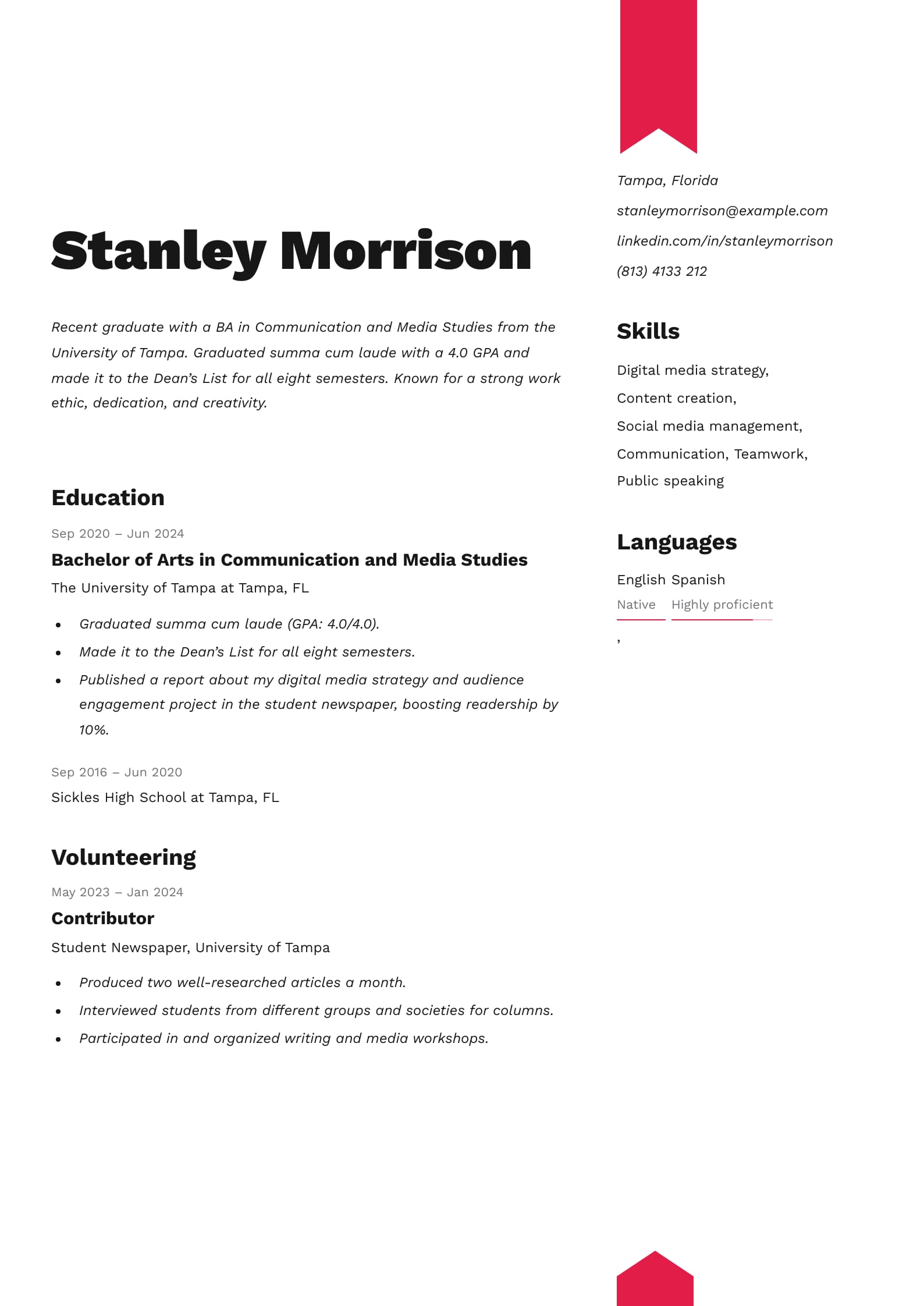
Before we discuss Latin honors further, we’ll illustrate how to showcase them on a resume example:
Cum Laude on Recent Graduate Resume
Should You Put Cum Laude on a Resume?
You should put cum laude on a resume if you are a recent graduate, as it demonstrates your work ethic and dedication. This is especially helpful if you’re writing your very first resume and don’t have any professional experience to pad it out.
The same applies to putting magna cum laude and summa cum laude on your resume; all Latin honors can boost your application when you’re just entering the workforce.
However, once you gain sufficient experience, you no longer need to include cum laude on your resume. At that point, the focus should be on your professional experiences, which should prove that you possess the necessary skills and qualifications. You can still put cum laude in your application, but recruiters will prioritize your work history over it.
There is one more situation where including cum laude can boost your chances: when you’re changing careers. Since you won’t have many relevant professional experiences to add, you’ll need to focus on your skills and achievements.
Where to Put Cum Laude on a Resume
You can put cum laude in the following resume sections: education, honors and awards, and resume summary. Most commonly, graduates list it as one of their resume academic achievements in the education section, but you can highlight it more by including it elsewhere.
With that in mind, let’s see how to list cum laude on a resume:
Education
If you choose to add cum laude in the resume’s education section, as it’s usually done, you can list it directly next to your degree or in one of the achievement bullet points.
If you opt for the former, your education section might look like this:
Education Format #1
Education
Bachelor of Arts in Communication and Media Studies, summa cum laude
The University of Tampa, Tampa, FL
2020–2024
Otherwise, you can format it this way:
Education Format #2
Education
Bachelor of Arts in Communication and Media Studies
The University of Tampa, Tampa, FL
September 2020–June 2024
Graduated summa cum laude (GPA: 4.0/4.0).
Made it to the Dean’s List for all eight semesters.
Published a report about my digital media strategy and audience engagement project in the student newspaper.
Honors and Awards Section
Next, you can list honors on your resume in a separate section dedicated specifically to your academic achievements and awards. This only makes sense if you have several items to write about; if there’s only cum laude, it’s better to add it to the education section instead.
If you decide to make a separate honors and awards section, simply write down your achievements in a bullet point list. Here’s what that should look like:
Achievements Example
Honors and Awards
Graduated summa cum laude
Dean’s List for all eight semesters
Excellence in Digital Media Award
Media Innovation Award
Resume Summary

Lastly, you can add cum laude to your resume summary, where it will immediately capture the recruiters’ attention. This section is at the very top of the resume, right under contact information, and it serves to hook the reader. Therefore, it’s crucial to include your most impressive achievements and skills here.
However, since this section is very short (only 4–5 lines), you must use the space wisely. Most applicants struggle with that, so here’s a quick formula you can rely on when writing:
Sentence #1: your title, experience (if any), and brief background
Sentence #2: your most impressive achievement, described using an action verb and measurable outcomes
Sentence #3: A brief list of your key skills
If you use this formula, you should add cum laude either to the first sentence or the second one. We’ll show you both options:
Example #1
Recent graduate with a BA in Communication and Media Studies from the University of Tampa, who graduated summa cum laude. Published a report on digital media strategy and audience engagement in a student newspaper, increasing readership by 10%. Known for communication skills, teamwork, and dedication.
Alternatively, you can write this:
Example #2
Recent graduate with a BA in Communication and Media Studies from the University of Tampa. Graduated summa cum laude with a 4.0 GPA and made it to the Dean’s List for all eight semesters. Known for a strong work ethic, dedication, and creativity.
4 Mistakes to Avoid When Adding Honors to Your Resume
Even experienced candidates make resume mistakes. However, knowing what to watch out for makes resume writing easier. That said, here are four pitfalls to avoid when adding honors to your resume:
Writing about outdated awards and honors. Latin honors do have a place on your resume if you’re a recent graduate or a career changer who needs to prove their work ethic. However, if you’ve been in the workforce for a couple of years and gathered new experiences, you no longer need to include them. Over time, they start taking up space and distracting recruiters from the truly important information.
Lying about your GPA. High GPAs, like 4.0, may sound impressive on a resume, but they aren’t crucial for getting hired, so there’s no need to claim you had it if you didn’t. In fact, that can only make things worse; your employer can easily check your claim and disqualify you upon finding out that it’s not true.
Incorrect formatting. Latin honors should always be written in lowercase and italicized (summa cum laude). If you don’t format them correctly or your formatting is inconsistent throughout your resume, you’ll likely come across as unprofessional.
Including too many honors. You shouldn’t list every honor or award you’ve ever achieved, as that can create clutter on the page and bury what truly matters. Instead, add 2–4 most relevant and prestigious ones.
Add Academic Honors With Resume.co
Build your resume now!Closing Thoughts
Including cum laude, summa cum laude, or magna cum laude on a resume can make your application stand out, especially when you don’t have significant professional experience. If your resume competes with other graduate resumes, Latin honors give you an edge.
However, first you need to know how to write a resume, which may not be easy if you’ve never done it before. Also, check out our student resume templates for help, or simply visit our builder and start from scratch!
Cum Laude on Resume FAQ
#1. Is 3.3 a good GPA to put on a resume?
A 3.3 GPA is considered good, but there’s no need to include it on a resume unless it’s exceptionally high (above 3.5, usually). Of course, if you feel that it could boost your application, you can still add it.
#2. Do employers care about cum laude?
Employers care about cum laude the most when you’re a recent graduate with little other experience to offer. In those cases, graduating cum laude proves that you’re a hard-working individual with an excellent work ethic.
#3. Are there some industries where honors matter in the hiring process?
There are industries where honors matter in the hiring process; in particular, law, medicine, and academia. In these fields, high GPAs and academic awards mean a lot more than in fields like marketing, sales, or IT, where skills take a higher priority.