

An associate’s degree on a resume is an excellent way to showcase your skills and expertise if it’s your highest degree or if it is relevant to the role. Essentially, it’s a step between a high school diploma and university graduation, so it can be a strong advantage for students who want to give their resumes a little boost.
In this article, we will show you how to list an associate’s degree on your application, provide an associate’s degree example on a resume, and discuss some common mistakes to avoid.
Key Takeaways
An associate’s degree can benefit your resume when it demonstrates skills and expertise relevant to your job and when it’s the highest degree you have.
To properly list an associate’s degree on your resume, you should add the degree name, the institution where you obtained it, the place, the attendance period, and at least three bullet points with achievements.
You can add the associate’s degree to your resume even if you haven’t graduated, as long as you indicate that it’s incomplete.
Mistakes to avoid when adding an associate’s degree include using an incorrect abbreviation, inconsistency, dishonesty about your education level, and including it when it’s not necessary.
Should You Include an Associate’s Degree on Your Resume?
Yes, you should put an associate’s degree on your resume if it meaningfully contributes to your application and demonstrates your expertise in a particular field.
For instance, putting an associate’s degree on your resume is recommended when:
It’s your highest degree. If you’re writing a student resume and don’t yet have a bachelor’s degree (or aren’t planning to obtain one), your associate’s degree can elevate your application. You can also include it if you’re in the process of obtaining your bachelor’s degree, but haven’t graduated yet.
It’s relevant to your job. If you believe your associate’s degree demonstrates your skills and knowledge in a particular field better than your bachelor’s degree, add it to your resume.
You’re a recent graduate. If you lack work experience, an associate’s degree can fill the space and make your resume more effective.
The credential carries real weight with employers. Associate's degree holders have a 30.8% lower unemployment rate compared to high school graduates. However, there are times when it can be omitted, like when you obtain a bachelor’s degree in the same field or gain work experience. In these situations, an associate’s degree is typically redundant.
Associate’s Degree vs. Bachelor’s Degree on a Resume
An associate’s degree and a bachelor’s degree differ in several aspects. That said, let’s examine the key difference in the table below:
Aspect | Associate’s degree | Bachelor’s degree |
|---|---|---|
Duration | Typically takes two years to complete | Typically takes four years to complete |
Credits | Around 60 credits | Around 120 credits |
Curriculum | Focus on technical and vocational skills | Theoretical subjects and more in-depth knowledge |
Purpose | Quickly entering the workforce, preparation for a bachelor’s degree | Access to jobs with higher salaries or further education |
Associate Degree on a Resume Example
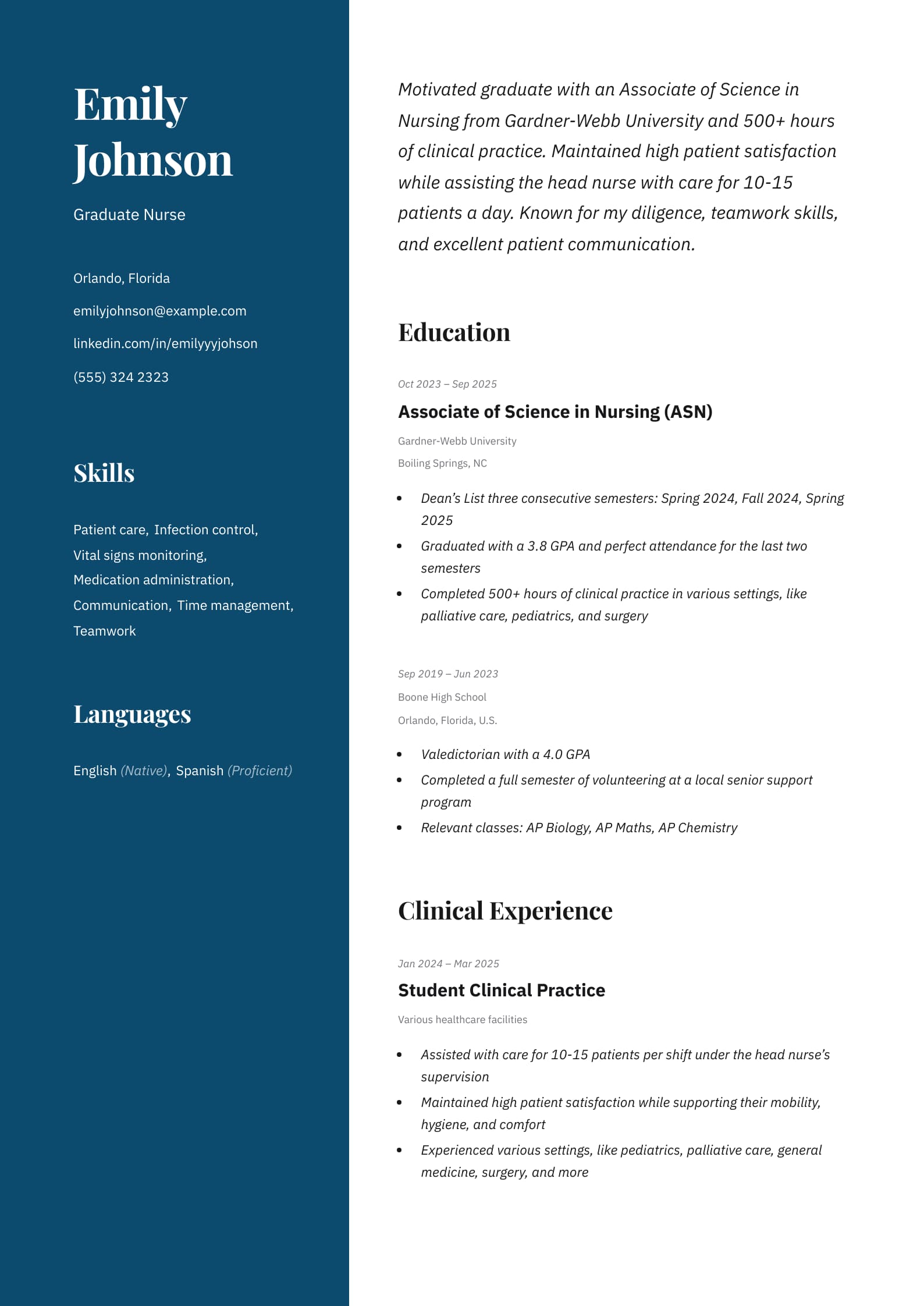
Before we explain how to list an associate’s degree on your application, here’s a resume example with an associate’s degree in nursing to illustrate what it should look like:
How to List an Associate’s Degree on a Resume
You should list an associate’s degree on a resume in the education section, just like you would a bachelor’s or a master’s degree. Start from your latest degree, whether that’s your associate’s or bachelor’s degree, then work your way backwards in a reverse-chronological order.
That doesn’t mean you should include every education experience you’ve ever had. As a rule, we suggest adding the two most recent ones, as they are the most relevant to the recruiters. So, if you have an associate’s degree but not a bachelor's, you can add your high school diploma, too.
When including an associate’s degree, you should follow standard resume formatting practices for the education section. In other words, you should use this template:
Education Section Template
[Degree Title]
[College/University], [City], [State]
[Start Month, Year] – [End Month, Year]
Measurable achievement #1
Measurable achievement #2
Measurable achievement #3
This format is fairly straightforward and very helpful when listing your college on a resume, but the achievements part tends to confuse candidates. Many mistakenly write about their past responsibilities or don’t include action verbs and measurable results to personalize the section.
So, they end up with something like this:
Bad Example
Associate of Science in Business Administration
College of Central Florida, Ocala, FL
October 2022–September 2024
Knowledge of accounting, marketing, and management
Consistent academic performance
Organized approach to assignments and deadlines
As you can see, this doesn’t say anything specific or relevant to your personal experience; there are thousands of candidates with an associate’s degree in business who can write the same.
Instead, say this:
Good Example
Associate of Science in Business Administration
College of Central Florida, Ocala, FL
October 2022–September 2024
Maintained a 3.7 GPA for three consecutive semesters
Prepared 10+ business reports using professional research standards
Completed 15+ projects in marketing, finance, and management
How to List an Associate’s Degree if You Didn’t Graduate
You can list an associate’s degree even if you didn’t graduate, as long as you are honest about the fact that it’s still incomplete. However, the exact method depends on whether you’re still working towards it or you dropped out and aren’t planning to finish it.
If you’re planning to complete your associate’s degree, you should put “Present” instead of the degree end date or include the expected graduation date. In practice, that looks like this:
In Progress (Present Format)
Associate of Science in Business Administration
College of Central Florida, Ocala, FL
October 2024–Present
Or, alternatively:
In Progress (Expected Graduation Format)
Associate of Science in Business Administration
College of Central Florida, Ocala, FL
Graduating June 2026
On the other hand, if you dropped out but still have a few semesters under your belt, you should focus on coursework or credits obtained. Also, you should write about your university or college first and make it clear that you don’t have the degree you originally pursued.
Here’s what that looks like:
Listing Incomplete Education
College of Central Florida, completed three semesters toward an Associate of Science in Business Administration, 2024–2025.
4 Mistakes to Avoid When Adding an Associate’s Degree to Your Resume
Here are four common mistakes to avoid when adding an associate’s degree to your resume:
Using an incorrect abbreviation. In general, we suggest you write the full degree title, but if you must abbreviate, use a correct associate’s degree abbreviation on your resume. Check your institution’s website to find the correct one, or use a widely recognized one, such as AA for Associate of Arts or AAS for Associate of Applied Science.
Inconsistency. If you’re including both your bachelor’s and your associate’s degrees, don’t write the full name of one and abbreviate the other. Choose your preferred formatting and stick to it throughout the resume.
Insinuating that you’ve completed the degree when you haven’t. If you still don’t have your associate’s degree, don’t make it sound like you do. Always emphasize that you’re still in the process of obtaining it or that you’ve completed part of it and decided not to continue.
Including it after you’ve obtained higher degrees. Though you may keep your associate’s degree in your resume when you get a bachelor’s, you may omit it once a master’s degree enters the picture. At that point, it becomes redundant and simply takes up space. The only exception is if you obtained your associate’s degree in a very different field, which is more relevant to the job you’re applying to.
Need Help Including an Associate’s Degree on Your Resume?
Use our resume builder and add your credentials in no time.Closing Thoughts
As you have seen, including an associate’s degree on a resume is straightforward, and it can make a significant difference when applying for a job. Even if you don’t have a bachelor’s degree yet, an associate’s degree demonstrates your dedication, expertise, and skill level in a particular field.
So, follow our steps to add it to your resume and improve your chances of getting hired. And if you need some extra help, explore our resume templates and examples, which can facilitate the writing process significantly.
Associate’s Degree on Resume FAQs
#1. Do employers value an associate’s degree?
Employers do value an associate’s degree because it demonstrates work ethic, specialized skills, and expert knowledge. In other words, even if you don’t have a bachelor’s degree, your chances of landing a career in IT, business, nursing, or marketing increase if you hold an associate’s degree.
#2. Should I include my associate’s degree if I have a bachelor’s?
There’s generally no need to include your associate’s degree if you have a bachelor’s, but you may still do so if you believe it will improve your hiring chances. For instance, if your associate’s degree demonstrates certain relevant skills better than a bachelor’s, you should add it to your resume.
#3. Is it correct to say associate’s or associate degree?
Both associate’s and associate degree are correct, but only “associate” is used in degree names. So, when writing your resume, we suggest you pick that option and stick to it for consistency.