

To shorten a resume, remove repeated wording, combine related tasks, and reduce detail that does not help explain your fit. Keep the facts that make your experience specific: what you did, the scope of your work, relevant tools, and results you can support. Check the page layout after editing the content.
“Handled administrative duties” is shorter than a paragraph about scheduling and supplier records. It is also less useful. The aim is to make the evidence easier to read, not simply to produce fewer words.
This guide follows a fictional office coordinator from a wordy resume to a complete shorter version. It includes a record of what we removed and why, plus an instruction you can use when asking AI to help. The worked resume is an editorial example, not a real applicant’s document or evidence of hiring results.
Key takeaways
Shorten repeated wording before removing useful evidence.
Protect accurate dates, tools, scope, and responsibilities throughout the edit.
Give AI a specific format and factual boundaries, then compare its draft with the source.
Our fictional editorial example falls from 384 to 158 words; this is not a measured AI result or page-count reduction.
Check the complete layout and exported file after editing the text.
What our research tells us about shortening requests
Resume.co’s internal Custom AI Prompting analysis identified requests to shorten text, combine related bullets, and change paragraphs into a clearer structure. It also described requests to remove just enough text to fit an entire resume onto one page, even when the instruction was entered in a field for one section.
That distinction matters. Editing a paragraph and fitting a complete document onto a page are different jobs. A concise replacement can still overflow a page because of other sections, the template, or spacing. Conversely, deleting a useful qualification may reduce the length while weakening the resume.
A separate internal Suggestions 2.0 — User Session Review noted long experience bullets and summaries as usability problems in the sessions reviewed. We use these historical observations to define the editing problem; they do not establish how often it occurs or how the current product behaves.
Our method below is an editorial response to those needs: choose what must survive, shorten the wording, then inspect the whole document.
First decide whether you need fewer words or fewer pages
If the application specifies a page limit, use that as your constraint. Otherwise, start with the material the employer needs to understand your experience. Do not delete a required credential or an important recent role just to reach an arbitrary length.
Use this quick diagnosis:
What you see | What to try first |
|---|---|
A long paragraph describing several related duties | Separate the ideas, remove filler, and combine related tasks into concise bullets |
The same responsibilities repeated in the summary, skills, and experience | Give the summary a short overview, keep evidence in experience, and shorten the skills labels |
A second page containing only a few lines | Edit low-value wording and inspect spacing and page breaks in the actual document |
Several substantial, relevant roles or required credentials | Keep the evidence; consider whether the page target is appropriate |
If your main question is whether one page is appropriate, see our one-page resume guide. The example here focuses on editing decisions, not on assigning everyone the same page count.
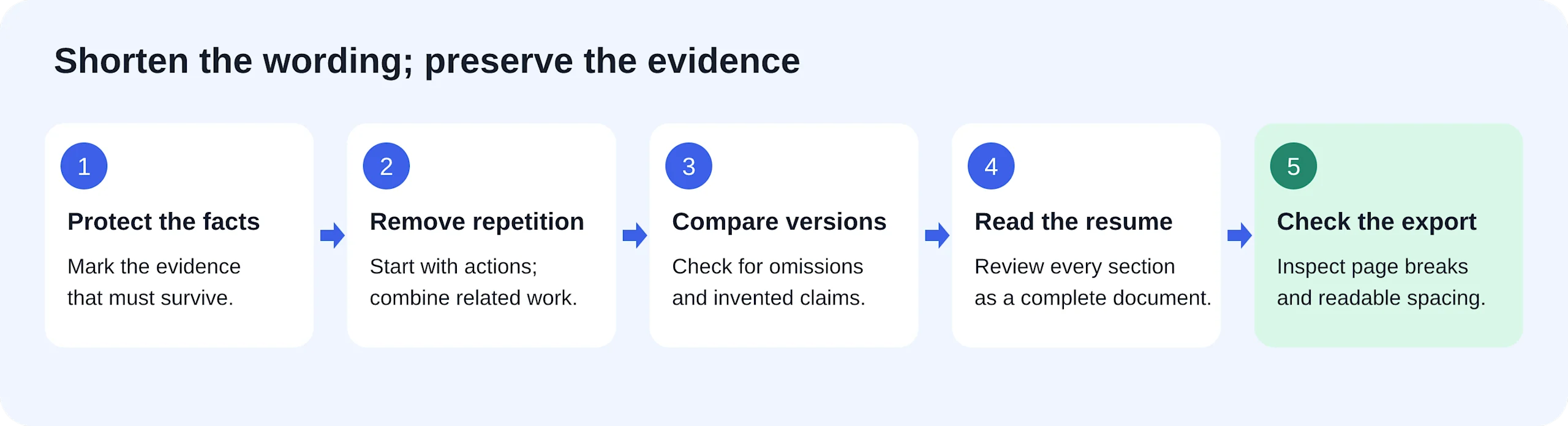
This is an editorial editing workflow, not a screenshot or a guarantee of a particular page count.
The complete starting resume
Morgan Reed is applying for office coordinator roles involving appointment scheduling, reception support, and supplier records. All names, employers, education, and numbers below are fictional teaching data. The longer wording is deliberate; the underlying experience is already usable.
Morgan Reed
Office Coordinator Columbus, OH · morgan.reed@example.com · 202-555-0142
Professional summary
I am an organized and hardworking office coordinator who has experience working in an office environment and carrying out a wide variety of administrative tasks. My experience includes managing appointment calendars, communicating with clients about appointments, keeping records in Excel, following up on office supply deliveries, and helping colleagues learn reception procedures. I am looking for an office coordinator position where I can use my organizational and communication skills to support the day-to-day running of an office.
Work experience
Office Coordinator · Example Community Services · January 2022–December 2025
I was responsible for coordinating the appointment calendar for a team of six advisers and for keeping that calendar up to date whenever changes were needed. I scheduled approximately 25 appointments each week, sent confirmation emails to clients, and contacted clients again when an appointment needed to be rescheduled. As part of my administrative responsibilities, I maintained an Excel spreadsheet for office supply orders, recorded the order date and delivery status, and followed up with suppliers about outstanding deliveries. I also prepared a weekly list of outstanding deliveries for the office manager so that they could review which orders had not arrived. In addition to these duties, I put together a checklist covering 12 steps for opening the reception desk at the start of the day. I showed two new colleagues how to use that checklist and how to update the appointment calendar. I answered routine reception enquiries by phone and email, and passed questions outside my responsibility to the appropriate adviser.
Reception Assistant · Example Learning Centre · June 2020–December 2021
I worked at the reception desk, where I greeted visitors when they arrived, checked their names against the appointment list, and directed them to the correct room. I also answered phone calls and passed messages to the relevant staff member. Another part of my role was making sure that paper registration forms were filed in the correct folders each day.
Education
Associate of Applied Science in Business Administration · Example Community College · 2020
Skills
Appointment calendar coordination; scheduling and rescheduling appointments; communicating with clients about appointments; Excel spreadsheets for office supply orders; following up with suppliers about deliveries; reception enquiries by phone and email; explaining reception procedures to new colleagues; organization; communication; teamwork.
References
References available upon request.
1. Mark the facts that must survive
Before rewriting, identify the information you would be disappointed to lose. For Morgan’s latest role, we protected:
A calendar serving six advisers and approximately 25 appointments per week.
Confirmation emails and rescheduling.
Excel supply-order records, including order dates and delivery status.
Supplier follow-up and a weekly outstanding-deliveries list for the office manager.
A 12-step reception-opening checklist and help given to two new colleagues.
Routine phone and email enquiries, with other questions referred to advisers.
These facts show different dimensions of the work. “Six advisers” describes the team supported; it does not mean Morgan managed six people. “Approximately 25 appointments” describes workload; it does not mean scheduling improved by 25%. Preserve those distinctions when shortening.
Not every resume needs numbers in every bullet. Here, the numbers are useful because they already exist in the source. The previous reception job can be clear without inventing visitor totals or response-time improvements.
2. Remove the introduction to each action
The opening sentence spends words announcing a responsibility before describing it. Start with the action instead.
Before: “I was responsible for coordinating the appointment calendar for a team of six advisers and for keeping that calendar up to date whenever changes were needed.”
Shorter: “Coordinated the appointment calendar for six advisers.”
The second sentence contains details that should join this one: appointment volume, confirmations, and rescheduling. Combining them gives us a complete bullet:
Coordinated approximately 25 appointments per week for six advisers, including confirmation emails and rescheduling.
The edit removes repetition without turning the role into a vague claim about “excellent organizational skills.”
3. Combine related work without flattening it
Supply-order records and supplier follow-up belong together. So do the checklist and showing colleagues how to use it. Combining these pairs creates room without deleting a distinct responsibility.
Here is our editorial decision record for the full resume:
Source material | Decision | Why |
|---|---|---|
Calendar coordination, scheduling, confirmations, and rescheduling | Combine into one bullet | The actions describe one appointment workflow |
Excel records, supplier follow-up, and weekly delivery list | Combine into one bullet | Retains the tool, record details, follow-up, and reporting cadence |
Checklist creation and guidance for two colleagues | Combine into one bullet | Keeps the concrete output and the limited scope of the guidance |
Reception enquiries | Keep separately | A distinct responsibility that should not disappear during compression |
Earlier reception role | Keep two short bullets | Preserves the employment history and filing experience with less detail |
Summary’s generic adjectives and job-seeking statement | Remove | The remaining summary explains the kind of work Morgan has done |
Repeated phrases in skills | Replace with short skill labels | Experience already provides the supporting detail |
“References available upon request” | Remove from this example | The fictional application does not request references in the resume |
This is not a rule to delete every older job or every summary. Morgan’s earlier role helps explain the work history, and the short summary gives the document a useful introduction. Another candidate may need different choices.
4. Give AI a specific shortening task
If you use an AI editor, tell it both the desired form and the facts to preserve. A request such as “make it shorter” leaves the priorities unstated.
For Morgan’s latest experience block, use:
Shorten this work experience to four concise bullets. Keep approximately 25 appointments per week, the six-adviser team, the 12-step checklist, and the two colleagues. Preserve the weekly outstanding-deliveries list and supplier follow-up, combining related tasks where helpful. Use only supplied facts. Do not add efficiency gains, software, management responsibilities, or outcomes. Do not change the job title or dates.
Supply the original experience text with the instruction. Four bullets is a choice for this example, not a universal resume requirement. If the result needs five bullets to remain clear, reconsider the constraint rather than accepting a dense paragraph disguised as a bullet.
Check the revised text against the complete source, including facts you did not explicitly name in the prompt. A short instruction cannot replace that comparison. Keep the original available so that a missing detail is easy to restore.
5. Read the complete shorter version
The version below is our finished editorial rewrite. It is not presented as unedited AI output. The contact details, employment titles and dates, education, and underlying responsibilities are unchanged.
Morgan Reed
Office Coordinator Columbus, OH · morgan.reed@example.com · 202-555-0142
Professional summary
Office coordinator with experience in appointment scheduling, Excel supply-order records, supplier follow-up, and reception support.
Work experience
Office Coordinator · Example Community Services · January 2022–December 2025
Coordinated approximately 25 appointments per week for six advisers, including confirmation emails and rescheduling.
Maintained Excel supply-order records with order dates and delivery status, followed up with suppliers, and prepared a weekly outstanding-deliveries list for the office manager.
Created a 12-step reception-opening checklist and showed two new colleagues how to use it and update the appointment calendar.
Answered routine reception enquiries by phone and email and referred other questions to the appropriate adviser.
Reception Assistant · Example Learning Centre · June 2020–December 2021
Greeted visitors, checked appointments, directed visitors to rooms, and passed phone messages to staff.
Filed paper registration forms daily.
Education
Associate of Applied Science in Business Administration · Example Community College · 2020
Skills
Appointment scheduling · Excel recordkeeping · Supplier follow-up · Reception support · Procedure guidance
The shorter version still explains what Morgan coordinated, recorded, created, and communicated. It does not claim that Morgan managed the advisers, reduced missed appointments, or improved supplier performance. Those would be new claims, not shorter descriptions of the supplied facts.
The supply-order bullet is deliberately longer than the others because it carries several useful details. If it looks crowded in your template, split it into records and follow-up/reporting. Keeping every bullet the same length is less important than making each one readable.
What the edit actually changed
We counted the text in both complete examples, then checked the shorter experience block against the protected facts:
Text counted | Before | After | Words removed |
|---|---|---|---|
Complete resume, including contact information and section headings | 384 | 158 | 226 |
Latest role’s description, excluding its title, employer, and dates | 162 | 73 | 89 |
All six groups of protected facts remain: appointment volume and team size, confirmations and rescheduling, Excel record details, supplier follow-up and weekly reporting, the checklist and colleague guidance, and reception enquiries and referrals. The earlier role, its daily filing task, and the education entry also remain.
These counts measure our editorial example, not AI performance or hiring effectiveness. We counted whitespace-separated tokens containing a letter or number, excluding Markdown markers and standalone separators. Hyphenated terms, the email address, phone number, and date expressions without spaces each count as one token. Other word counters may use different rules. We have not measured a page-count reduction.
6. Check the layout after the content edit
Paste or apply the shorter text in your resume editor, then inspect the entire document. You can use Resume.co’s resume builder to organize the sections and review the layout.
Check whether headings stay with their content, whether bullets are easy to scan, and whether the last page contains substantive information. If the document still exceeds a required limit, revisit repeated or less relevant detail before making the text difficult to read.
Open the exported file too. Page count is a property of the formatted document, not the wording alone. We do not claim that the text above fits a specific number of pages across templates, paper sizes, or export settings.
Questions that come up while shortening
Consider its relevance and the work history it helps explain. In this example, the earlier reception job stays, but its description becomes two short bullets. Removing detail and removing the entire role are separate decisions.
Describe specific work you can support: tasks, tools, deliverables, people served, or responsibilities. Morgan’s daily filing bullet needs no invented percentage. Use a number only when you know what it measures and can support it.
No instruction removes the need to compare the rewrite with the source. Check for omissions as well as additions. An output can preserve every number you mentioned while still dropping a useful responsibility.
Stop when further cuts would hide relevant qualifications, obscure what you did, or make the wording difficult to understand. Then resolve layout issues in the formatted document. The final check is whether a reader can still understand your experience and whether you can explain every claim.