

If you’re wondering how to get a job at Google, you’re looking at some of the most competitive roles in the tech and business industries. Google receives millions of applications every year, so you must have a strategic approach, a flawless resume, and extensive interview preparation to stand out from the competition.
In this article, we’ll see what makes working at Google so competitive and what the minimum qualifications are to do so. Then we’ll teach you how to write a strong resume and cover letter that help you grab recruiters' attention, and we’ll show you how to apply. Finally, we’ll go through interview preparation and disclose common reasons why Google rejects applications.
Key Takeaways
To get a job at Google, your resume and cover letter need to be perfectly tailored to the role you’re applying for.
While some positions at Google still require a bachelor’s degree, you can apply for many positions with equivalent practical experience.
When emphasizing your accomplishments, use numbers to quantify results and focus on leadership efforts.
Prepare for both technical and behavioral interview questions, and practice thinking out loud, since interviewers want to assess your thought process.
Why Is Working at Google So Competitive?
Working at Google is so competitive because the company is globally renowned for its compensation, great perks, engineering culture, and high-impact projects. Their roles attract applicants from top universities and experienced professionals from leading companies.
Google receives around 3 million applications each year, resulting in about a 0.2% chance of being hired. With such a huge influx of talent from around the world, talent acquisition professionals at Google don’t have to compromise.
Recruiters and hiring managers evaluate applicants using extremely high benchmarks for technical skills, problem-solving, leadership, communication, and other abilities and qualities. Google’s own hiring pages frequently emphasize that they are looking for practical experience and demonstrated impact over just credentials.
What Are the Minimum Qualifications to Work at Google?
The minimum qualifications to work at Google vary widely by role, but the company has shifted away from strict degree requirements.
For some roles (especially in software engineering), a Bachelor’s degree in Computer Science or a related field is typically required. However, for many other positions, Google often adds a phrase “or equivalent practical experience” to role descriptions.
This means the company values professionals who have gained experience and achieved measurable results through other means, without formal degrees. Candidates can improve their chances with:
Personal projects
Open-source contributions
Research work
Technical portfolios
Participation in hackathons
Experience in startups and freelancing
Can You Get a Job at Google Without Experience?
Yes, you can get a job at Google without experience. The most common way to do it is to leverage one of their early-career programs.
Some of the biggest and most well-known internship programs at Google include:
Student Training in Engineering Program (STEP). This internship is specifically designed for undergraduate computer science students in their first or second year.
Build Opportunities for Leadership & Development (BOLD). This is one of the best programs for young professionals interested in non-technical roles at Google, such as business and marketing roles.
Associate Product Manager (APM). The Associate Product Manager program is highly competitive and designed for recent graduates seeking to enter product management.
How to Create a Google-Worthy Resume and a Cover Letter
To create a Google-worthy resume and cover letter, you need to focus on the most impactful data-driven results and cut all the fluff. Let’s go through some of the most effective Google resume tips and cover letter strategies that will help you grab the attention of hiring managers.
#1. Tailor Your Resume to the Exact Role

Every bit of information in your resume needs to align with the role's requirements. Google’s recruiters will likely discard a generic resume.
To tailor your resume, carefully analyze the job description. This will allow you to align your previous experience and skills with the demands of the position. Eliminate previous jobs or technical skills that are completely unrelated to the position you’re applying for.
For example, if the role requires experience with machine learning infrastructure, you can include a bullet point like this:
Good Example
Directed a team of 5 engineers to develop a Python-based machine learning pipeline.
Let’s compare that to a bad example:
Bad Example
I have experience in software engineering and project management.
#2. Use Measurable Achievements and Metrics
Measurable achievements and metrics show concrete results of your previous work and the actual impact on a business.
One of the best ways to quantify your achievements and make them impress recruiters is to use the “X by Y by Z” formula popularized by Laszlo Bock, Google’s former Senior Vice President of People Operations. It goes as follows:
Accomplished X as measured by Y by doing Z.
Here’s a good example:
Good Example
Reduced page loading time by 15%, as measured by Google Lighthouse scores, by refactoring legacy JavaScript.
Here’s a bad example:
Bad Example
Improved the website's speed with better code.
#3. Highlight Leadership and Impact
Google values professionals with strong leadership skills, even when they apply for junior positions. Leadership doesn’t necessarily mean management experience. It can also be demonstrated by taking ownership of projects and navigating uncertain situations with effective cross-functional collaboration.
To highlight leadership and impact, you can emphasize instances where you mentored junior staff, led teams or projects from the start, or even persuaded stakeholders to see your point of view.
Here’s a good example:
Good Example
Led a cross-functional project between engineering and design, managing 7 team members to launch an application two weeks ahead of schedule.
Here’s a bad example:
Bad Example
Led weekly team meetings
#4. Optimize Your Resume for ATS
Since Google receives millions of applications each year, it uses applicant tracking systems (ATS) to organize and filter them. Your resume has to be optimized for the ATS to ensure it passes software screening and reaches a human recruiter.
If your resume has poor formatting or lacks the exact keywords in the job description, it will likely receive a low score from the ATS and may even be automatically discarded.
That’s why you want to use an established format (typically the chronological resume format) and organically integrate relevant keywords throughout the document. Make sure to include both hard skills and soft skills mentioned in the job posting.
#5. Start Cover Letter Strong and Keep It Short
To start your cover letter strong, address the recipient by their name, professional title, or department (avoid generic openings, like “To Whom It May Concern”) and state one or two of your most impressive accomplishments relevant to the role you’re applying for.
Here’s a good example:
Good Example
“As a software engineer with a passion for building scalable distributed systems, I was eager to apply for the open cloud infrastructure position at Google. In my current position, I successfully containerized infrastructure, reducing costs by 21% and accommodating a 41% increase in daily active users.”
Following that, keep it concise and focused on value, in a 250–400-word letter with 3–5 paragraphs. Quantify all your accomplishments and focus on cultural fit and problem-solving.
A brief call to action toward the end will maximize your chances of getting a callback. Let’s see that in an example:
Bad Example
“Thank you for your consideration. I look forward to further discussing how my qualifications align with your needs over an interview.”
#6. Showcase “Googleyness” with a Cover Letter
“Googleyness” refers to a specific set of traits and soft skills that the company looks for in employees. It represents a combination of emotional intelligence, intellectual humility, comfort with ambiguity, and an action-oriented mindset.
Since a cover letter gives you more room to express yourself, you can describe these qualities with a concrete example. For instance, you can emphasize an ambitious project that you navigated with a cross-functional team to overcome complex roadblocks.
Here’s a good example:
Good Example
“When our core team lost two members mid-sprint, I had to step out of my conventional role and assist front-end members to ensure we shipped the project ahead of schedule.”
Here’s a bad example:
Bad Example
“I thrive in fast-paced environments and always look for action.”
#7. Don’t Repeat Information
Your Google resume and cover letter should complement one another rather than repeat the same information in different ways. Don’t restate the bullet points that you’ve already included in your resume, but talk about additional accomplishments, your motivation, and reasons for applying.
However, you should still use concrete examples and numbers for quantification, even in your cover letter. You’ll demonstrate your expertise much better by focusing on outcomes instead of everyday tasks.
Google Resume Example
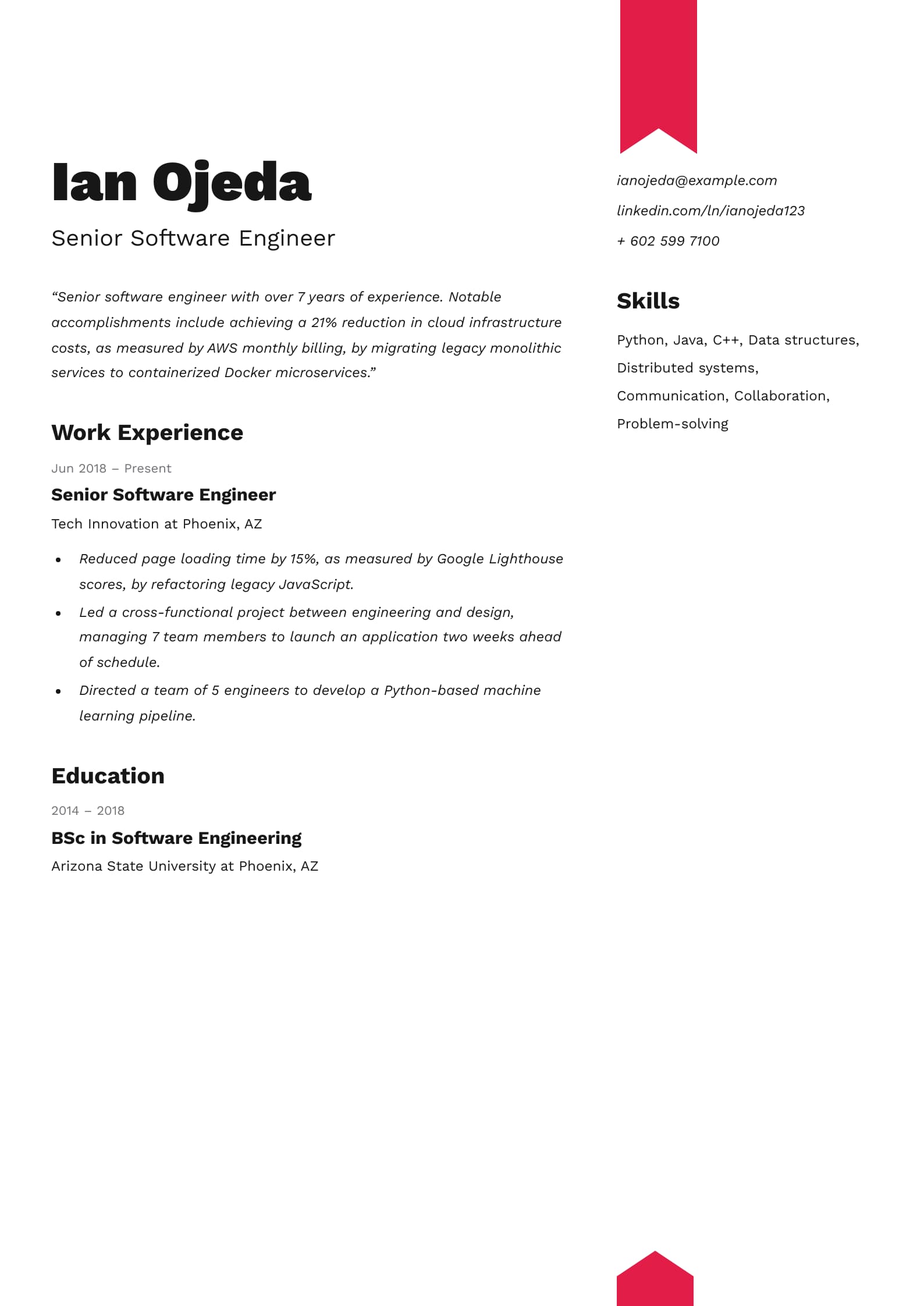
Here’s a complete Google resume example to show you what the document should look like:
Google Resume Cover Letter
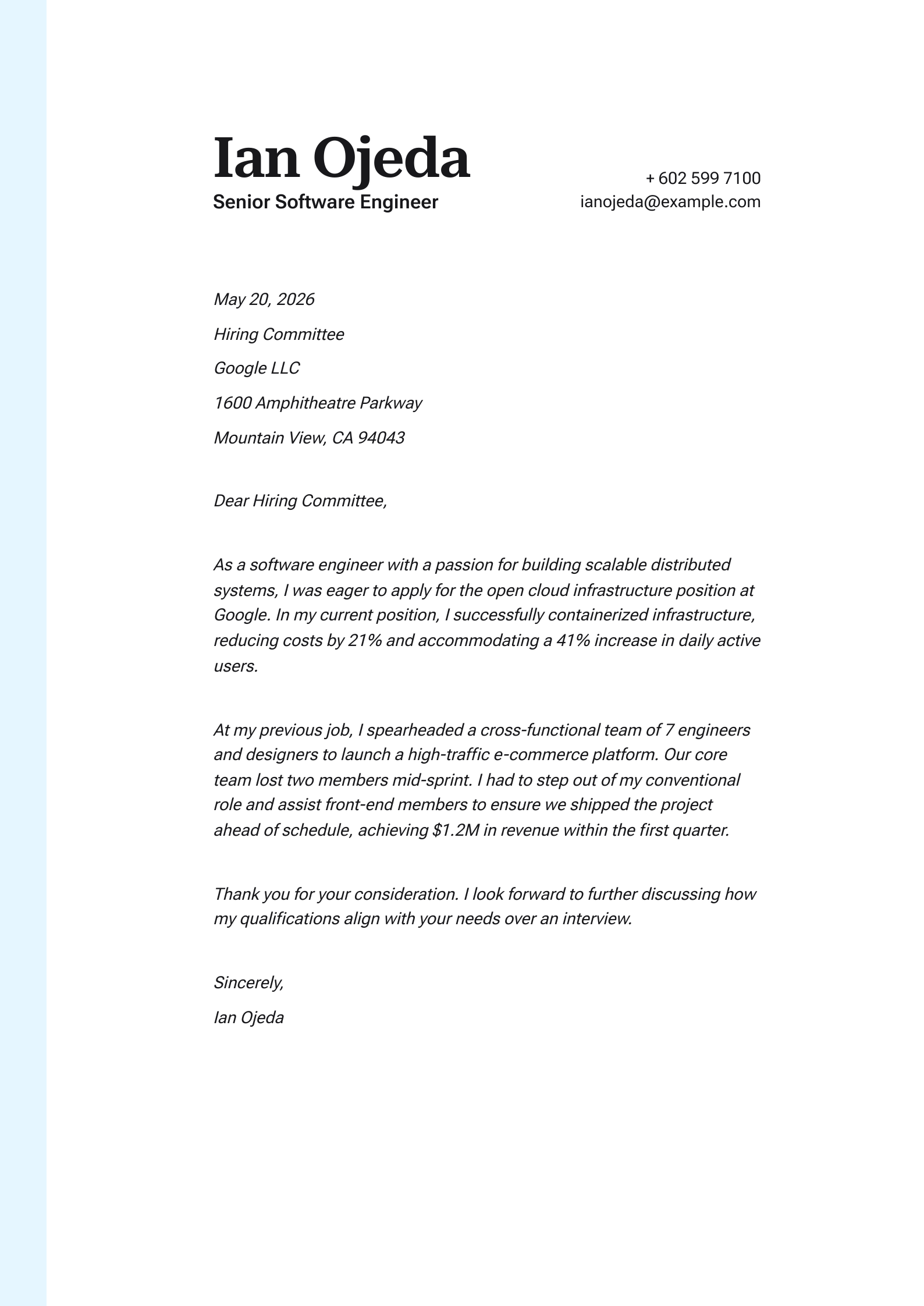
Now, here’s an example of a well-written cover letter:
How to Apply for a Job at Google
The most direct method of applying for a job at Google is to look for open positions on Google’s official careers portal. You can filter roles by location, skills, and degree requirements, and often submit your resume directly through the portal. However, getting a callback can be extremely difficult due to the sheer volume of applications submitted this way.
To increase your chances of getting hired at Google, you should leverage professional networking and employee referrals. Referred candidates typically have higher success rates because a referral means that someone in the company has vouched for your competence.
You can even contact a recruiter from Google on professional networks (e.g., LinkedIn), but make sure that your profile is fully optimized for your target role.
Once your initial contact is successful, you’ll enter a lengthy process that involves recruiter screening, technical and behavioral interviews, interviews with a hiring committee, a team matching phase, and potentially a full-day on-site or virtual interview.
The timelines vary due to the multi-stage nature of the process, but the entire Google application process usually takes between one and two months.
Keep in mind that the company also does headcount planning. In case all the roles get filled, your application may be temporarily put on hold until the roles open again at a later date.
5 Effective Strategies For Interviewing at Google

Interviewing at Google is a multi-stage process designed to assess the limits of your knowledge, experience, and cultural alignment. Here are the five tips to help you best prepare for it.
#1. Case Study and Analytical Interviews
Google interviews often involve ambiguous problems for both technical and non-technical roles. Interviewers want to assess your analytical skills and see you break down complex and ambiguous problems.
When posed with a case study, take the time to establish a structured framework for your response. Analyze all facets of the problem (e.g., core objective, constraints, pros and cons of multiple solutions), and then provide a comprehensive answer backed by data.
#2. Master Technical Interview Fundamentals
If you’re after one of the technical positions (e.g., Google data analyst or software engineer), you need to ace the technical interview. Make sure to brush up on the fundamentals (regardless of your seniority), and even practice on platforms like LeetCode or HackerRank.
Common topics that Google tests include:
Algorithms
Data structures
Coding ability
Systems design
Complexity analysis
#3. Prepare for Behavioral Interview Questions
Google recruiters ask behavioral interview questions to predict your future performance based on past behavior. These questions often assess collaboration skills, leadership prowess, and communication competence.
The method that works best for this type of question is the STAR method. This method gives you a structure to follow, with the steps being:
STAR Method
Situation. Describe the context first.
Task. Specify the task you were responsible for.
Action. Talk about the actions you took to solve the problem.
Result. Quantify the results of your efforts.
#4. Practice Thinking Out Loud
One of the most important Google interview tips is to avoid solving problems in silence. Google recruiters want to evaluate your thought process, and not just your solutions.
When presented with a prompt, you should ask clarifying questions to help you uncover constraints and edge cases. Talk as you’re working through the problem, and explain why you’re choosing a specific approach. Make sure to acknowledge any potential drawbacks and listen carefully to the interviewer's feedback.
#5. Study Google’s Products and Culture
You need to thoroughly understand the products, business model, and culture behind the role you’re after. For instance, cloud candidates should understand distributed infrastructure, while ads candidates should understand analytics and auction systems.
Make sure to research the challenges and industry trends associated with the position that you’re applying for to make your answers more precise and effective.
15 Common Google Interview Questions
While Google interview questions vary by department, these are some of the most common questions candidates report:
Common Interview Questions
Why do you want to work at Google?
Describe a difficult technical problem you solved.
Tell me about a time you had to solve a complex problem with incomplete data.
Tell me about a project you led.
Choose one Google product and tell me how you’d improve it.
Tell me about a time you took a risk that did not pay off.
Walk me through a project that failed. What did you learn from the experience?
Tell me about a time you received critical feedback from a manager.
Describe a situation where you had to pivot a project halfway through.
When it comes to technical interview questions (e.g., if you want to get a job at Google as a software engineer), you might encounter some of the following:
Technical Questions
Write a code to solve [specific algorithm problem].
Given a grid, find the safest path from the top left to the bottom right.
Design a highly scalable system like Google Drive or YouTube.
Write an algorithm to find the shortest common supersequence of two strings.
How would you identify and resolve a slow page-loading issue?
Best Degrees and Skills for Google Careers
Some of the best degrees for Google careers include:
Computer Science
Software Engineering
Data Science
Mathematics
Statistics
Business Analytics
Human-Computer Interaction
However, we’ve already established that Google often values practical experience as much as academic background. Important skills to demonstrate in your Google resume and cover letter include:
Programming
Cloud computing
System design
SQL and data analysis
UX research
Project management
Leadership
4 Reasons Google Rejects Applicants
Even exceptional professionals can receive rejection letters from Google if they make mistakes or have inadequate applications. Here are four common reasons why Google rejects applicants:
Generic resumes. Using the same resume you’ve submitted to a dozen other jobs will raise red flags in recruiters. Plus, your resume might not have the right keywords to pass ATS in the first place.
Vague accomplishments. Not using numbers to quantify your efforts will lead to weak impact statements that don’t stand out or demonstrate your expertise.
Absence of cultural fit. You can have the most sought-after hard skills, but if you lack “Googleyness” and come off as rigid and unable to collaborate, your application may face rejection.
Poor interview communication. Some candidates may have strong technical skills and accomplishments, but aren’t able to communicate that adequately. Interviewers want to see how you think and behave, not just if you can memorize a solution.
Get a Job at Google with Resume.co
If you want to work at Google, you first need a powerful resume. With our AI-powered resume builder and professional resume templates, you can create a document that will impress recruiters and maximize your chances of landing an interview.
Ready to design your Google resume?
Create my resumeClosing Thoughts
Getting a job at Google means overcoming one of the toughest challenges in the corporate world. However, by understanding what recruiters are looking for, you can significantly improve your chances.
Remember the X-Y-Z formula, ensure that you can demonstrate “Googleyness,” and prepare for technical and behavioral interviews with diligence. Keep in mind that rejection is common at Google, so many current employees had to apply multiple times. Don’t forget to check out our resume and cover letter builder to shift the odds in your favor!
How to Get a Job at Google FAQs
#1. How hard is it to get a job at Google?
It is very hard to get a job at Google. Google receives millions of applications each year, so its hiring process is rigorous, involving multiple stages of recruiter screening, technical interviews, behavioral interviews, and more.
#2. Can you get a job at Google without experience?
Yes, you can get a job at Google without experience. Google offers several early-career programs, including the STEP (Student Training in Engineering Program) internship for computer science students and the BOLD immersion program for business roles. They also offer apprenticeships that prioritize potential and aptitude over formal experience.
#3. Is it easier to get hired at Google with a referral?
Yes, it is generally easier to get hired at Google with a referral. Having a reputable, trusted employer who can endorse your skills and cultural fit can increase your chances of getting past the initial resume screening and landing an interview.