

Extracurricular activities are pursuits outside of school or work that can help you build useful skills for your professional and personal life. They aren’t obligatory, but they can boost your job application, especially if you’re a student or recent graduate who lacks actual work experience.
In this article, we will dig deeper into the importance of extracurricular activities, explain how to include them in your resume, and share the most common examples you can refer to. We will also explore when you should mention them in your job application and when this isn’t necessary.
Key Takeaways
Extracurricular activities are performed outside of school or work, usually for enjoyment, but also to help you build particular skills.
You should include extracurricular activities in your resume if you’re a student or recent graduate who lacks relevant work experience.
When listing extracurricular activities, write a title, add dates, and list your achievements, like you would if you were writing about your work experiences.
You can write about your extracurricular activities in a separate section or include them as bullet points in your education section.
What Are Extracurricular Activities?
Extracurricular activities are the activities you participate in outside of school or work, not because they are a requirement for school credits or employment, but because you enjoy them. They are completely optional and voluntary, but highly beneficial, since they help you gain various skills that can improve your personal and professional life.
For example, such activities can teach you communication, teamwork, time management, or leadership. They may also expand your knowledge in a specific field, which may be highly relevant for your career, or help you develop practical skills with tools like an image upscaler for visual projects.
As a result, extracurricular activities are useful to include in a resume, particularly if you’re a student or a recent graduate. However, before you do, you must understand the distinction between these activities and hobbies, as they aren’t the same, but often get mixed up.
Namely, while both have the voluntary, personal aspect, extracurricular activities are organized and usually involve a club, a team, or a group. Long-term commitment and participation are expected; otherwise, you lose the right to be a member.
On the other hand, hobbies are far less structured and rather informal, and many don’t require the presence of other people. So, drawing would be considered a hobby, while an art club is an extracurricular activity.
2 Resume Examples With Extracurricular Activities
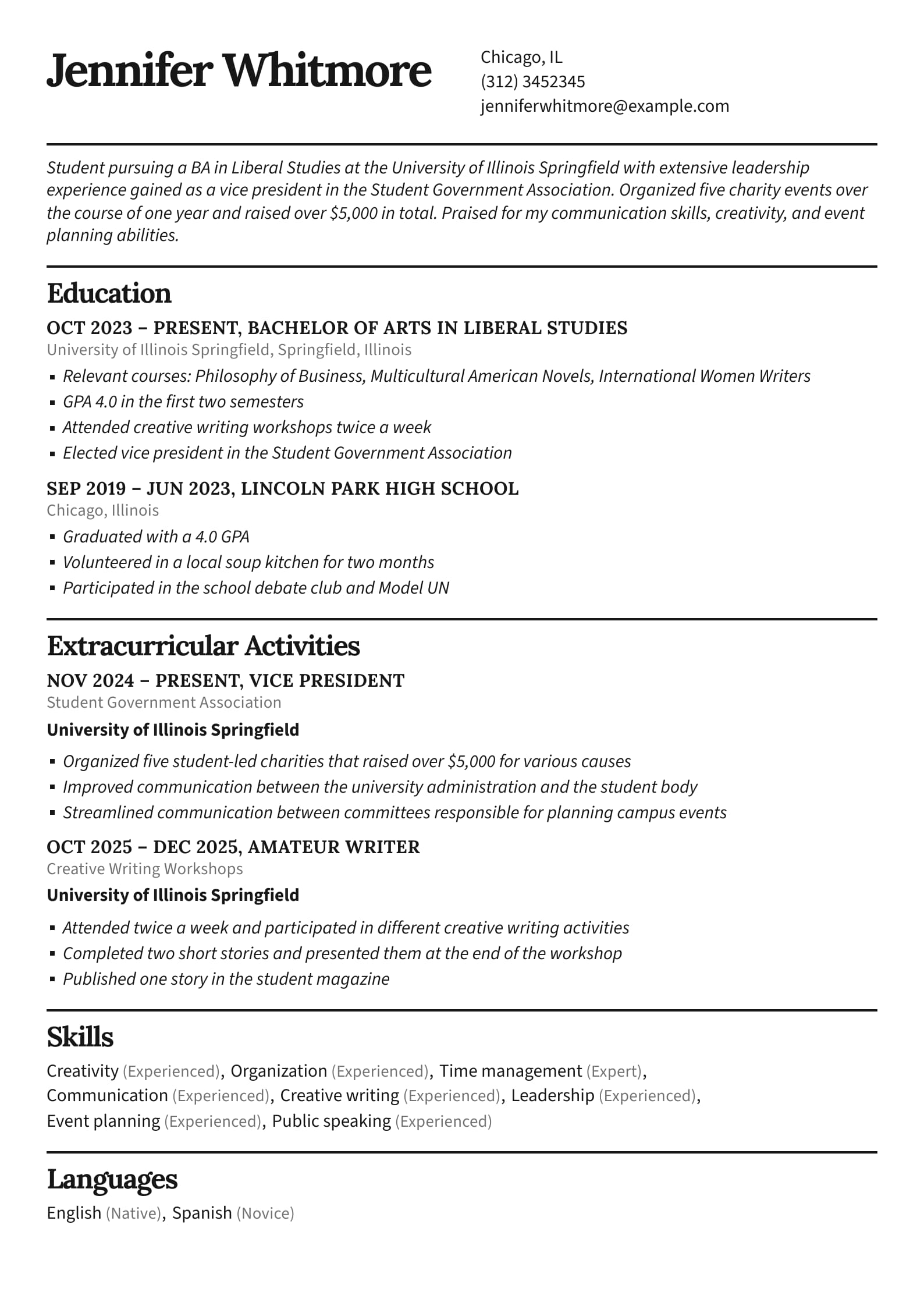
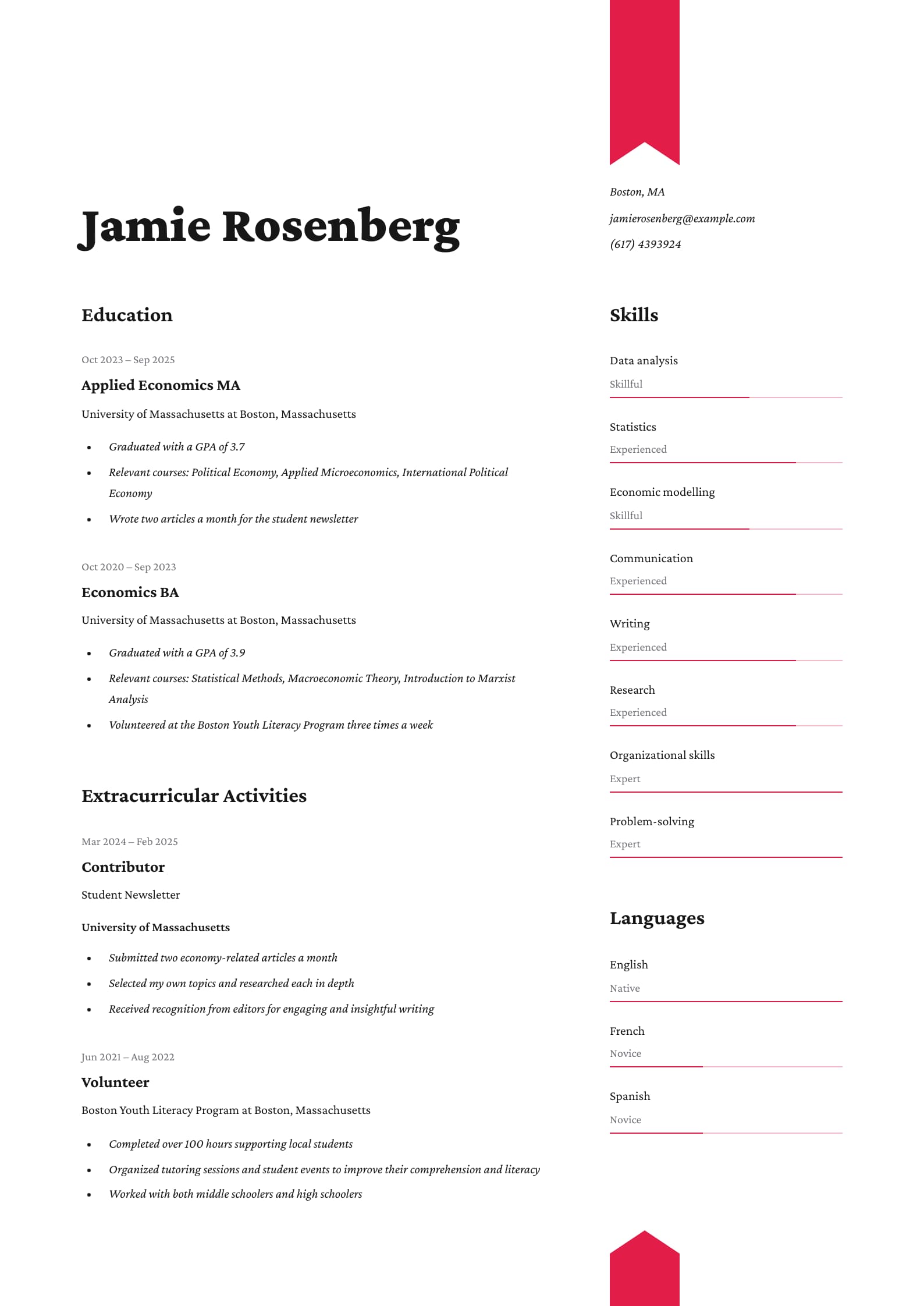
Before we explore extracurricular activities in more detail, we’ll show you two resume examples containing these sections: a student's resume and an entry-level candidate's resume.
Let’s start with the student example:
Now, let’s see an example of an entry-level candidate with no work experience:
123+ Examples of Extracurricular Activities
Extracurricular activities encompass a range of activities that we’ve sorted into ten categories: academic, media, art, culture and language, music, performing arts, technology, volunteer and community service, sports, and social justice.
Let’s take a closer look at each:
#1. Academic
Academic extracurricular activities focus on intellectual growth and skill development outside high school or college classes. Most commonly, the skills they target are leadership, problem-solving, and critical thinking, which can, in turn, boost your academic performance.
Here are some common extracurricular activities belonging to this category:
Science clubs
Robotics teams
Debate teams
Chess clubs
Spelling bees
Creative writing clubs
Quiz bowls
Astronomy clubs
Math/science competitions
Essay contests
Mock trials
Language competitions
#2. Media
Media-related extracurricular activities are ideal for students who wish to become journalists and reporters, since these put them in situations to prepare them for these careers. Additionally, they teach them communication, research skills, interviewing, video editing, content creation, and more.
These are some of the media-related activities you may add to your resume:
School/College newspaper
Literary magazines
School/College radio station
School website
Video game development club
Podcasting
Yearbook committee
Photography club
Graphic design club
AV club
Community news outlet
Film production
School social media
#3. Art
Artistic extracurricular activities help you express your creativity and connect with others whose interests lie in the same field. They are vital when applying for an art-related job, but including them in your resume also demonstrates that you’re an original thinker with fine motor skills.
Also, since art is a powerful tool for exploring social and personal issues, your involvement in related extracurriculars may be a sign of your developed critical thinking and emotional intelligence. These traits are always in demand, as practically every company and position benefits from them.
So, here are some art-related extracurriculars to consider including:
Art club
Culinary arts club
Anime and manga club
Shakespeare club
Jewelry making
Photography workshop
Curating art exhibitions
Poetry club
Pottery club
Sewing club
Woodworking club
#4. Culture & Languages
Cultural or language-related extracurricular activities allow you to explore your own and other cultures, connect with people within the culture of your interest, and practice languages. Aside from making you more open-minded and culturally sensitive, they also provide spaces for celebrating tradition and discussing potential political issues.
These activities can be particularly beneficial for minorities, who may feel like this is the only opportunity to reconnect with their cultures. However, those who are simply interested in a culture shouldn’t hesitate to join, either, as long as they can be respectful and dedicated to learning.
Add the following cultural extracurricular activities to your resume:
Spanish club
Japanese club
German club
French club
Chinese club
American Sign Language club
Foreign language club
Endangered languages club
Black students’ union
Asian students’ union
Ethnic food club
Cultural dances
Cultural music
International food club
Foreign language contest
Foreign exchange
#5. Music

Music is always among the most popular extracurricular activities, probably because most people want to engage with it in some capacity. So, some join choirs, while others play classical instruments or hone their skills in bands.
Whatever the case, music-related extracurriculars can look good on a job application, as they demonstrate your creativity, discipline, and teamwork. Even if you’re a soloist who doesn’t have to synchronize with other orchestra or band members, being a musician typically implies a strong work ethic, which employers usually appreciate.
Here are some great music-related extracurriculars for your resume:
School band
Marching band
Choir
Jazz ensemble
Acapella
Orchestra
Music production club
Music theory classes
Songwriting classes
Music summer camp
Church band
Vocal competition
Vocal training
#6. Performing Arts
Performing arts typically involve theater and dance, which combine creativity with public self-expression, fostering self-development. In fact, theater is said to build confidence in children, as it challenges them and simultaneously provides tools they can reach for when dealing with different life situations.
Aside from confidence, performing arts improve your discipline, since you must show up for rehearsals on time and follow the schedule properly. Being on stage and practicing for it also improves empathy, patience, and perseverance, all of which can be crucial for your job.
Here are some performing arts that are often found in resumes:
Drama club
Classical dance
Contemporary dance
Choreography club
Improv
Musical theater
Slam poetry club
Renaissance fair
Community theater workshops
#7. Technology
Technology extracurriculars are especially useful to include if you’re applying for a position in an IT field, as they prove that you have some related experience, even if it’s not paid. After all, much can be learned about computers and programming through school clubs and hackathons.
However, aside from the technical skills you’re likely to gain, tech-related extracurricular activities teach you strategic thinking, problem-solving, and teamwork. They also demonstrate your initiative and willingness to tackle real issues, especially through your participation in hackathons.
These are some notable technology-related extracurriculars:
Coding club
Computer science club
Hackathon
Robotics
3D printing
AI and machine learning
Cryptography
Gaming tournaments
#8. Volunteer & Community Service
Volunteering and community service on your resume show that you’re committed to making the world a better place, even in small ways. As a result, these activities tend to look excellent on job applications, especially if you have no work experience to showcase your skills.
And speaking of skills, volunteering certainly helps you develop quite a few: communication, teamwork, time management, emotional intelligence, and leadership, for one. Furthermore, you’ll become a better problem solver and gain a larger network as you engage with your community.
Here are some volunteering activities you can write about:
Animal shelter
Food bank
Hospital volunteering
Fire department volunteering
Mentoring
Tutoring
Summer camp volunteering
Soup kitchen
Red Cross volunteering
Community cleanups
Recycling programs
Charity
#9. Sports & Team Activities
Sports are excellent extracurricular activities to include on your resume, as they demonstrate that you understand the importance of teamwork and have experience with it. Whether you’ve played basketball, football, or soccer, you know that your abilities can only truly shine when they contribute to the overall team strategy.
Furthermore, sports are resume activities that show leadership, especially if you were a team captain at some point. With such experience and your clear ability to commit to your goals and persevere, you gain an edge over candidates who didn’t participate in sports in high school or university.
Let’s see which sports and team activities you can add to your resume:
Basketball
Baseball
Cheerleading
Gymnastics
Martial arts
Cycling
Rock climbing
Hiking club
Golf
Lacrosse
Ping pong club
Soccer
Football
Swimming
Track and field
Volleyball
Water polo
Fencing
Yoga club
#10. Social Justice
Participating in social justice activities during your studies shows that you want to make a difference in the world and stand for minority rights and against inequality. In some ways, this overlaps with volunteer and cultural activities, but it’s distinct because these activities focus specifically on social and political issues.
So, what skills can you gain from actively fighting for social justice? Leadership, critical thinking, and emotional intelligence are high on that list. Furthermore, you’ll learn how to take initiative, collaborate with others, and be aware of issues that don’t affect you, but have a great impact on the lives of those around you.
Here are some social justice activities to boost your resume:
Immigrant rights organizations
Climate change policy activism
LGBTQ+ rights and policy
Students Against Sexual Harassment
Community advocacy initiatives
Panel discussions
When Should You Include Extracurricular Activities on a Resume?
You should include extracurricular activities on a resume without work experience; in other words, when you’re still a student or have just completed your studies. In these cases, extracurricular activities can replace your work experience section and demonstrate your achievements and skills to the employer.
Of course, that doesn’t mean you should include every activity you’ve ever done just to bulk up your resume. Focus on the ones relevant to the job you’re applying for or those that showcase particular technical or transferable skills. Everything you add to your resume should have a purpose, and extracurriculars are no exception.
Once you start gaining actual work experience, you can update your resume and slowly start replacing extracurricular activities with jobs and responsibilities you were paid for. This doesn’t have to happen at once; many young employees keep particularly relevant extracurriculars alongside their professional background.
However, you’re unlikely to find student resume activities in an experienced worker’s job application. These are usually present only in student resume templates.
The only exceptions are career changers, who may not have relevant experiences in their new field and essentially have to start from scratch. As a result, they may turn to extracurricular activities to demonstrate their transferable skills.
How to List Extracurricular Activities on a Resume
To list extracurricular activities on a resume, you should treat them similarly to job entries in the work experience section. So, rather than simply listing what you have done, you should elaborate on achievements, skills, and responsibilities.
Here are a few resume tips for students who want to write about their extracurricular activities:
Include a title. If you had an official title in your club or organization, make sure to put it at the top of your entry, much like you would for a job position. So, for example, you can write “Team Captain” for a basketball team or “Lead Actor” for drama club. Avoid generic titles like “Member”; you can use them if you can’t think of anything else, but they aren’t descriptive enough to add much value.
Add dates. This is another common practice when writing about your work experiences, and you should apply it to your extracurriculars, too. You don’t have to be overly specific; the [Start Month, Year] – [End Month, Year] format should suffice.
List your achievements. Include extracurricular achievements on your resume to show verifiable proof of your skills and abilities. We advise you to use bullet points, active verbs, and measurable results whenever possible, though you may not have specific data and numbers as you would in a workplace. Still, make sure to highlight your contributions.
Now, let’s illustrate these points through an actual example:
Good Example
Team Captain Varsity basketball team
May 2024 – October 2024
Motivated a team of 12+ players during practices and competitions
Promoted teamwork and sportsmanship
Communicated my team’s needs and issues to coaches
Where to Put Extracurricular Activities on a Resume

Extracurricular activities can be placed in different parts of the resume, depending on how prominent you need them to be. For instance, they can have a separate, dedicated section, or they can be listed as bullet points in your education section.
If you decide to include a dedicated extracurricular activities section on your resume, you should place it underneath the education section. In this case, you likely won’t have work experience to write about, but if you do, that should take priority, too.
Here’s what a dedicated section may look like:
Extracurriculars Dedicated Section Example
Extracurricular activities
Vice President Student Council at Bakersfield College
June 2024–September 2025
Helped organize 10+ student events, many of which were charity-based
Increased student participation in council events through improved outreach
Introduced a student suggestion system to enhance communication with the council
More experienced applicants are more likely to include extracurricular activities in the education section, if at all. If you choose to do so, you can simply place your most relevant extracurriculars in bullet points under the entry they are related to.
So, for example:
Extracurricular Activities In The Education Section
Education
Bookkeeping Certificate of Achievement Bakersfield College
October 2023–September 2025
Graduated with a 3.7 GPA
Elected as vice president of the student council and held that position for a year
Organized and participated in 10+ charity events
Need to Add Extracurricular Activities to Your Application?
Use our resume builder to do it in minutes!Closing Thoughts
Extracurricular activities can boost your resume and impress your potential employer if you use them to highlight your achievements and skills. Our comprehensive guide has shown you how to do just that, so make the most of them next time you write your resume.
If you’re still not sure how to do this, consult our resume examples for help. They can serve as an inspiration as you write your own job application.
Extracurricular Activities FAQs
#1. How many extracurricular activities should I include?
You should include 3–5 extracurricular activities, though the exact number isn’t as important as their content. If these activities are highly relevant to the position you’re applying for or demonstrate a particularly important skill, don’t be afraid to add more than that. However, if you’re a recent graduate with some work experience, 2–3 activities should suffice.
#2. Can extracurricular activities count as work experience?
Extracurricular activities don’t exactly count as work experience, but they play essentially the same role in your resume if you know how to properly showcase them. More specifically, they demonstrate your skills and achievements in a tangible, verifiable way.
#3. Can I turn extracurricular activities into skills?
You can turn extracurricular activities into skills by showing how they’ve helped you develop certain abilities. Most of them teach communication, collaboration, teamwork, and leadership, so you can write about specific achievements that helped you build these skills in the extracurricular activities section.