

What 4,740 instructions reveal about resume editing
Sometimes you do not need AI to write a whole resume. You need it to shorten an awkward paragraph, bring the right experience forward, or make a sentence sound like something you would actually say.
Resume.co's research into 4,740 instructions submitted while editing resume summaries and work experience shows that these smaller requests deserve attention. The original analysis recorded 570 requests to add content, 544 to shorten text, and 365 to tailor it to a job. People were asking for specific changes, not simply handing over the entire writing process.
If you are editing your own resume, those requests offer a useful starting point: decide what needs to change before asking AI to improve it. Here is what the research found and how to turn those editing needs into clearer instructions.
Key takeaways
The study covers 4,740 editing instructions, not 4,740 individual job seekers.
70.1% of instructions were ten words or fewer; these requests accompanied product context.
Adding content and shortening text were both common requests in the original analysis.
The findings describe editing needs, not prompt effectiveness or hiring outcomes.
Ask for one clear change, supply the facts, and check what the edit adds or removes.
Most instructions were ten words or fewer
Of the 4,740 instructions, 3,324 contained no more than ten words: 70.1% of the total. The median length was seven words.
That is a short request, not an elaborate prompt. In an editor where you are already working on a particular section, you can name the change rather than explain your entire career again. These instructions accompanied product context, so they were not necessarily everything the AI received.
The takeaway is not that shorter prompts work better. It is that a small, clearly defined editing task can be a practical place to start. If you want a paragraph shortened, say what to remove and what to keep. If you want it tailored, provide the vacancy and identify the experience you can support.
What people wanted to change
The original Resume.co research report identified the following requests. These are counts of instructions, not individual job seekers, and the categories should not be read as separate slices of the whole.
Requested change | Instructions reported |
|---|---|
Add skills, experience, keywords, or other content | 570 |
Shorten the text | 544 |
Tailor it to a particular job | 365 |
Change structure or formatting | 350 |
Make the wording more professional | 348 |
Emphasize specific details | 242 |
Remove information | 215 |
Make the wording more human | 188 |
Add metrics or numbers | 164 |
Make the text ATS-friendly | 98 |
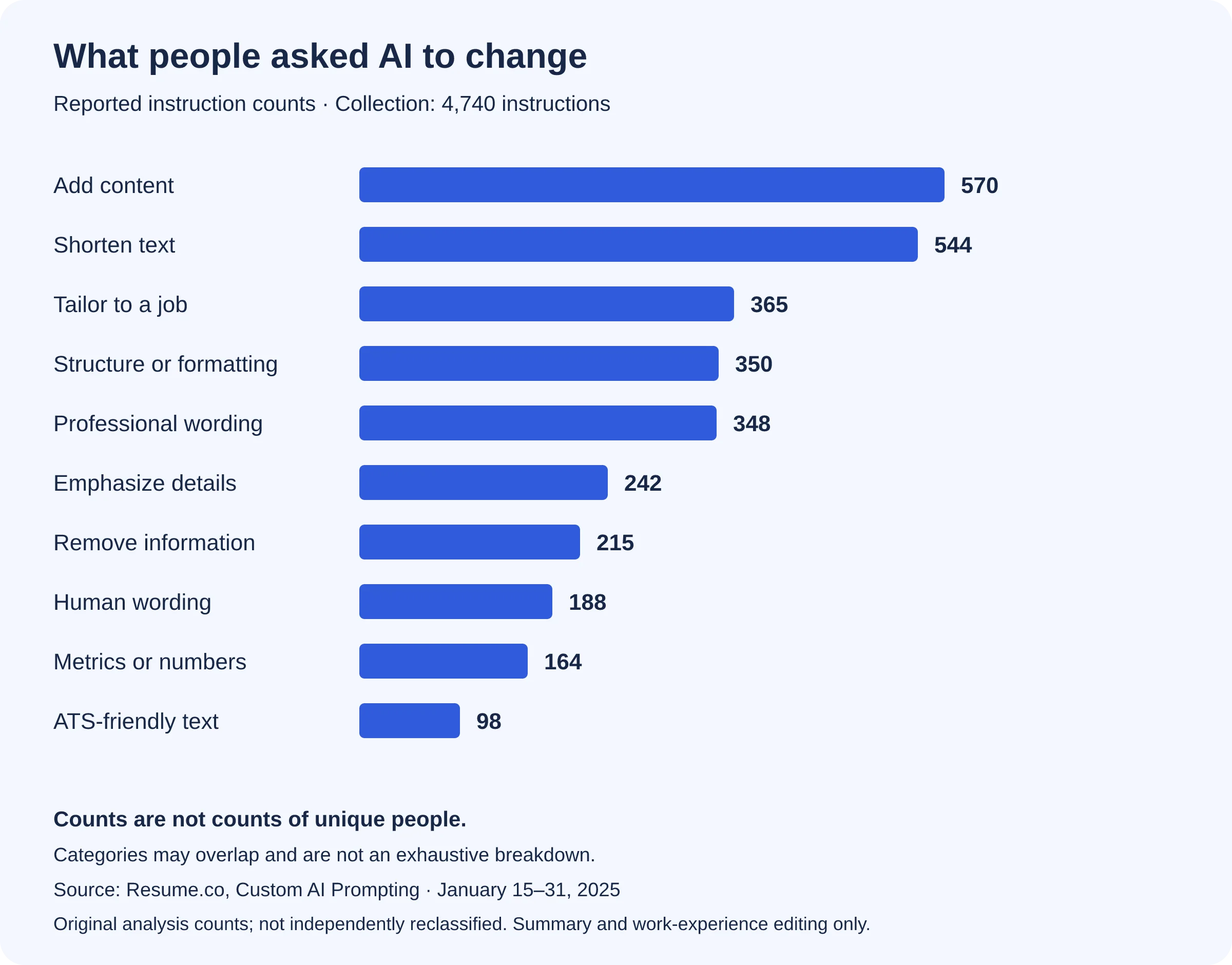
Reported request counts in Resume.co’s Custom AI Prompting study, January 15–31, 2025. The collection contains 4,740 instructions from summary and work-experience editing. Categories may overlap and are not exhaustive; counts are from the original analysis, not independently reclassified.
Several of these needs can coexist in a single resume. You may want fewer words but more relevant detail, a professional tone without stiff language, or clearer achievements without invented results.
Less text does not have to mean less substance
The report recorded almost as many requests to shorten text as to add content: 544 versus 570. Those are different requests, but they highlight a familiar editing problem. A resume can be wordy and still leave out something important.
For example, removing "I was responsible for a wide variety of administrative duties" creates room for the actual work: maintaining a delivery spreadsheet, checking orders, and reporting outstanding items. The useful distinction is between cutting repetitive language and cutting evidence of what you did.
Instead of asking only for a shorter version, tell AI which tools, responsibilities, and facts must survive the edit.
Professional wording should still sound like you
The analysis counted 348 requests for more professional wording and 188 for a more human tone. These are related but different goals: you may want clearer workplace language without a sentence you would never say aloud.
A useful check is to read the result as if an interviewer had asked you to explain it. If "facilitated cross-functional operational alignment" really means "sent the weekly order list to the office manager," the simpler wording tells the reader more.
Also check the level of responsibility. Replacing "helped" with "led" is not merely a tone adjustment; it changes the claim about your work.
Numbers need a source
There were 164 requests to add metrics or numbers. Numbers can make experience more specific, but asking for them does not establish what the numbers should be.
"Showed four colleagues how to follow the procedure" uses a supplied fact about the scope of the work. "Improved team productivity by 30%" introduces a result that needs its own evidence. If you do not have a measured outcome, describe the work accurately rather than asking AI to manufacture one.
Give the tool facts you know: the number of people you supported, the frequency of a task, or the volume of work you handled. Keep only numbers you can explain and substantiate.
How to ask for the edit you actually need
You do not need to use every instruction below. Choose the one that matches the problem in front of you, then supply your text and relevant facts. These are illustrative prompts written for this article, not quotations from customers.
Your goal | An instruction to try |
|---|---|
Shorten a section | Cut repeated wording. Keep the tools, dates, numbers, and distinct duties supplied below. |
Tailor to a vacancy | Put the experience relevant to this vacancy first. Flag requirements my source does not support. |
Add useful detail | Use the supplied workload and team-size facts. Do not invent percentages or business results. |
Make the tone natural | Use direct professional English that I could explain aloud. Preserve my actual responsibilities. |
Improve the structure | Combine repeated tasks into four bullets. Keep each distinct activity at least once. |
Afterward, compare the new text with the original. Look for both kinds of unwanted change: a qualification or result that appeared without support, and a useful fact that disappeared. A cleaner sentence is only an improvement if it still describes your experience.
An example of shortening without losing the facts
Consider this fictional example. Casey maintains a supplier-delivery spreadsheet, checks it every Friday, and sends the office manager a list of outstanding orders. There are no figures showing cost savings or fewer late deliveries.
Before:
In my role, I was responsible for taking care of the supplier delivery spreadsheet, which I checked on a weekly basis every Friday, and I would then send over a list of orders that were still outstanding to the office manager.
Instruction:
Shorten this to one bullet. Keep the spreadsheet, Friday check, outstanding-order list, and office manager. Do not add results that are not in the source.
One possible edit:
Checked the supplier-delivery spreadsheet each Friday and sent the office manager a list of outstanding orders.
The edited version keeps the concrete action, its frequency, and the recipient of the work. It removes filler without inventing savings or claiming responsibility for the whole purchasing process. This is an editorial example, not a tested AI output.
That is the standard to apply to your own revision: can you point to what became clearer, and can you still support every claim?
Start with one change
The research shows a range of requests behind the broad idea of "writing a resume with AI." Shortening, tailoring, adding detail, and changing tone are different jobs. Asking for one of them gives you a clearer result to review than asking for an unspecified improvement.
Whether you use Resume.co or another writing tool, start with the section that needs attention. Name the change, provide the facts, and say what must stay. Then review the result before putting it into your final resume.
About the research
This article draws on Resume.co's Custom AI Prompting study, which reports a collection period of January 15–31, 2025. It covers 4,740 instructions from summary and work-experience editing features, not 4,740 different people. Instruction lengths were recalculated for this article; request-category counts are attributed to the original analysis and were not independently reclassified. The categories are not an exhaustive breakdown and may overlap.
The findings describe what people asked for, not whether the edits worked or helped them get hired. Examples are fictional, and private customer instructions are not reproduced.