

To tailor a resume to a job description, match the employer's requirements to experience you actually have, then adjust the wording and order to make that evidence easy to find. In Resume.co, open Tailor, paste the job description, choose supported keywords, add instructions, and review the suggested changes before applying them. Change the emphasis, not the facts.
You do not always need a completely new resume. Sometimes the version you already have fits. Sometimes you need a different version for a different type of role. The useful question is: What does this employer need to see that my current resume makes difficult to find?
This hands-on guide is for people who already have a base resume and want to adapt it in Resume.co without inventing experience. We use one fictional candidate and two fictional vacancies to show the complete workflow, actual screenshots, and full before-and-after experience sections. The final versions include our manual corrections, not just AI suggestions.
Key takeaways
Review each vacancy, but do not rewrite accurate text just to make it different.
Keep a complete base resume and create role-specific versions when the emphasis changes.
Select only job requirements that your experience supports. An optional skill is not permission to invent it.
In our two Resume.co runs, tailoring changed the wording and emphasis, but some suggestions still needed factual editing.
A match score is not proof that every sentence is true or that an employer will invite you to interview.
What our research found about resume tailoring
The synthesis of Resume.co’s Q3 2025 interviews with 12 paying users recorded these behaviors:
Finding in the interview synthesis | What it suggests for your workflow |
|---|---|
9 of 12 participants reported tailoring, manually or automatically | Tailoring is not limited to pressing an AI button; choosing and editing relevant evidence is also tailoring |
4 of 12 tailored for every or almost every application | Some people need a repeatable process for frequent adjustments |
4 of 12 tailored for priority applications or roles substantially different from their baseline | Selective tailoring is another observed approach, not necessarily starting over every time |
The same research described people keeping one to five baseline versions. Participants also reported reviewing AI wording, removing unsupported skills, and restoring information that a rewrite had removed. A separate interview study with 21 former subscribers, conducted from October 2025 to February 2026, likewise described versions for different roles and industries.
These are observations from small, selected interview groups, not estimates for all job seekers or proof that one strategy produces more interviews. The frequency descriptions above are not an exhaustive partition of the 12 participants.
Our analysis of custom instructions in resume-writing fields also identified requests to adapt text to a vacancy and to correct experience attributed by AI. That combination matters: a rewrite can become more relevant while still introducing something you did not do.
The decision guide below is our editorial recommendation based on these needs, not a tested formula for hiring success.
Do you need a base resume, a role version, or a tailored version?
Keep a master record of your experience, including useful tasks and achievements that may not belong in every application. Use it as the source for shorter, targeted versions.
Your situation | Start with | What to change |
|---|---|---|
The posting has substantially the same responsibilities and your relevant evidence is already easy to find | Your current role-specific resume | Check requirements, dates, and wording; keep text that already works |
You are applying across different kinds of roles, such as customer support and operations | A separate baseline for each direction | Change the summary emphasis, leading experience points, and skills order |
A particular vacancy prioritizes something your current version buries | The closest role-specific version | Bring that evidence forward and use the employer’s terminology where it is accurate |
The role requires a qualification you do not have | Your factual background, not a stronger rewrite | Identify the gap; check whether an alternative is explicitly accepted rather than adding the qualification |
For example, a support resume that leads with customer emails may be suitable for another support opening. An operations opening may call for the same person’s recordkeeping and warehouse coordination first. That is a change in presentation, not a new employment history.
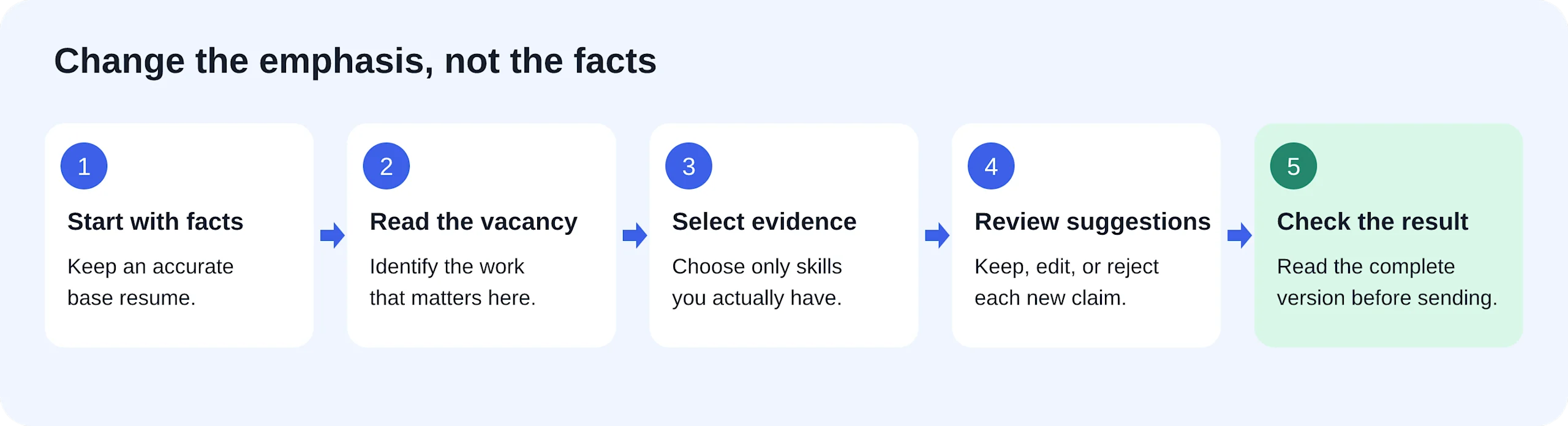
Keep your base resume as the source of truth throughout the process. The diagram summarizes the workflow; it is not a screenshot of the product.
One candidate, two different job descriptions
We created a new resume in Resume.co and ran tailoring twice, once for each of two fictional job descriptions. Both runs started from the same unmodified base resume. We reviewed the proposed text and edited it before applying it.
Candidate: Jordan Lee, Customer Support Specialist at Example Home Goods, January 2023 through December 2025.
Facts supplied to the product:
Answered approximately 35–45 customer emails daily about orders, deliveries, and returns.
Recorded returns in Excel and checked order numbers and refund status.
Sent unresolved delivery issues to the warehouse team and followed up for updates.
Wrote six reusable email templates for common customer questions.
Showed four new colleagues how to handle returns and use the templates.
The base summary described those activities and three years of experience. Its skills section contained Excel recordkeeping. We supplied no Salesforce experience, advanced Excel macros, inventory forecasting, staff management, or measured improvement in speed or satisfaction.
The two job briefs:
Customer Support Coordinator: answer order and return emails, coordinate delivery updates, maintain response templates, and help colleagues learn returns procedures. Salesforce was preferred, not required.
Operations Assistant: maintain returns records in Excel, check order details and refund status, follow up with the warehouse, and keep process instructions current. Advanced Excel macros and inventory forecasting were preferred, not required.
Jordan, both employers, and both vacancies are fictional. The screenshots and suggestions come from actual Resume.co runs. This is a worked example, not a comparison of tools or a measurement of interview outcomes; the walkthrough date and method are noted at the end.
How we tailored the resume in Resume.co
1. Open Tailor and supply the job description
With the base resume open, we selected Tailor, pasted the job description, and chose Check my match. Each run created a separate document version, leaving the original available for the second test.
Use the actual responsibilities and requirements, not only the job title. For our two briefs, the difference was the work being emphasized: customer communication versus operational recordkeeping.
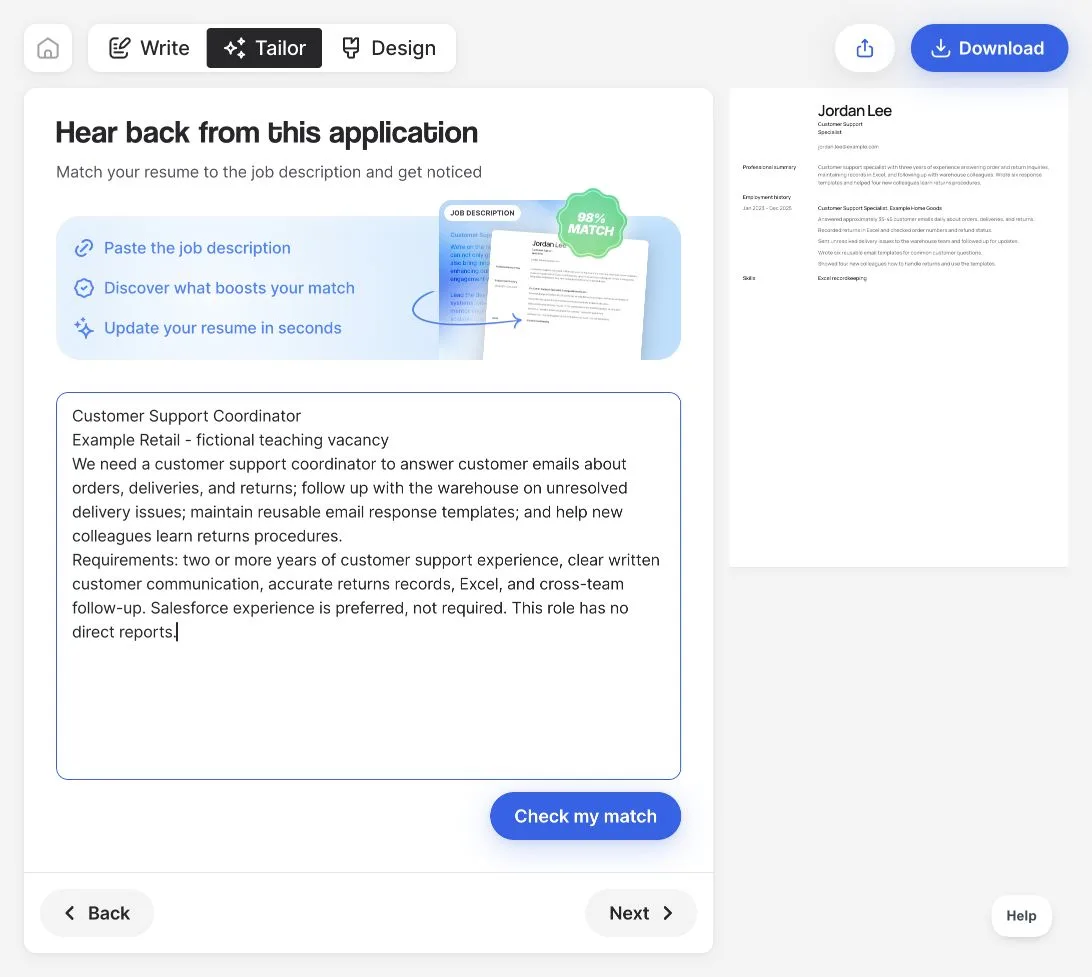
Start with the job description and an accurate base resume. Jordan and the vacancy are fictional teaching examples.
2. Review the keywords before requesting changes
The next screen, Choose keywords to highlight, let us select which terms applied to Jordan.
For the support role, Salesforce was initially unchecked; we left it that way. We selected warehouse coordination, refund status, recordkeeping, and colleague training because the original experience supported those activities. We left the broader onboarding term unchecked.
For operations, we selected order details, refund status, warehouse communication, email templates, and colleague training alongside the relevant preselected terms. Advanced Excel macros stayed unchecked. Inventory forecasting was excluded in our note and did not appear in the selected keywords.
This is a decision step, not a “select everything” step. A phrase appearing in the posting does not make it part of your experience.
3. Add a note that defines the emphasis and boundaries
We used Add your note to give a direction and identify claims the source did not support. For the operations version, our instruction was:
Lead with Excel returns records, order checks and warehouse follow-up. Preserve all dates and numbers. I have no advanced Excel macros, inventory forecasting or staff management experience. Do not claim improved speed, accuracy or satisfaction. Keep the historical job title unchanged.
For the support version, we instead asked the product to emphasize customer email support, response templates, and warehouse follow-up, while excluding Salesforce, people management, and unmeasured improvements.
The note helped specify the task. It did not remove the need to review the output.
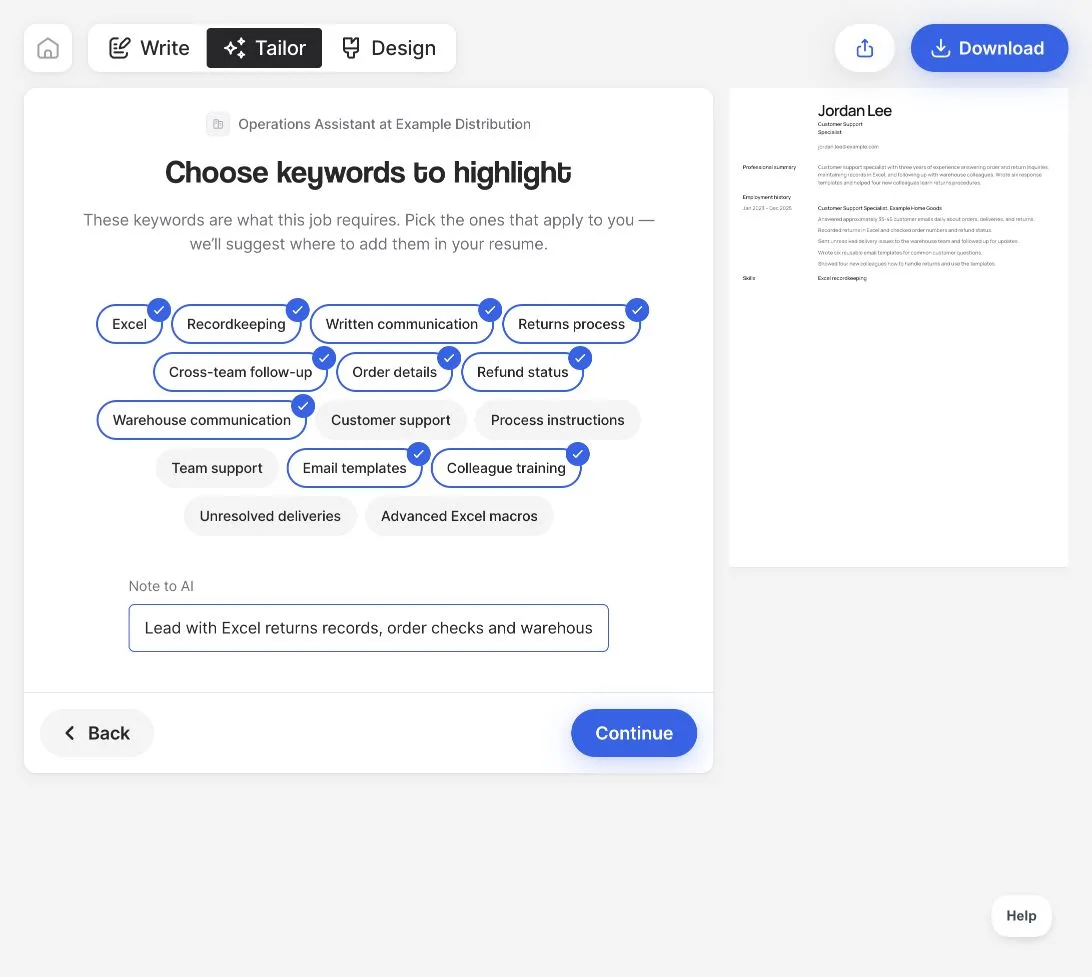
Select supported requirements and add guidance. The one-line note field shows only the beginning of our full instruction, quoted above.
4. Compare suggestions with the source facts
After Continue, the interface offered suggestions for the top-level job title, work experience, and skills. We reviewed them individually instead of using Apply all suggestions.
The operations run moved Excel recordkeeping to the first experience point, as requested. The support run kept customer communication first. Both preserved the supplied email volume, six templates, and four colleagues in their proposed experience text.
But preserving the numbers was not enough. Here are three specific decisions from the review:
Product suggestion | What the source supports | Our decision |
|---|---|---|
Support: “Wrote six reusable email templates for common customer support questions, improving response consistency.” | Six templates were written; an improvement in consistency was not established | Keep the activity and count; remove the claimed effect |
Support: “Trained four new colleagues on handling returns, using email templates, and best practices for customer support.” | Jordan showed colleagues the returns process and templates; broader best-practice training was not supplied | Narrow the description to the two activities in the source |
Operations: “documented warehouse communication updates” | Jordan followed up with the warehouse; documenting those updates was not stated | Remove the added responsibility and keep warehouse follow-up |
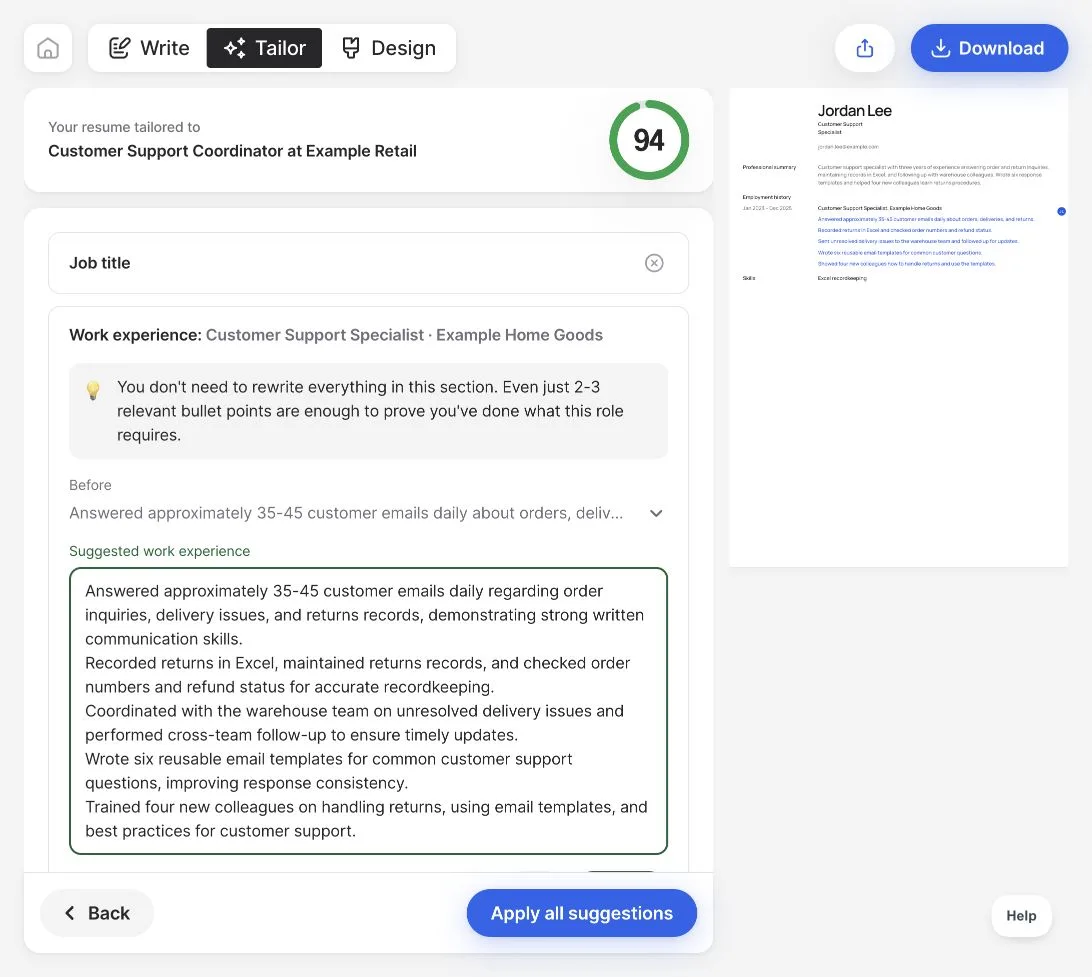
Before our review: the suggestion includes “improving response consistency” and broader training responsibilities. The score does not validate these claims.
We made these corrections in the editable Suggested work experience field before selecting Apply. This kept useful phrasing without accepting new claims.
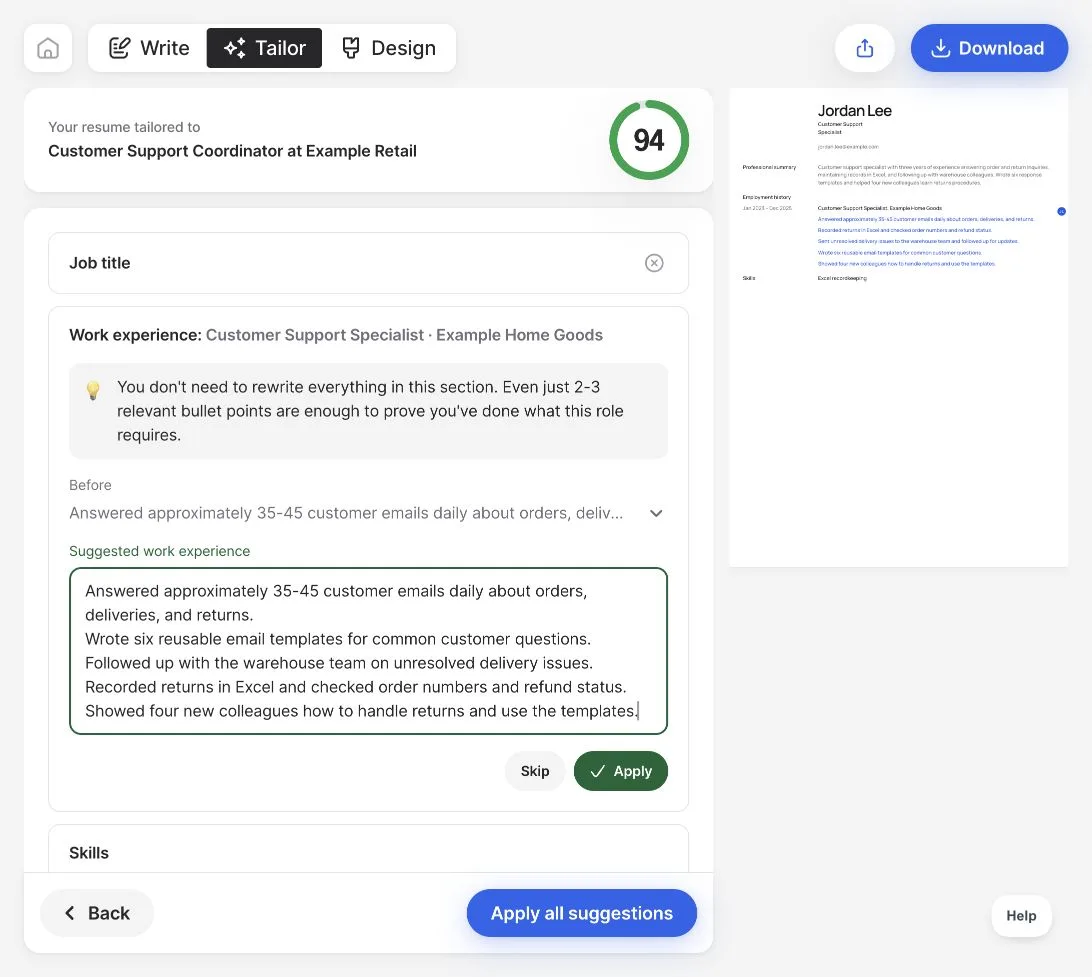
After our manual review, before Apply: the source facts remain, with templates and warehouse follow-up moved higher. This is edited text, not the untouched AI output.
The suggested top-level titles were Customer Support Coordinator and Operations Assistant. We skipped both in this walkthrough and kept Customer Support Specialist. A clearly labeled target role can be appropriate, but it should not be confused with a job you previously held. The historical employment title remained unchanged in our runs.
Before and after: the same facts, two tailored versions
Here is the complete work-experience block before tailoring and in both final versions. All three describe the same job: Customer Support Specialist, Example Home Goods, January 2023–December 2025. The target roles below identify the applications, not new titles in Jordan's employment history.
The final versions combine Resume.co's suggestions with our manual review. They are not untouched AI output. The bullets reproduce the source and reviewed text; only the list formatting is standardized here.
Before: the base resume
Answered approximately 35–45 customer emails daily about orders, deliveries, and returns.
Recorded returns in Excel and checked order numbers and refund status.
Sent unresolved delivery issues to the warehouse team and followed up for updates.
Wrote six reusable email templates for common customer questions.
Showed four new colleagues how to handle returns and use the templates.
After: applying for Customer Support Coordinator
Answered approximately 35–45 customer emails daily about orders, deliveries, and returns.
Wrote six reusable email templates for common customer questions.
Followed up with the warehouse team on unresolved delivery issues.
Recorded returns in Excel and checked order numbers and refund status.
Showed four new colleagues how to handle returns and use the templates.
Customer emails still lead. We moved the templates and warehouse follow-up higher because the support vacancy asks for those activities. Excel records remain, but they no longer interrupt the customer-support emphasis. We removed the suggested improvement claims rather than presenting them as achievements.
After: applying for Operations Assistant
Recorded returns in Excel and checked order numbers and refund status.
Followed up with the warehouse team on unresolved delivery issues.
Answered approximately 35–45 customer emails daily about orders, deliveries, and returns.
Wrote six reusable email templates for common customer questions.
Showed four new colleagues how to handle returns and use the templates.
Excel records and warehouse follow-up now lead because they address this vacancy's operational responsibilities. Resume.co had already moved Excel first; we manually moved warehouse follow-up second and simplified the text. Customer communication remains as supporting experience rather than disappearing.
What changed, and what did not: the two versions bring different evidence to the top, but keep all five original activities, the same numbers, employer, dates, and historical title. The warehouse sentence is shortened, not expanded into a new responsibility. Neither version adds Salesforce, advanced macros, management experience, or an unmeasured performance gain.
This is the useful distinction: tailoring can change what an employer sees first without making the candidate sound more experienced than they are. In this example, the finished wording stays close to the source because the source already contains relevant evidence. More rewriting would not automatically make it better.
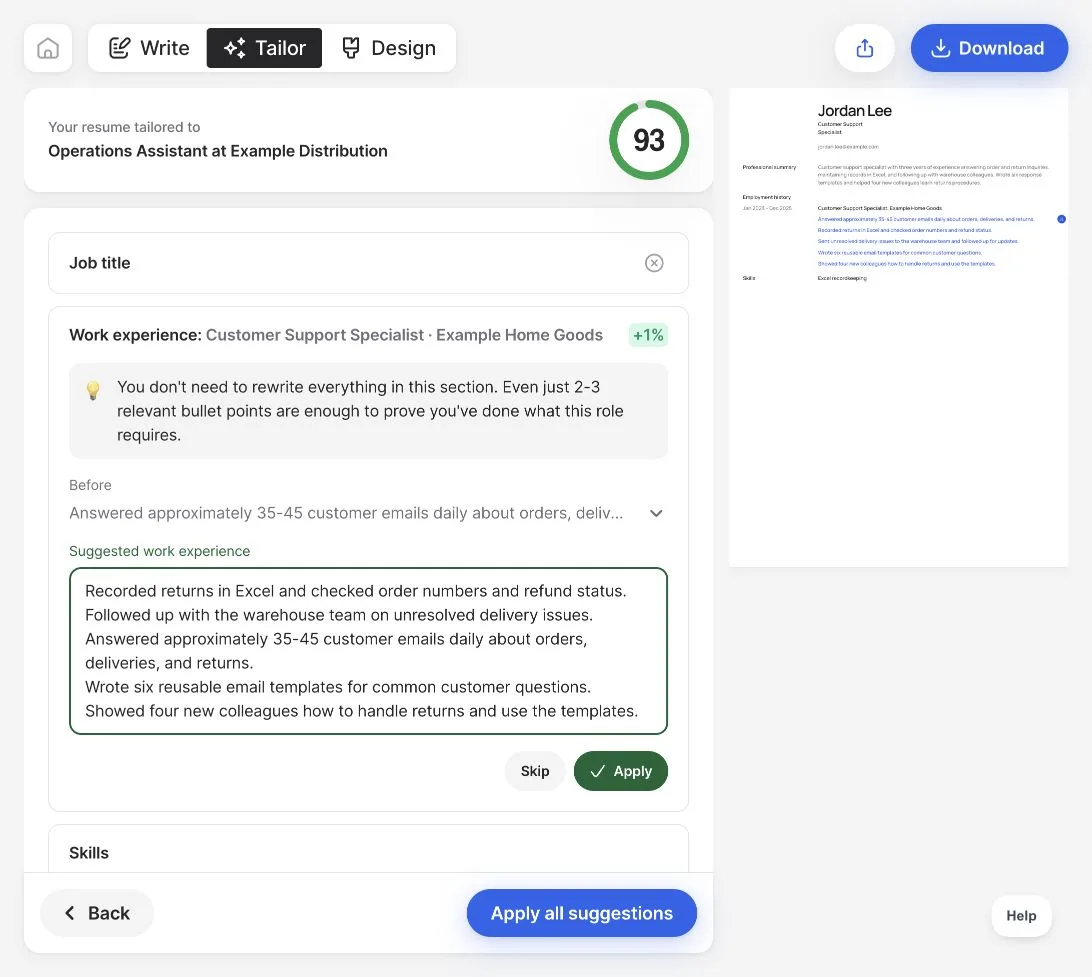
The operations version uses the same facts in a different order. We removed unsupported additions before applying it.
We also shortened the suggested skills to terms supported by the source. The support version added customer email support, returns processing, warehouse follow-up, and response template writing. The operations version added returns processing, order record checks, warehouse follow-up, and written communication. In both previews, the original Excel recordkeeping skill remained.
The professional summary stayed unchanged in these runs. Do not assume every section has been adapted just because the tailoring flow is finished. Read the summary separately and decide whether its emphasis still fits.
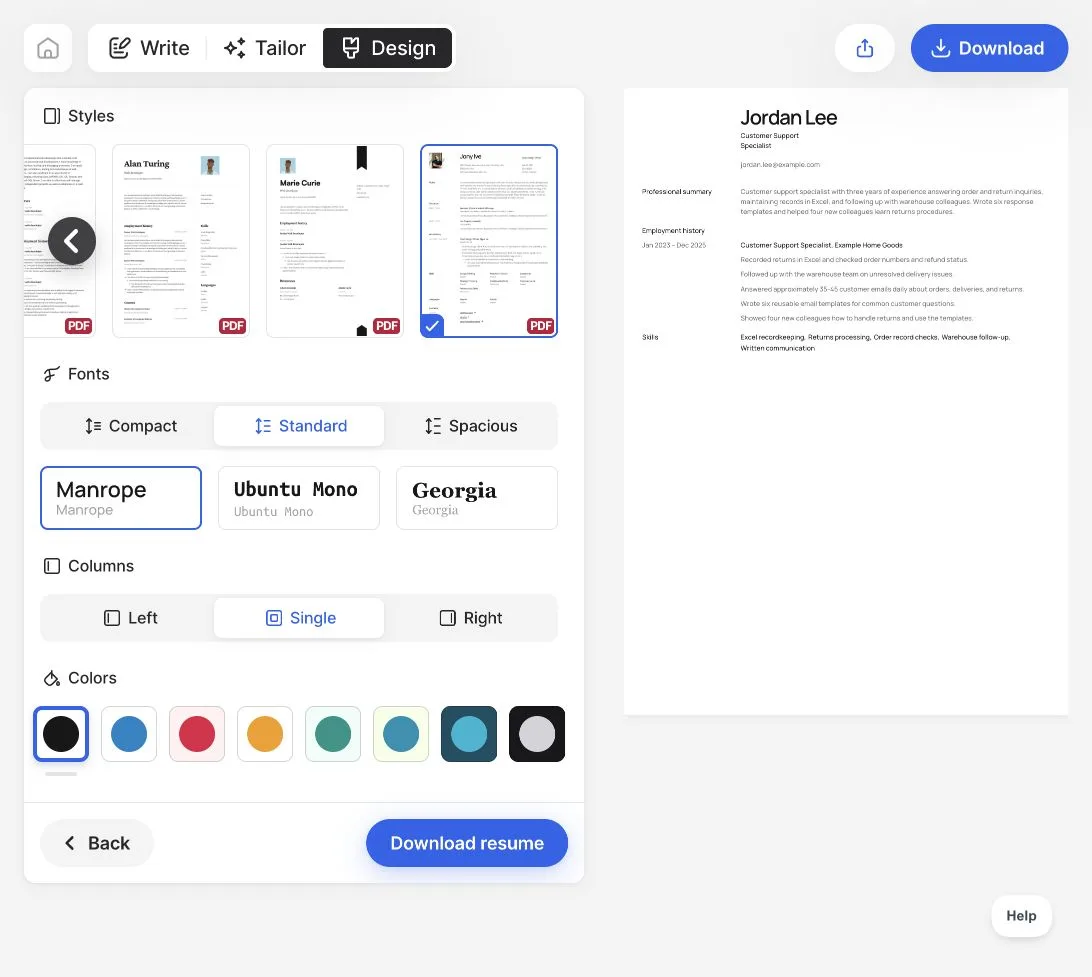
The resulting document preview: Excel records lead the experience section. This is the product preview, not a verified PDF export. The full experience text is reproduced above for readability.
What to check before sending a tailored resume
Use these questions on the completed version, whatever tool you use:
Can I trace each claim to my experience? Check tools, responsibilities, outcomes, dates, and numbers, not only keywords.
Does the first relevant section answer this employer’s needs? In our case, support began with emails; operations began with Excel records.
Did useful facts disappear? Compare against the base resume as well as against the posting.
Does the wording imply more than I did? Writing templates is not automatically improving response efficiency; helping colleagues is not automatically managing them.
Is this the version I intend to submit? Keep it identifiable by role and employer, then inspect the exported file before sending it.
The photographed runs showed scores of 94 for support and 93 for operations before our experience edits. We did not use them to judge factual accuracy: the high-scoring suggestions still needed review. These were product scores, not scores returned by an employer’s ATS or probabilities of receiving an interview.
Closing thoughts
Good tailoring makes existing evidence easier to find. In our example, customer support and operations needed different priorities, not different facts. Keep the useful suggestions, remove unsupported additions, and check the complete document before sending it.
You can use Resume.co’s resume builder to follow this workflow. The useful outcome is not the highest possible score. It is a relevant version of your resume that you can explain and defend in an interview.
Frequently asked questions
Review it against every posting, but keep text that already presents the right evidence clearly. Reuse role-specific versions when the work is similar. Make deeper changes when the role’s priorities differ.
No. In our example, Salesforce, advanced Excel macros, and inventory forecasting stayed out because the profile did not support them. A preferred qualification is still a factual claim if you add it to your resume.
Treat that instruction as guidance, not a guarantee. Our notes excluded unsupported claims, yet the proposed text still required corrections. Compare the output with your source facts before applying it.
No. The walkthrough demonstrates the editing process and the decisions needed to keep the result accurate. We did not submit applications or measure hiring outcomes.