

We compare two ways to create and update a resume: working with ChatGPT and using Resume.co's resume builder, with practical examples from both.
You do not automatically need a resume builder because you use ChatGPT. Start with the part of the job you need help with: deciding what to say, maintaining a resume layout, or producing and updating the final file. ChatGPT can support drafting and document creation; a dedicated builder gives you a resume-specific editing workflow. Using both makes sense when each solves a problem you actually have.
If you already have a layout you like and can revise it comfortably, try completing the task with ChatGPT and your existing document setup first. If choosing a template and editing structured resume sections helps you finish, try a builder. Judge the finished document and the effort needed to update it, not just the first paragraph either tool generates.
About this comparison: This guide is published by Resume.co, which offers a resume builder. It combines current documentation, a fictional teaching example, and two separately captured product observations. These are not a controlled head-to-head benchmark, speed test, or study of hiring outcomes. Documentation and observations are dated October 11, 2026. Resume.co is the specific builder discussed; other builders can work differently.
Key takeaways
Choose a workflow by the accurate, readable file you can finish and update.
ChatGPT supports document workflows; a resume builder offers structured resume editing.
Our two separate observations are not a controlled benchmark, export test, or hiring-outcomes study.
Check every rewrite against the source facts: both observed outputs needed factual review.
Use both tools only when each solves a specific remaining task.
First, separate writing from finishing
What our interviews showed — Q3 2025, 12 paying Resume.co users:
8 of 12 participants mentioned using ChatGPT alongside the builder.
Reported ChatGPT tasks: generating cover letters, analyzing job descriptions and extracting keywords.
One combined workflow described: drafting a baseline resume in ChatGPT, then formatting it in Resume.co.
Small, selected sample; the tasks varied by participant. These findings do not establish market-wide usage or which tool performs better.
The takeaway: the choice need not be either-or. Evaluate the whole workflow, not just the first generated paragraph.
A resume task has several parts: establish the facts, select the evidence relevant to a vacancy, revise the wording, arrange the document, and inspect the file you will submit. A tool can help with several of these parts without removing your responsibility to check the result.
ChatGPT is not limited to returning text that you must format somewhere else. OpenAI documents file creation, review, revision, and downloading in ChatGPT Work, including documents and PDFs. Which controls you see depends on the surface you use. That establishes a document workflow, not a guarantee that a generated resume has the layout you want. OpenAI: Work with files.
Resume.co provides a template-based resume editor. Its documented DOCX workflow asks users to select a template carrying the DOCX label; the help page says that label requires an active subscription. Check the available template and download options in your account before committing to that format. This is a documented condition, not an export-quality test. Resume.co resume builder, Resume.co DOCX instructions.
The practical question is therefore: Which workflow lets you reach an accurate, readable file and revise it again without unnecessary work?
Compare the work you will actually do
The table below is a decision framework, not a scorecard. It suggests what to try and what to inspect; it does not award points for features we have not tested side by side.
Your priority | ChatGPT workflow to try | Resume.co builder workflow to try | What decides the choice |
|---|---|---|---|
Work out which experience belongs in the application | Supply the job description and source facts; ask for a requirement-to-evidence explanation before a rewrite | Enter accurate experience and review the tool's tailoring suggestions | Can you see why a fact was selected, and identify qualifications you do not have? |
Keep control of wording | Ask for a focused revision, then edit the result | Edit the relevant resume field or proposed suggestion | Can you make one change without accepting unrelated changes? |
Preserve a layout you already like | Use your existing editor or try ChatGPT's documented file workflow | Try a template with your actual content | Does the finished file preserve the structure and spacing you need? |
Prefer a resume-specific starting structure | Specify the sections and layout you want | Start with a resume template and fill its sections | Which setup makes the task easier for you to finish? |
Produce several application versions | Keep a master source and clearly name each revised file | Keep an unchanged base and distinguish role-specific versions | Can you recover the original and identify what you sent? |
Make a small update later | Reopen the saved document or supply it for a focused revision | Reopen the saved resume and update the relevant field | Does changing a date or bullet create extra cleanup? |
Pay only for what you need | Check the tools and limits available in your account | Check creation, AI, template, and download conditions separately | Can you complete and later update the required file under the terms shown? |
For either workflow, a convincing sentence is not evidence that the sentence is true. Also keep relevance and file handling separate: a well-written experience section does not establish that a downloaded document looks right.
A complete task you can use to compare them
Use a small task with known answers before deciding whether a second tool is worth adding. Here is a fictional candidate and vacancy that make the review manageable. Nothing here describes a real applicant or employer.
Source record
Jordan Lee worked as a Customer Support Specialist at Example Home Goods from January 2023 through December 2025:
Answered approximately 35–45 customer emails daily about orders, deliveries, and returns.
Recorded returns in Excel and checked order numbers and refund status.
Sent unresolved delivery issues to the warehouse team and followed up for updates.
Wrote six reusable email templates for common customer questions.
Showed four new colleagues how to handle returns and use the templates.
The source establishes no advanced Excel macros, inventory forecasting, staff management, or measured improvement in speed, accuracy, or satisfaction.
Fictional vacancy
Example Distribution is hiring an Operations Assistant to maintain returns records in Excel, check order details and refund status, follow up with the warehouse, and keep process instructions current. Advanced Excel macros and inventory forecasting are preferred, not required.
Suggested instruction for your own comparison: This expands on the instructions used in our observations below; it is not a transcript of either run.
Adapt Jordan's experience for the Operations Assistant vacancy. Return the unchanged historical title, employer, and dates; exactly five concise experience bullets; a list of skills supported by the source; and a separate note identifying requirements the source does not establish. Lead with Excel returns records and warehouse follow-up. Preserve all five activities and all supplied numbers. Do not add macros, forecasting, staff management, or improved performance. Showing colleagues a process does not establish managing them. Writing templates does not establish maintaining process instructions. Do not change the historical title to the target role. Do not put the gap-analysis note in the resume itself.
In ChatGPT, provide the entire source, vacancy, and instruction in the same conversation. In a builder, enter the same source facts, supply the same vacancy through its tailoring workflow, and use its instruction field where available. Interfaces differ, so record any part of the instruction a tool cannot accept. Equal source information matters more than making the clicks identical.
Save the first output before editing. Then record the corrections you need to reach an acceptable experience section. A second prompt or an edit in a builder both count as review work; do not hide one of them when comparing effort.
What we observed in two separate runs
We submitted Jordan's source facts and an Operations Assistant vacancy to logged-out ChatGPT. The interface displayed “ChatGPT” but did not establish the exact model. We compared the response with an earlier, photographed Resume.co Operations run using the same factual profile and target role. The vacancy wording and instruction assembly differed: ChatGPT received a single prompt; Resume.co used a saved resume, selected keywords, and a note. A fresh Resume.co creation/copy attempt returned internal errors, so we did not complete a new paired run. These observations illustrate review decisions, not relative product quality.
The ChatGPT instruction requested five concise experience bullets, supported skills, a separate list of requirements Jordan could not claim, and preservation of supplied numbers, dates, and the historical title. Resume.co's note requested Excel records and warehouse follow-up first, preservation of dates and numbers, and exclusion of macros, forecasting, management, and unmeasured improvements.
Observation | What needed review |
|---|---|
ChatGPT preserved the historical title and dates, six templates, and four colleagues. Its separate gap list correctly excluded advanced macros, forecasting, and staff management | It omitted the customer-email activity and the 35–45 daily volume despite the preservation instruction. It used two bullets for the original Excel/checking activity |
ChatGPT described the templates as supporting “process instructions” and listed “Process documentation” as a skill | Writing reusable emails did not establish responsibility for process documentation. We would narrow this language to template writing |
Resume.co put Excel first and retained the email volume, template count, and colleague count in its proposed experience | It added documenting warehouse communication updates and expanded delivery issues to delivery or returns issues; neither addition was supplied |
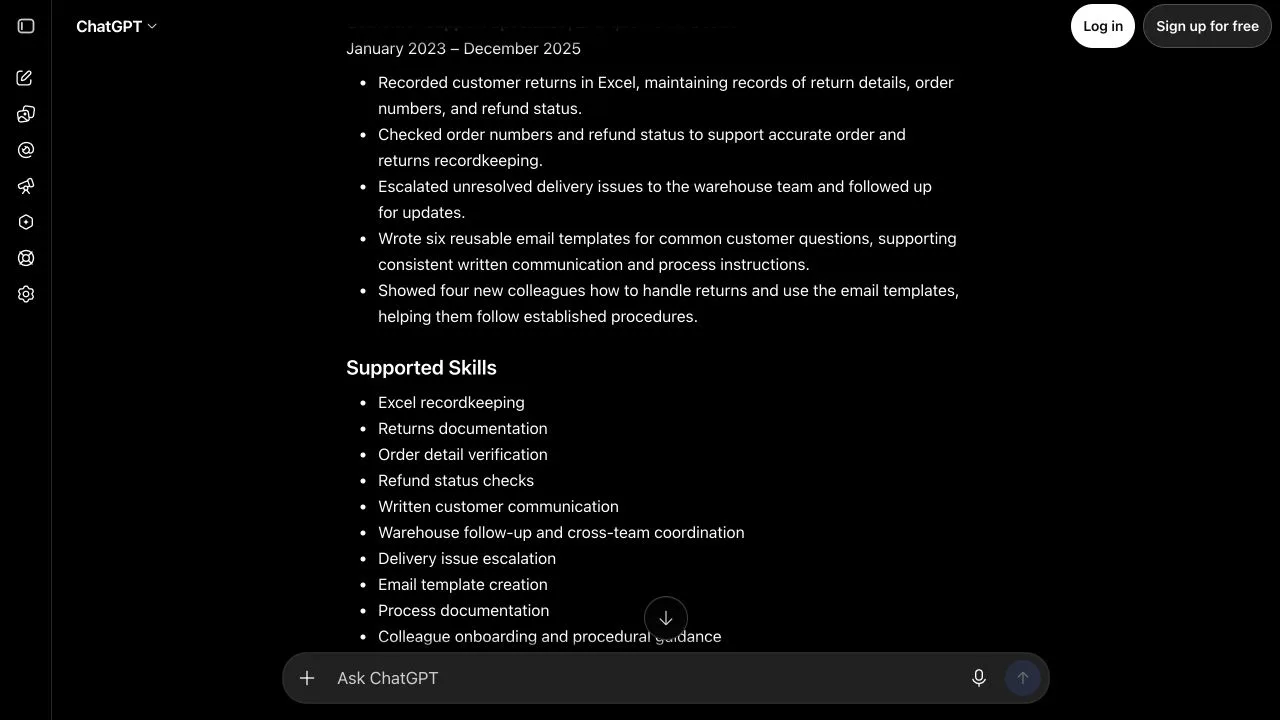
Unedited ChatGPT output. The source's email-handling activity is missing; the screenshot also shows the broader process-documentation skill.
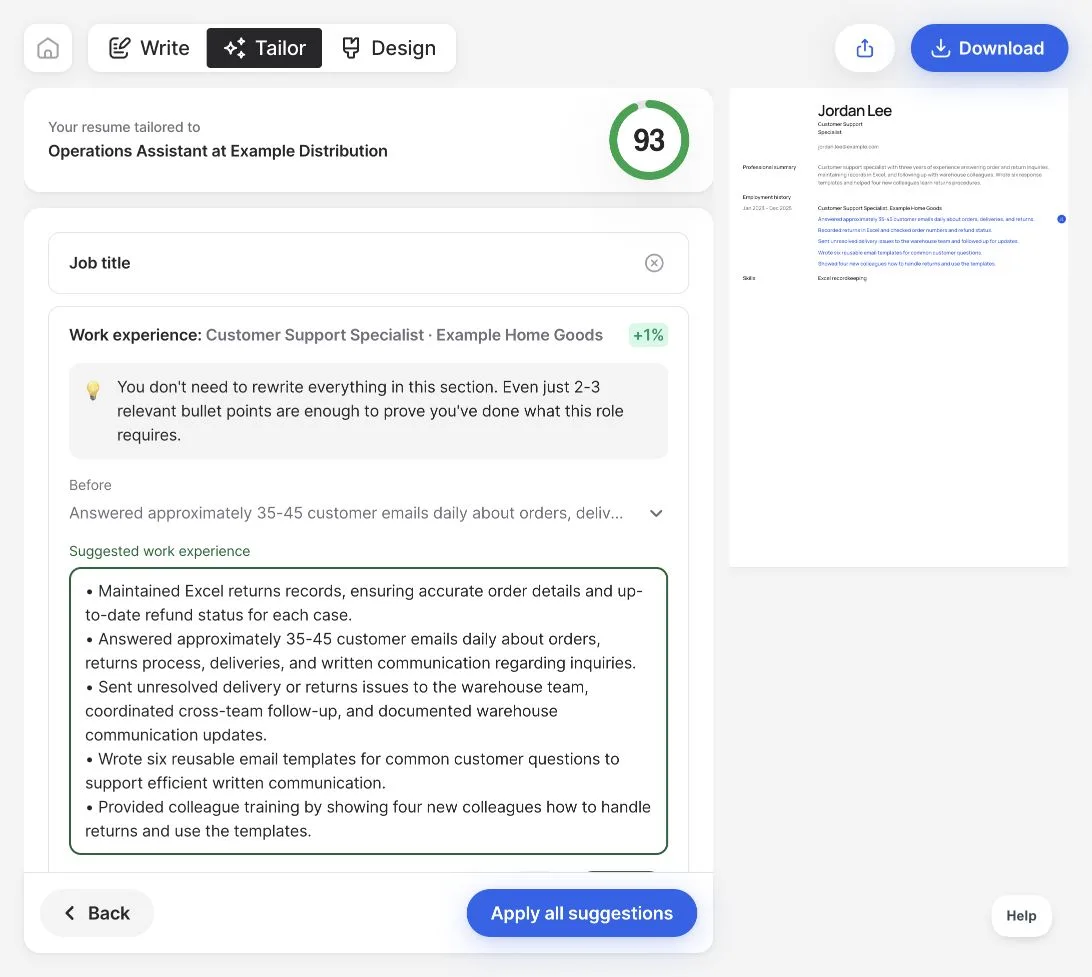
Earlier Resume.co observation, before manual corrections. The visible 93 is a product score, not validation of the added claims or a result comparable with ChatGPT.
For the ChatGPT response, our recommended correction is to combine the two Excel bullets, restore the customer-email bullet and its volume, and narrow the process wording. In the Resume.co run, we actually removed the added warehouse responsibilities, simplified the wording, and moved warehouse follow-up second before applying the changes. The reference below shows the factual destination of those decisions; we did not apply a follow-up correction in ChatGPT.
Neither observation tested file generation, exports, elapsed time, employer ATS handling, or hiring outcomes. The ChatGPT text-only attempt also does not test the documented ChatGPT Work file workflow described above.
What an acceptable result looks like
The following is an editorial reference answer, written from the source record. It is not a ChatGPT response or a claim about a builder's generated output. Other wording can be equally accurate.
Editorial reference answer
Customer Support Specialist — Example Home Goods January 2023–December 2025
Recorded returns in Excel and checked order numbers and refund status.
Followed up with the warehouse team on unresolved delivery issues.
Answered approximately 35–45 customer emails daily about orders, deliveries, and returns.
Wrote six reusable email templates for common customer questions.
Showed four new colleagues how to handle returns and use the templates.
Supported skills: Excel recordkeeping, returns processing, order record checks, warehouse follow-up, customer email support, and response template writing.
Review note, kept outside the resume: Advanced Excel macros and inventory forecasting are not established. Writing reusable emails provides related experience, but it does not prove responsibility for keeping process instructions current.
This answer changes the order more than the language. That is enough for this task: the relevant operational work moves to the top without changing Jordan's employment history. A more elaborate rewrite would need to justify every additional claim.
Finish the comparison at the file, not the chat response
For a full resume comparison, use the same complete source document in both workflows, including contact details, education, and any other sections you need. The five-bullet exercise above evaluates one section; it cannot establish whole-resume quality.
Take each version through the available document workflow and open the actual downloaded file. Check that the text matches the approved version, headings and dates are readable, bullets do not spill or disappear, and the required format is available. Keep an editable copy. Then make one small update and check the file again.
If you compare time, include setup, prompting, corrections, layout work, and file review on both sides. Record the date, account conditions, model if shown, selected template, and output format. A single attempt tells you about that attempt; it does not establish which product always writes better or works faster.
When using both is useful—and when it adds work
Use both if you like discussing content in ChatGPT and prefer maintaining your resume in a builder. A practical handoff is to approve the text first, paste it into the right sections, and compare the preview with the approved version. Keep one master record of facts so the two tools do not become competing sources of truth.
Do not automatically ask the second tool to rewrite already approved text. That creates another output to inspect and can undo decisions you have made. Use the second tool for the specific remaining task, such as arranging the approved content in a template.
You may need only ChatGPT and your existing document workflow when the text is your main difficulty and the file already works for you. You may need only a builder when its editing and layout controls meet your needs. You may need neither AI workflow for a simple update you can make directly.
Before paying for another tool, complete one real application version and one small revision. Choose based on the accuracy of the result, your control over changes, the final file, and the work required to return to it. Those are useful outcomes you can inspect yourself; a promise of a better resume or a higher match score cannot substitute for them.